
This post was originally published on this site.
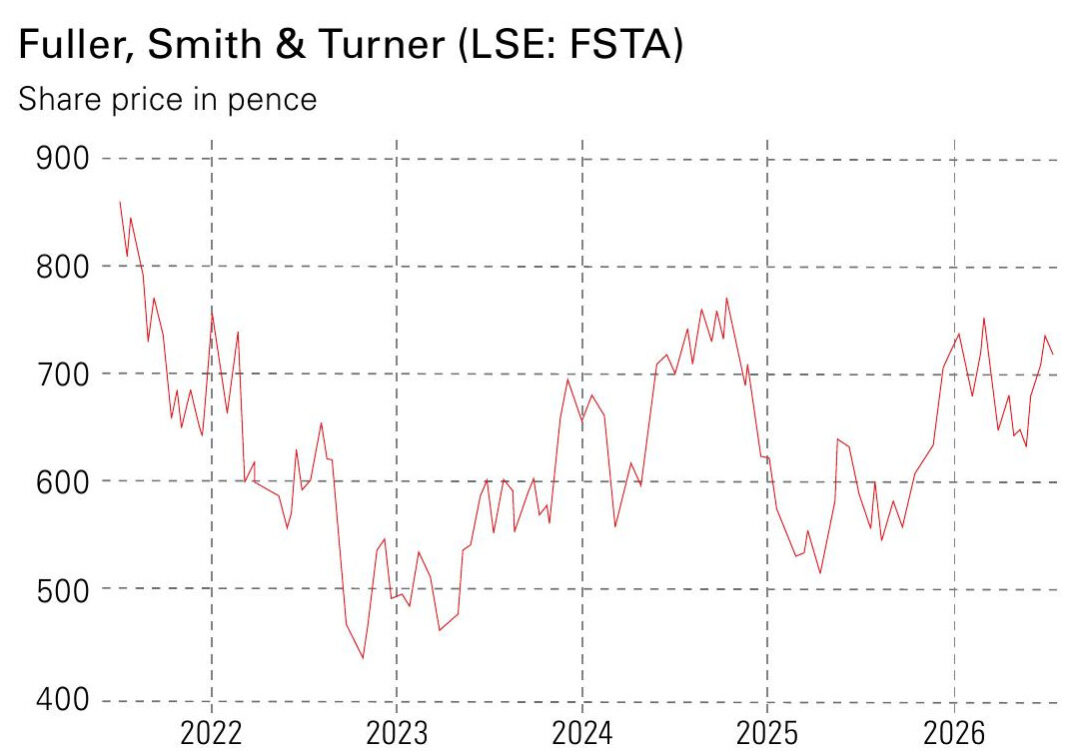
Since the last time I covered Fuller’s – Fuller, Smith & Turner (LSE: FSTA) – in November 2022, the shares have returned around 51% excluding dividends, outperforming the FTSE All-Share index’s 41% over the same period. The pub group has not been immune to the headwinds facing the wider hospitality sector, but its robust balance sheet, cash generation and focus on higher-earning consumers in the wealthy areas of London and the southeast have helped it outperform in a tough market. In the past two years, the company has also reorientated its approach to shareholder returns.
How Fuller’s is shifting focus on the customer
For its financial year ending March 2022, Fuller’s reported total revenue of £254 million. The following year, the first full year of uninterrupted trading after the pandemic, top-line sales came in at £337 million. However, due to economic uncertainty, rampant cost inflation and disruption caused by Russia‘s war in Ukraine, operating profit was just £16.5 million and the company reported an operating margin of 3.2% for the year.
Most of this uncertainty-driven disruption is now in the rear-view mirror. For the company’s 2026 financial year, it reported sales of £398 million, and analysts at Panmure Liberum have pencilled in sales of £416 million for 2027, rising to £450 million by fiscal 2028. Operating profit was £40 million for 2026 and could hit £51.3 million on current projections.
Sign up to Money Morning
Don’t miss the latest investment and personal finances news, market analysis, plus money-saving tips with our free twice-daily newsletter
Don’t miss the latest investment and personal finances news, market analysis, plus money-saving tips with our free twice-daily newsletter
Fuller’s clientele and its aggressive focus on costs are both helping it hit these targets. There is a whole section in the firm’s annual report on the customer, which rightly insists that “understanding your customer is key to the success of any business”. To this end, management has invested heavily in a database of 6.9 million customers, 2.6 million of whom are fully contactable to help identify spending patterns and tailor marketing. Fuller’s now knows that most of its customers have a household income above £75,000, a group that can be relied upon to spend its spare money on going out.
Management believes that it’s this attention to detail that drove like-for-like food and drink sales up 3.5% and 5.8% respectively last year. Meanwhile, continued investment helped hotel sales rise 4.9%. Fuller’s has 1,030 bedrooms, up from 1,009 two years ago, with an average room rate of £127.50, up from £120.
Fuller’s champions sustainability
Fuller’s has also made progress with controlling costs. Since 2022 it has made a concerted effort to refurbish its pubs and switch from gas to electricity, helping push down energy costs. Its “Too Good to Waste” plan has also helped reduce food waste across its pubs and the group has offset rising costs through labour efficiency improvements and price increases.
One of the biggest problems in the hospitality industry is high staff turnover and inexperienced staff, which can slow service and dent customer satisfaction. To overcome these issues, Fuller’s has built a reputation as a leader in training and retaining its staff. Last year, the group opened the new Fuller’s Kitchen Academy in Reading, which has already delivered nearly 500 training sessions for chefs, while several thousand team members have also undertaken technical and career-building courses and management training.
New investments in procurement have also yielded significant efficiency savings across the supply chain. Thanks to such initiatives, the overall group operating profit margin hit 11.5% in full-year 2026, up from 7.5% in 2023. The Ebitda margin across the firm’s managed pubs – those managed by the group directly rather than leased to individual landlords – hit 21.6%, up from 17.4% in 2023.
Fuller’s is a cash machine – here’s why you should buy in
With costs under control and margins growing, Fuller’s has become something of a cash machine. Last year, it generated £80 million in cash from operations and reinvested £40 million into the business, resulting in free cash flow of around £40 million, suggesting the shares are trading at a free cash flow yield of around 10.5%.
Finance costs were £11.3 million including lease liabilities, or £8.4 million on bank debt and debenture stock (100% of net debt excluding leases). This borrowing looks sustainable given the value of cash flows and assets. The directors’ valuation of the entire property estate is £991 million, £397 million higher than the net book value of £594 million, implying a net asset value per share of 1,512p.
Management has laid out plans to continue investing around £40 million a year in its estate, upgrading hotel rooms, adding new rooms to existing pubs (particularly in and around central London to capitalise on a booming tourism market) and pursuing select acquisitions.
The rest of the capital will either be returned to shareholders or used to pay down debt. Fuller’s recently declared a full-year dividend per share of 21.2p, up 7.3% year on year. It has also commissioned a series of share buybacks over the past couple of years, in one-million-share lots. Last year, the group retired 2.3 million of its “A” shares and it has returned £54.7 million to shareholders through buybacks since fiscal 2023, retiring around 15% of outstanding shares. Including dividends, total shareholder yield was around 7.5% last year. The forward dividend yield is 3.2%.
As if shareholders didn’t need more of a reason to buy, investors who own more than 1,000 A or C ordinary shares can apply to receive a “Shareholder Inndulgence Card”. Cardholders get a 15% discount on food and drinks in any of the group’s managed pubs and hotels and special rates on some of its rooms – equivalent to a nice little tax-free dividend.
Disclaimer
Rupert owns shares in Fuller’s
This article was first published in MoneyWeek’s magazine. Enjoy exclusive early access to news, opinion and analysis from our team of financial experts with a MoneyWeek subscription.