
This post was originally published on this site.
The writer Bret Easton Ellis once said that his advice to young artists was simple – marry someone rich. The line holds true because, well, it’s true. Ellis may be biased towards seeing the uglier logic of money – the way it quietly shapes outcomes while pretending not to – but in this case, the bleak diagnosis is backed up by the numbers.
The art market does not reliably sort by talent. It sorts by who can keep going, stay visible, absorb unpaid years, access the right rooms, and remain legible to collectors and institutions long enough for momentum to build. A striking statistic from the most recent Frieze London art fair is that just 7% of exhibiting artists came from working-class families.
This statistic is not saying “talented working-class artists are being excluded” (which would be bad enough). It is saying something harder – the conditions for becoming an artist are already filtered by class before the market even gets to pretend it is judging talent. Talent is not the organising force. Survival is.
Sign up to Money Morning
Don’t miss the latest investment and personal finances news, market analysis, plus money-saving tips with our free twice-daily newsletter
Don’t miss the latest investment and personal finances news, market analysis, plus money-saving tips with our free twice-daily newsletter
Making the market see emerging art
I founded New Blood Art, a gallery, in 2004, because I could see a gap the market had not built a mechanism for – the gap between serious artists leaving art school and buyers who wanted thoughtful original work by credible emerging artists, but who had no reliable way of finding it and needed a trusted filter.
New Blood Art did not simply spot artists before the market noticed them. Rather, it created visibility, credibility and access for collectors at the point when a market around them did not yet exist.
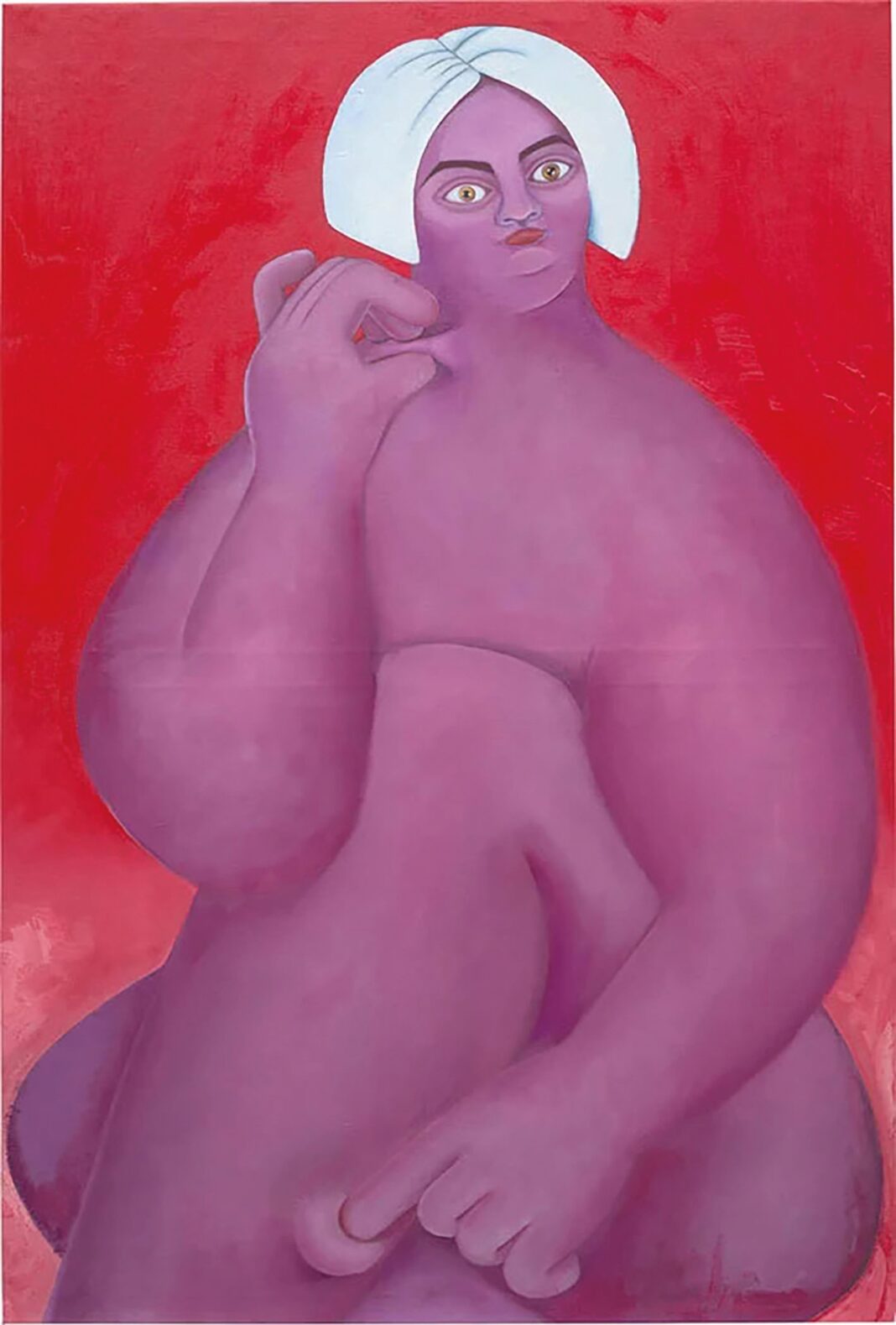
Take artist Georgia Dymock. We introduced her at New Blood Art in 2020, just after her graduate diploma in fine art at University of the Arts London. We listed her painting Purple Pinch at £1,700. In April 2022, it sold on the secondary market at Phillips’ “New Now” auction for £23,940 – a fourteen-fold increase in under two years. The fourteen-fold increase is exceptional. The pattern is not.
Across 22 years, New Blood Art has had many examples of artists first shown or supported early on, who later gained serious market traction. Without that initial platform, credibility, access for collectors and market context, would the later traction have happened in the same way, or at the same speed?
We can’t say for certain that those artists wouldn’t have garnered attention without New Blood Art. But the pattern across 22 years makes the question legitimate, and it becomes reasonable to argue that early visibility, credibility and access for collectors materially affected the speed or likelihood of later traction, alongside my ability to identify serious artists early.
What 22 years at New Blood Art taught me
The artists who survive long enough to build meaningful careers are usually those with some form of material protection – financial stability, housing security, helpful geography and, above all, the capacity to absorb years of low or unpaid work. Most art students leave college with debt, need to earn, and cannot afford the years that an art career takes to build. And when only a small group can afford to keep going, only a small group get to tell the story of the world. Whose stories have we lost from the history of art?
The economics of early-stage work
The second realisation is commercial, and perhaps it has taken me this long to see it clearly because New Blood Art arose out of idealism as much as being a business interest. Consider where Dymock’s £22,000 uplift went. A modest resale royalty may have returned to the artist under Artist’s Resale Right, but the larger gain went to the auction house and the early seller. Nothing returned to the platform that showcased and launched her.
That is the economics of early-stage work – the identification, advocacy and development that actually forms careers carries sustained cost, while the rewards concentrate later, elsewhere in the market. Yet if nobody does this work of launching serious artists, then these artists don’t gain visibility. The work is essential, while structurally unpaid. My gallery has, in effect, carried a public-interest function that the economics of the sector never reflected.
Splitting New Blood Art in two
There have been personal costs, too. Sustaining an independent gallery for 22 years without venture capital, while also carrying early-stage artists’ development work the emerging art market does not properly pay for, had become unsustainable. Professionally and personally, I needed to step back. I downsized, spent time in a Cornish fishing village, and began asking myself a stark question: was it possible to operate profitably in the emerging art market, while holding on to the values that made the business worth building in the first place?
What has come back from this reflective 18-month period is clarity. New Blood Art had been carrying too much inside one structure and I decided to separate the two kinds of work so both can function properly. The gallery has now become smaller, sharper and more commercially focused, with a tighter roster of contemporary artists, many of whom we first came across years ago at their degree shows. The New Blood Art Foundation is now in formation and it will carry the public-interest and outreach work, including the Emerging Art Prize in collaboration with Fine Art departments across the UK, artists’ development, mentoring and, I hope, studios and residencies.
The cost of independence
The route to charitable status has been thought-provoking and demanding. It has forced me to separate mission, governance, money and power. A foundation growing out of New Blood Art cannot simply be a more worthy arm of the gallery; it has to be able to protect its own public-interest purpose, especially where the commercial gallery and the Foundation sit close together. That raises an uncomfortable question. The Foundation is being created to support artists without financial cushioning, inherited networks, or easy access to the art world. But serious governance also requires time, confidence, independence and security. An unpaid independent chair is not just structurally complicated, it is also difficult to find.
The chair needs to be competent in a specialist field, independent, available, committed, financially secure enough to work unpaid, and not personally or financially entangled with me or with New Blood Art. That is a very narrow pool.
A foundation built to address the fact that only the financially cushioned can sustain an art career finds that only the financially cushioned can afford to govern it. Unpaid governance, like unpaid studio years, is a filter.
Artists as infrastructure
The Foundation’s long-term vision of permanent bases across the UK rests on a pattern MoneyWeek readers will recognise from the property sector. Developers have long used artists to warm up cold districts – King’s Cross, Peckham, Hackney Wick, Deptford. Artists arrive. Creative presence generates cultural heat, footfall, interest from buyers and rising values. Then the studios close and the artists are priced out of the value they helped create.
That cycle is not only unfair; it is economically short-sighted. Artists are not decorative add-ons to regeneration. They are often the source of the atmosphere, identity and desirability that later becomes financial value – value which can dissipate once they are removed. Anchoring artists permanently, as cultural infrastructure, is the enlightened version of that trade – it holds the value where it was made. Housing artists is not philanthropy. It is investment.
This is the opportunity I want the Foundation to build towards – a structure where artists are held as part of the long-term cultural and economic life of a place. For philanthropists, developers, institutions and collectors, this is a chance to support practising emerging artists and bring live cultural energy into buildings and districts.
Artists shouldn’t just be used to revive the discarded edges of cities. They should be embedded in places of existing power and value – Knightsbridge, the Square Mile, major corporate buildings, prime developments – because their presence is not remedial, but is inspiring and generative.
In an AI-shaped world, original human creation will become more valuable, not less. This is an invitation to philanthropists, developers and corporations to build with us the conditions where cultural life is visibly happening inside your buildings.
This article was first published in MoneyWeek’s magazine. Enjoy exclusive early access to news, opinion and analysis from our team of financial experts with a MoneyWeek subscription.