

Interest rates held but Bank signals rise if energy prices stay high
-
Published
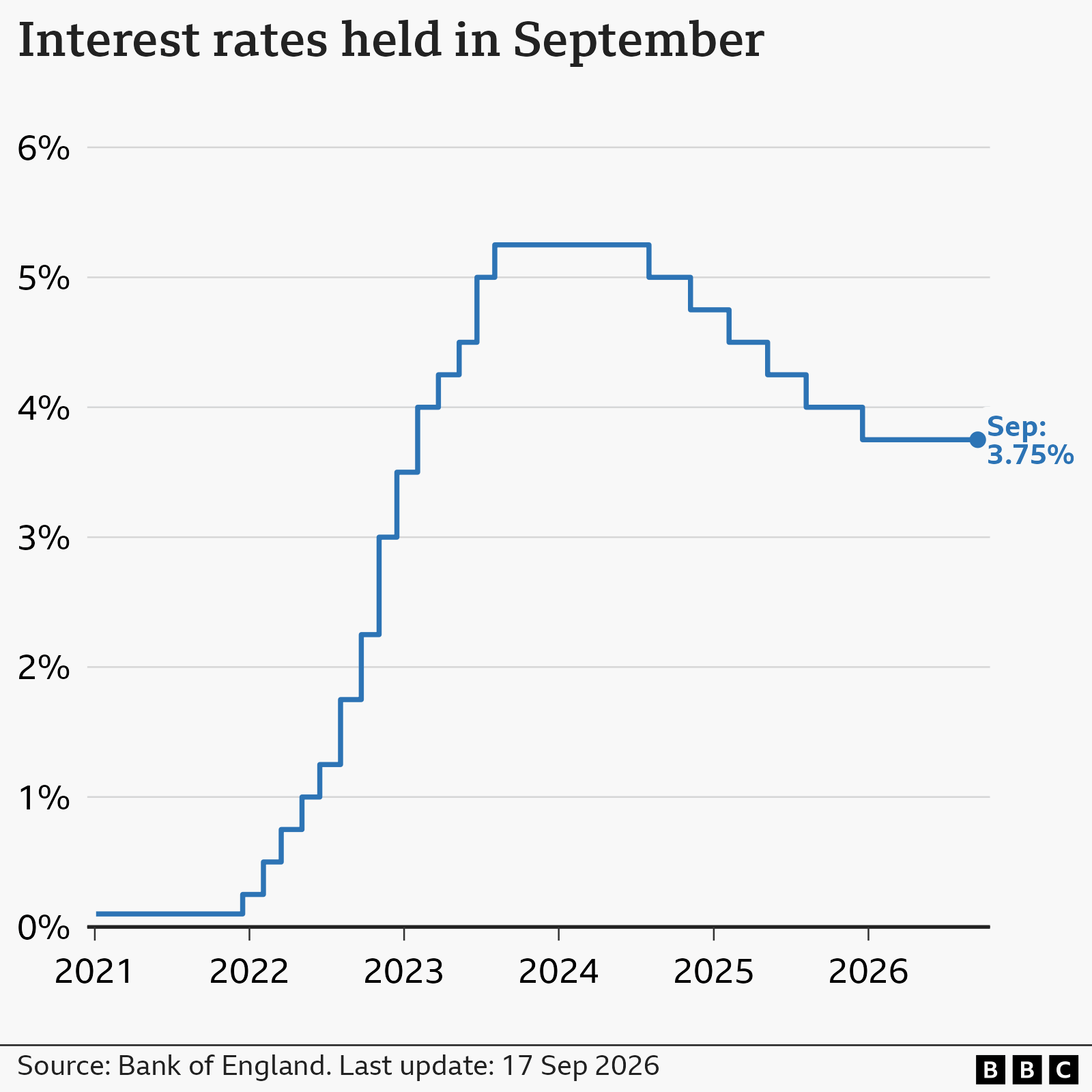
The Bank of England has held interest rates for the sixth time in a row but said they are likely to rise if high energy prices caused by the conflict in the Middle East continue.
The main Bank rate has been kept at 3.75% despite an uptick in the rate of inflation.
The US-Israel war with Iran has disrupted global energy supplies which has led to a sharp increase in petrol and diesel prices.
Bank of England governor Andrew Bailey said the longer the volatility in energy prices persists, “the bigger the impact it will have on inflation and the more likely it is we will need to raise [the] Bank rate to ensure that inflation falls back to our 2% target”.
The Bank now forecasts that inflation will rise more than it previously thought and warned that the price cap on household gas and electricity bills for January is “now expected to rise substantially further”.
Speaking after the Bank’s decision, Bailey said the direct impact of higher energy prices was clear, but officials were still assessing how far those costs would feed through into wider inflation across the economy.
The Bank’s main interest rate is a crucial benchmark for banks and other lenders in setting interest rates for individuals and businesses who want to borrow or save money.
The Bank of England uses interest rates to help control inflation, the pace at which prices are rising.
The UK’s central bank aims to keep inflation at a target of 2%, but it has been above that rate for nearly two years.
On Wednesday, official figures showed inflation had risen to 3.1% in August from 2.9% in July.
Other major central banks have increased rates to counteract higher prices.
On Wednesday, the US Federal Reserve announced its first hike in three years while the European Central Bank has raised rates twice since June.
Of the nine members on the Bank’s Monetary Policy Committee (MPC), six voted to hold rates at 3.75% while three – including the Bank’s chief economist Huw Pill – wanted to raise them to 4%.
While financial markets have priced in the possibility of several rate rises next year, Bailey said the global backdrop remained “hugely unpredictable at the moment”.
He said that for interest rates to come down we would need to see “an end of conflict in the Middle East… and energy prices coming really back to where they were before this conflict began”.
There were some positive notes from the Bank of England.
It said the UK economy had been “more resilient” than it had expected and now predicts economic growth of 0.4% between July and September – up from the 0.1% increase it forecast in the summer.
It also said that because the effect of higher energy costs had not yet spilled over into other areas of the economy, food price inflation was now predicted to rise 4% by the end of the year, less than the Bank’s previous forecast of 6-7%.
Households feel the impact of a rising Bank rate through higher borrowing costs, but can also benefit from more generous savings rates.
Given the global picture, and market expectations of a higher Bank rate, a host of major lenders have already increased the cost of new fixed-rate mortgages.
Ahead of the latest rate decision, Andrew Montlake, chief executive of mortgage broker Coreco, said that if “inflation proves sticky, lenders’ funding costs stay under pressure, which makes cheaper mortgages harder to deliver”.
The average two-year fixed residential mortgage rate is at its highest since 11 May, at 5.77%, while the average five-year is at its highest since 8 November 2023, at 5.83%, according to financial information service Moneyfacts.
‘Knock-on effect’
 Image source, Andy Pargeter
Andy Pargeter from Flintshire and his wife are coming off a five-year fixed rate mortgage of 1.19%. Their rate expires in November, and Andy expects his new rate to be at least 4.75%, or £300 more a month,
He says that at the start of this year, when he started thinking about the end of his fixed rate deal, he was expecting the Bank of England’s core rate to be cut.
“We’re in a fortunate position where we’re able to accommodate that [increase],” he told BBC News. But he expects it will have “a knock-on effect in terms of how much we potentially save every month”.
“It’s definitely been something… I have constantly been thinking about.”
Bond sales paused
Alongside the interest rate decision, the Bank also said it would halt its so-called “quantitative tightening” (QT) programme.
It will pause its annual sale of government bonds – which are a kind of IOU that can be traded on the financial markets – and will instead sell off smaller chunks over eight years.
The Bank bought £895bn of mainly government bonds during periods of economic turbulence such as the global financial crisis and the Covid pandemic to help keep the economy on an even keel. This was known as “quantitative easing”.
Since 2022, it has been offloading the bonds, including through sales. This has contributed to higher interest rates – or yields – on bonds, making it more expensive for the government to borrow money.
The Bank said discussions to put in place a plan to reduce the current £488bn stockpile of bonds had started a year ago, implying its proposal has nothing to do with recent movements in financial markets where yields on 10-year bonds and 30-year bonds soared.
Government bond yields have been rising globally for months, driven by worries that inflation caused by the oil price surge since the start of the Iran war will lead to higher interest rates.
The news that the Bank of England is overhauling its QT programme prompted an immediate reaction.
The yield on 30-year UK government bonds fell from 5.86% on Thursday morning to 5.75% following the Bank’s announcement. Yields on 10-year bonds dropped from 5.31% to 5.22%.
Get in touch
Have you been affected by the issues in this story? Share your experiences

Get our flagship newsletter with all the headlines you need to start the day. Sign up here.
-
-
Published3 hours ago

-
-
-
Published6 days ago

-