
Burnham proposes NHS-style social care system for England
To play this video you need to enable JavaScript in your browser.
This video can not be played
-
Published
Andy Burnham wants to offer access to free social care services to everyone in England, and will put his plans before voters at the next general election.
The prime minister told the BBC that it would be a system in which “everyone contributes, everyone is covered”. He did not rule out tax rises, acknowledging it may be “difficult or unpopular” with some.
Burnham said he wants to set out his “vision” on Tuesday and Whitehall troubleshooter Baroness Casey, who is conducting a review, will advise on the “best way of doing it”.
Shadow home secretary Chris Philp said the PM was suggesting Labour wanted “more tax rises” to pay for the reforms, adding the Conservatives would not support this.
Burnham has made reforming social care one of his flagship policies and has spoken of the experience of his father Roy, who had Alzheimer’s and died earlier this month.
While he has been clear on his ambition to make changes to the system, he has yet to explain how any changes would be funded.
Adult social care provides state support to help people live more independently, including assistance at home.
Unlike the NHS, social care is not free at the point of use. In England and Northern Ireland, people with savings worth more than £23,250 are not entitled to help with care costs from their council.
In Wales and Scotland, different rules apply in terms of eligibility.
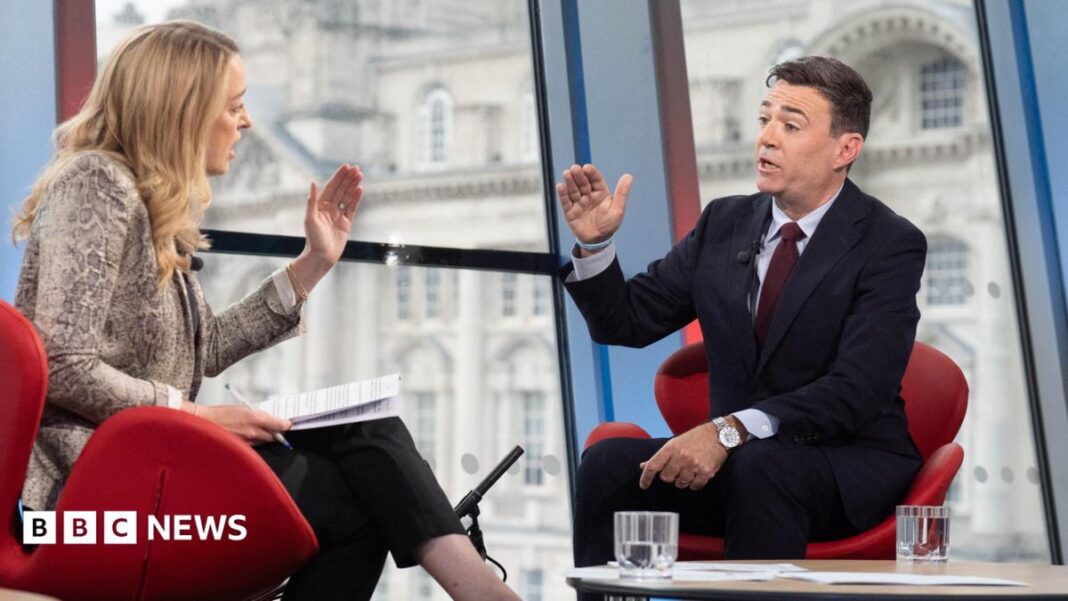
Speaking to the BBC’s Sunday with Laura Kuenssberg, the prime minister said: “I am talking about a system that works on NHS principles because that is the only way you can make it work.
“There is free personal care elsewhere in the UK. I don’t think it’s right that people in England don’t get the same and it’s not something we’re going to rush.”
Personal care offered in Scotland is available to all adults who are assessed as needing help with tasks including eating and bathing.
Burnham said the changes would have to be “done carefully, without putting extra strain on the public purse”.
But he said that “nothing is off the table at this moment in time” in terms of how the proposals would be funded.
When he was told it had been estimated that a system for everyone in England that is free at the point of use could cost taxpayers £18bn a year, Burnham replied: “It’s not that high.”
He said people already face a “huge cost” at the moment and that social care in England is “as unfair as American healthcare, where the most vulnerable in society can lose everything, they can be wiped out”.
Burnham added there is also a cost to the NHS due to the “huge number” of people in hospitals across England who cannot be discharged home “because the social care isn’t there”.
Asked whether everyone will have to contribute to his proposed system, Burnham replied: “It will be a system of that kind – so everyone contributes, everyone is covered but not precisely necessarily in the same way that we currently pay for the NHS.”
He said the details developed by Baroness Casey would be subject to cross-party talks in a bid to “build consensus”.
Baroness Casey was originally tasked by former PM Sir Keir Starmer to deliver her review of social care in 2028, but Burnham asked her to bring that forward to next summer.
On the timeline, Burnham added: “I’m going to say that we stick to the manifesto because I have to keep people’s trust, and there are commitments in the manifesto that would make it hard to do in this Parliament.”
The Labour manifesto in 2024 made clear commitments on tax, including not to increase national insurance, income tax or VAT.
Burnham added: “I don’t think you can reform this system without consensus. I will develop a very clear plan and I will put that plan to the public at a general election and that will be where the plan gets tested and people will then be able to decide.”
Philp said tax increases would be a “red line” for the Conservatives and they would “not under any circumstances” support more of them.
He said the country is “already taxed too highly”, telling the BBC: “If more money is needed, for example, for social care or indeed for defence we would find that money through savings elsewhere, particularly in the welfare budget.”
Labour MP Darren Jones, who served as a cabinet minister in Sir Keir’s government, said Burnham was being “very bold and brave” on social care.
He said: “Politics is about prioritisation and these things do cost money and so we’ll need to see the detail of that policy.”
Jones added if the PM “can land it in the right way, that’d be a huge achievement” for him and the government.
Reform UK’s economic spokesman Robert Jenrick said: “Andy Burnham refuses to rule out his universal death tax.
“He’s too weak to cut the benefits bill so he’s coming for your home instead.”
Burnham accused previous generations of politicians of “cowardice” for failing to reform social care, although his push for change is not without jeopardy.
He previously produced a plan for a national care service while serving as health secretary in Gordon Brown’s Labour government.
It was suggested this would be paid for through a compulsory contribution, including from people’s estates after they had died.
The idea was branded a “death tax” by Labour’s opponents and the proposals went no further after the party lost the 2010 general election.
At the 2017 general election, then-Conservative Prime Minister Theresa May was accused of trying to introduce a “dementia tax” by proposing that people receiving care at home pay for the full costs if they were worth at least £100,000.
The policy sparked a political outcry and the Conservatives lost their majority in the House of Commons at the election.
-
Andy Burnham wants to fix social care – what are the options?
-
Published29 July
-
-
NHS ‘will collapse’ without social care reform, PM tells BBC
-
Published27 July
-

Sign up for our Politics Essential newsletter to keep up with the inner workings of Westminster and beyond.