

Inside Scarlets and their struggle for existence
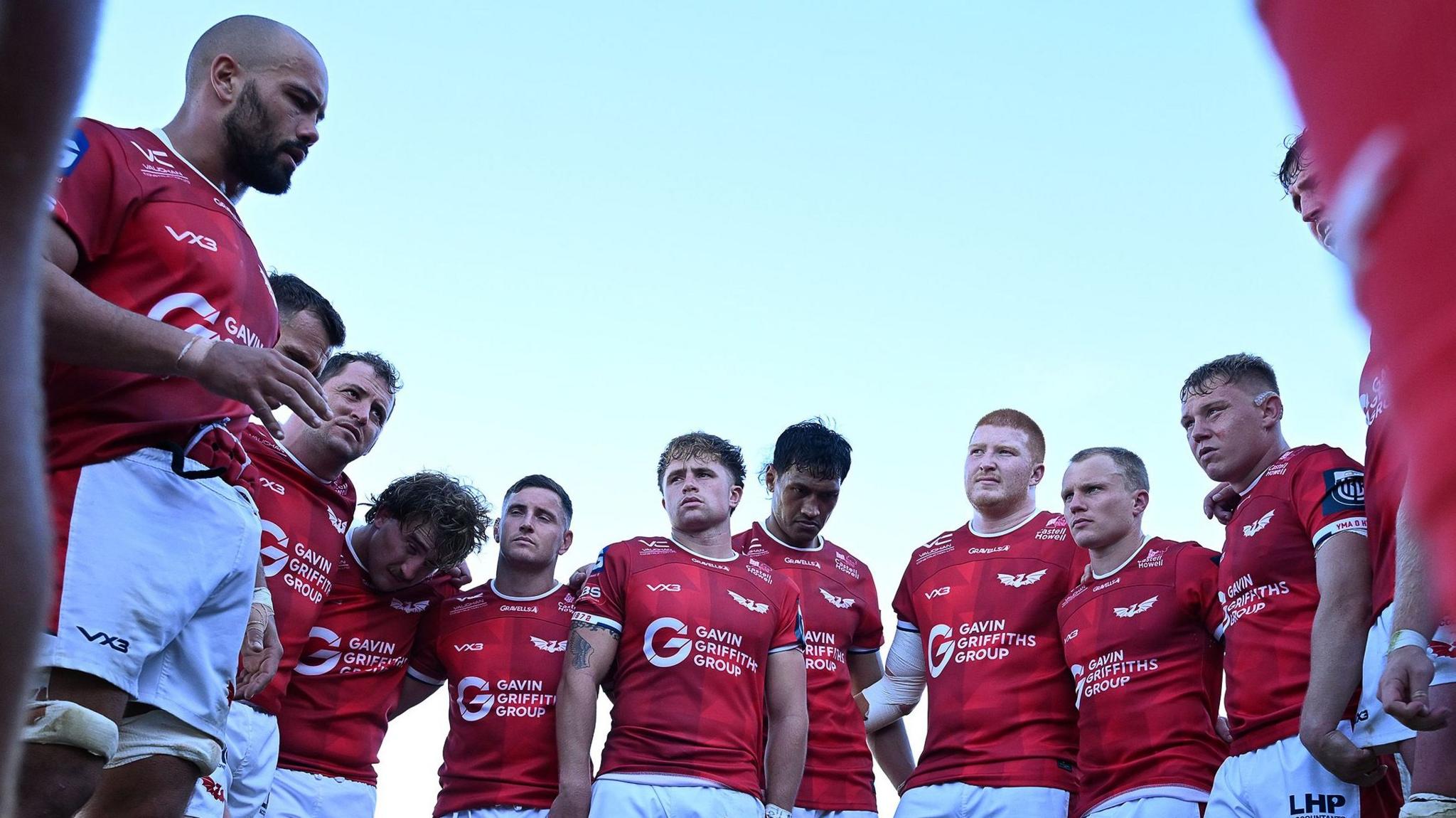 Image source, Huw Evans Picture Agency
-
Published
You pass the first reminder of Llanelli’s rugby identity before you even reach the town.
In Felinfoel stands a statue of Phil Bennett, captain of the Llanelli team which famously beat New Zealand in 1972.
A few miles further on, Welsh Sports Hall of Fame inductee Ray Gravell is immortalised outside Parc y Scarlets.
There are no footballers or cricketers competing for space here. The sporting story being told is overwhelmingly one of rugby.
Which makes the question hanging over the place particularly brutal: what happens if professional rugby disappears from Llanelli?
The Welsh Rugby Union (WRU) plans to cut its professional men’s teams from four to three. Under its preferred model, Scarlets or Ospreys will cease to exist by 2028.
-
WRU sticking to three-team plan – Reddin
-
Published19 September
-
-
WRU seek to sell SRC side RGC to private investors
-
Published4 days ago
-
Inside Parc y Scarlets, photographs of former teams and famous victories cover the walls.
Rugby autobiographies fill a bookshelf in the cafe, where today’s lunch for the players is roast beef.
Dwayne Peel wanders over.
The former Wales and British and Irish Lions scrum-half is back coaching at the club where he began his career. His grandfather was once a physio here, running on with the magic sponge for Gravell.
Now Peel talks about the school run and his son playing junior rugby.
Three generations, one game.
It is a theme that keeps returning during a day at Parc y Scarlets with the Scrum V Podcast.
Director of rugby Nigel Davies grew up in Trimsaran, a few miles away. Peel is from nearby Tumble. A large proportion of the current squad grew up playing rugby in the towns and villages Scarlets represent.
Even managing director Jon Daniels once played for nearby Llangennech.
He believes that connection is precisely what is at stake.
“We don’t have Premier League or Championship football teams,” he said.
“When they want to play sport, they still play rugby in the (school) yards in west Wales.”
Later, his language becomes starker.
“I genuinely fear for west Wales if this continues the way it is,” Daniels said. “For the young generations of Wales, I think there would be a real loss.”
To play this video you need to enable JavaScript in your browser.
This video can not be played
It is the emotional heart of Scarlets’ argument for survival.
The problem is that Welsh rugby’s current predicament cannot be solved by emotion alone.
The WRU holds most of the cards.
Scarlets can make their case, but cannot guarantee their own future.
Daniels argues Welsh rugby should be asking how it can preserve four teams rather than accepting one must disappear.
“We have not seen the numbers laid down in front of us to prove that we can’t sustain four,” he says.
But that raises an obvious question in return: where are Scarlets’ numbers?
Daniels says season-ticket revenue is ahead of last year, attendances increased by 7% last season, sponsorship is performing well and the stadium is generating money away from matchdays.
But when pressed on where the additional money needed to sustain four properly funded teams would come from, there is no clear answer.
Instead, he argues for time.
“Can we put together a 10-year plan where, in 10 years’ time, we can have four competitive, successful, viable teams?” he asks.
It is an argument for more time but not yet a funded alternative, and Scarlets do not control the timetable.
On one of the cafe walls, among black-and-white photographs and faded old jerseys, is an image that looks strikingly modern.
The colours are sharp, the picture unmistakably digital. It shows Scarlets celebrating their 2017 league title – the last time a Welsh team won the competition.
James ‘Cubby’ Davies played in that team. Now he helps recruit the next generation.
He says the “secret sauce” was connection.
“We built success on the pitch through a lot of the things that we did off the pitch,” he said. “We just connected as a group.”
Now his job is to build another.
Davies says that uncertainty over Welsh rugby’s future meant Scarlets were late entering the recruitment market last season.
There is another meeting with the WRU on the day we visit.
Davies talks about planning ahead, then hesitates.
“We’re very hopeful of our… what’s the word? Our existence, obviously,” he said.
Existence.
A strange word to hear in the everyday surroundings of a professional sports club.
On the other side of the stadium, past a couple of burger vans with their shutters still down, around 40 players are playing football in an indoor training barn.
There is shouting, laughter and arguing over decisions.
After two opening defeats and plenty of analysis, director Davies wants people smiling again.
“It’s all about bringing the energy,” he says.
It is striking to watch at a club whose very existence is being debated.
Daniels calls the constant speculation around Welsh rugby the “jungle drums”.
“Sometimes the potential impact on human beings is lost in all that,” he said.
Yet everything carries on.
Players train. Coaches prepare. Contracts are considered. Lunch is served.
This is what uncertainty looks like inside a sports club.
Mostly, it looks surprisingly normal.
Nine miles away, another club can make its own case.
 Image source, Huw Evans Picture Agency
Six Ospreys were selected for the 2013 British and Irish Lions tour – twice as many as the whole of Scotland. Only two Welshmen made the Lions squad in 2025.
Ospreys are planning for the future too, with St Helen’s in Swansea being redeveloped as their new home.
The geography is striking.
Llanelli’s built-up area has about 42,000 people and Swansea’s around 170,000. Dublin city alone has almost 600,000. Johannesburg has millions.
It helps explain the WRU’s logic.
On a map, consolidation can look obvious. On the ground, Scarlets and Ospreys have different histories, communities and identities.
For now, Daniels refuses to accept the choice and urges caution.
“We should do that before we just jump to ‘right, we cut two teams’, or now ‘we cut one team’,” he says.
His argument is for four.
But if the WRU presses ahead with three, Scarlets and Ospreys will eventually have to make a different argument.
Not simply why they should survive, why they should survive instead of the other.
By lunchtime, the football has stopped.
Players drift back into the cafe. Plates of roast beef appear beneath photographs of those who came before them.
For now, Scarlets continue with the strangely ordinary business of running a professional rugby club while waiting to discover whether they will remain one.
To play this video you need to enable JavaScript in your browser.
This video can not be played