
This post was originally published on this site.
James Hore

The launch of the first autistic Barbie doll has been welcomed by campaigners as a step towards more “authentic, joyful” representation for neurodivergent children.
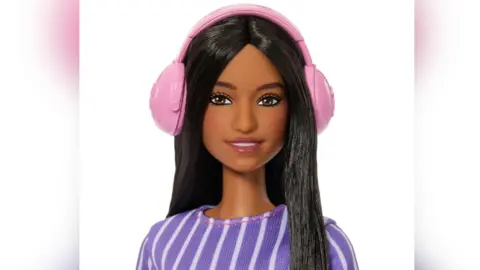
The doll features design choices intended to reflect experiences to which autistic people might relate, including loose clothing to ensure less fabric-to-skin contact and an eye gaze slightly to the side.
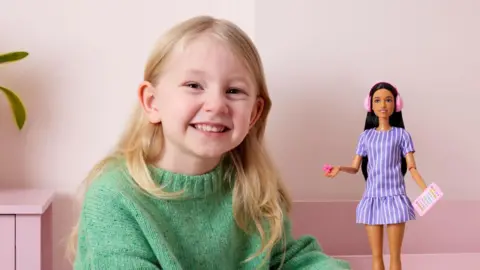
Autistic youngster Penelope, five, was part of the research for the doll, and her mum, Tonya, said: “She uses ear defenders, so to see that on a doll really made her feel special.”
The National Autistic Society estimates more than one in 100 people are autistic and there are at least 700,000 autistic adults and children in the UK.
 Mattel/PA
Each doll comes with a pink fidget spinner to reduce stress and improve focus, and noise-cancelling headphones to block out background sounds and therefore limit sensory overload.
Creator Mattel said the doll “invites more children to see themselves represented in Barbie”.
It follows the launch of a Barbie last year which has type 1 diabetes and one with Down’s Syndrome that came out in 2023 in a bid from the company to make its range more diverse.
‘Joyful representations’
Tonya, from Colchester, said seeing her daughter’s reaction to the doll was heart-warming.
“During research, they did the video reveal and she had a massive smile on her face.
“Until now there was just nothing out there to represent what autistic children experience.
“It’s been an overwhelmingly positive experience for Penelope – and she just loves looking at it.”
The finished product was created with input from the Autistic Self Advocacy Network in an effort to hear first-hand from the autistic community on the sorts of features the doll should have.
The network described the doll as a “milestone” in representation and said it was “thrilled” to help with the design, adding: “It is so important for young autistic people to see authentic, joyful representations of themselves, and that’s exactly what this doll is.”
 Mattel/PA
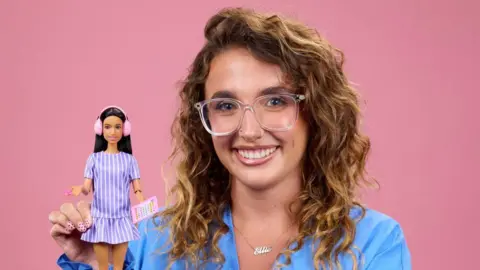
Ellie Middleton, an autistic writer who regularly shares her experiences online, described the doll as a “powerful symbol” for young girls in feeling accepted.
She said: “To now have an autistic Barbie doll makes me so emotional.
“Statistics show that young girls are often undiagnosed or misdiagnosed, so to have a powerful symbol like this autistic Barbie doll helps bring the conversation around neurodivergence in women to the forefront, so that autistic girls can feel accepted and seen.”
The National Autistic Society described autism as a “lifelong neurodivergence and disability” which influences how people experience and interact with the world.
It cautioned that it was “important to remember autistic people can be very different from each other”.
The society’s Peter Watt said: “Seeing more depictions of autism is key to understanding and autism acceptance.
“It’s really important that these representations are authentic and based on extensive consultation with autistic people, and we’re pleased Mattel involved the autistic community in the development of this doll.”
He said better public understanding of autism across society “could transform hundreds of thousands of autistic people’s lives”.