
This post was originally published on this site.

Much attention rightly has been paid to Mark Carney’s bombshell speech in Davos. His clarion call for other middle powers to join Canada in forging a strategic alternative to Donald Trump’s America elicited the third standing ovation in the World Economic Forum’s history — the others being for Nelson Mandela and Volodymyr Zelenskyy.
But there were some brassy European voices too. Christine Lagarde, president of the European Central Bank, and a model of diplomatic professionalism, walked out of a dinner in which the keynote speaker Howard Lutnick, Trump’s commerce secretary, repeatedly insulted Europe. Belgium’s prime minister, Bart De Wever, said: “Being a happy vassal is one thing. Being a miserable slave is another.” Finland’s president, Alexander Stubb, meanwhile, made it clear that Europe could look after itself. Ukraine, after all, had restricted Russia’s advances to barely 1 per cent more territory than it had in 2022 — and at the cost of a million men. “Can Europe defend itself?” Stubb asked. “My answer is definitely yes — without the Americans.”
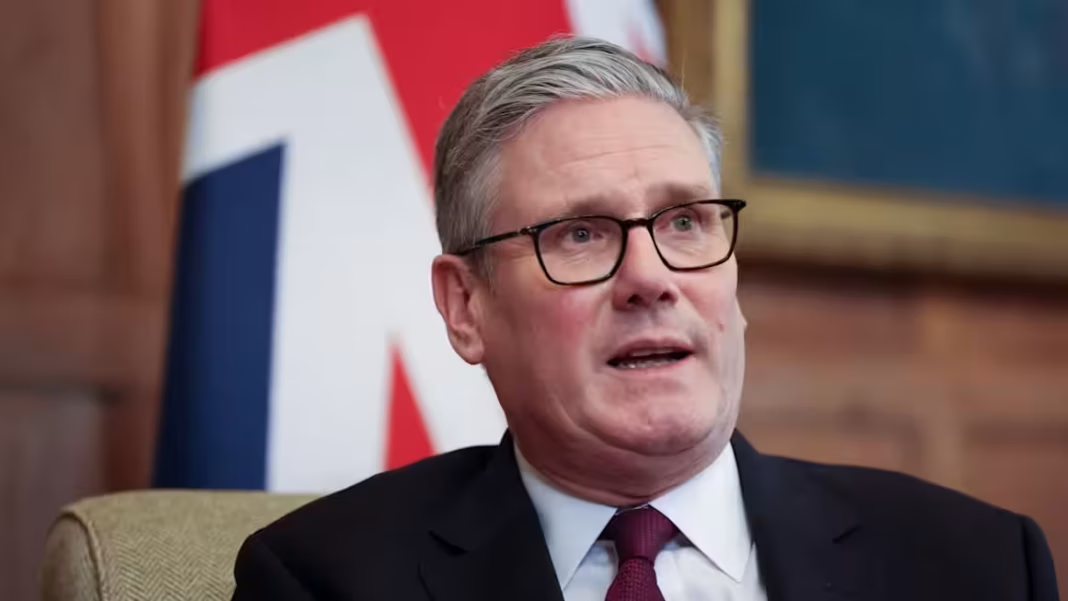
Which brings me to the prevaricating, second-guessing, self-abasing Sir Keir Starmer — prime minister of a nuclear power that dwarfs the likes of Finland and Belgium, and has an economy half as large again as Canada’s. Unlike Finland, the UK does not share a border with Russia. Unlike Canada, it does not share a border with America. Yet Britain is acting as if it has the most to lose. Notwithstanding the UK’s umbilical defence ties to America, the reality is close to the opposite. Moreover, the evidence keeps piling up that the cost of resisting Trump is considerably lower than bending the knee. If Starmer sticks to this posture, he will stake a claim to being the 21st-century reincarnation of Neville Chamberlain. OK, perhaps that’s hyperbolic. Trump is not Hitler. But appeasing Trump only invites further aggression.
Britain is lumbered with a penny wise-pound foolish government. In November, Starmer declined to join the $170bn Security Action for Europe (SAFE) fund, which is designed to boost European defence spending and allow countries to jointly procure new weapons by borrowing money guaranteed by the EU budget. SAFE, in other words, is the future. Starmer was only prepared to pony up €200mn against the billions pledged by other big members. A UK spokesman questioned whether it would benefit British industry in spite of the fact that the Europeans had conceded that up to 50 per cent of the fund’s spending could go on non-EU defence suppliers, chiefly British.
All the while, Trump has been heaping scorn on Britain as “weak” and “stupid”. His latest such salvo was over Britain’s 2024 deal to return the Chagos Islands to Mauritius sovereignty while securing a 99-year lease on the Diego Garcia military base. Last year, Trump hailed the cross-party effort (Conservative PM Rishi Sunak had negotiated the outlines) as a good deal. On Tuesday, following a brutish call with Starmer, he had changed his mind: “The UK giving away extremely important land is an act of GREAT STUPIDITY,” Trump posted. The Trump-Starmer call, incidentally, was prompted by Britain’s decision to send a defence attaché to Greenland, which Trump saw as provocative. Their conversation was short and laced with profanities starting with “F”.
For years now, people have been debating the shape of a new world order. Would we embrace a dog-eat-dog planet, as Trump prefers? Or would the rest of the west, as I have argued before, step in to fill the void that America is vacating. There are only two ways of looking at this. The first is to stick with the predator you know in the Hobbesian jungle of our nightmares. The second is for America’s allies to take control of their destiny and work with other middle powers to forge a principled and non-predatory new force in world affairs. As a G7 economy, along with Germany, France and Canada, the UK would have a critical influence over such a grouping. Handled with imagination and courage, Britain’s power would indeed be enhanced by taking the second option. But that would mean at least partially undoing Brexit.
It is a surpassing irony that Britain chose to quit Europe and put its chips on global trade deals at precisely the moment globalisation was going into reverse. The UK’s economic stagnation and strategic loneliness has made it needier than ever towards Washington. As Carney pointed out, and the record shows, America has weaponised integration as a tool of enforcing obedience. Dealing bilaterally with the US entails being crushed. Negotiating collectively, on the other hand, would restore clout and correct that costly imbalance. After wracking my brains, I have come up with a slogan for Britain’s middle power opportunity: “Take back control.”
I am turning this week to my colleague Robert Shrimsley, the FT’s redoubtable UK commentator. Robert, it is clear that the politics of this is far easier for Carney than Starmer, since the large majority of Canadians grasp the threat that Trump poses to their sovereignty (which he reiterated in Davos). How close is British public opinion to its own realisation? Or would Britain need another leader to spell that out?
Recommended reading
-
In addition to always reading Robert, Swampians should subscribe to my colleague Stephen Bush’s newsletter on the UK. His latest on why “Trump’s Davos rant should alarm Starmer” is pertinent. My column this week is on America’s barbarian turn. “As America prepares to commemorate its 250th anniversary, the republic is flirting with its own funeral,” I write.
-
On a related theme, do read my colleague Katie Martin’s excellent column on how the US is torching its most valuable asset — trust. Investors are increasingly questioning America’s full faith and credit. “It [America] risks paying a heavy price for decades to come,” she writes. Likewise, my colleague Tej Parikh is instructive on how China is on course to win the AI race. And Gideon Rachman, who pulled off a twofer on stage with both Carner and De Wever in Davos this week, accurately chronicled the return of Taco with Trump’s Greenland climbdown.
Robert Shrimsley replies
Hi Ed. It has certainly been an uncomfortable week for Starmer. He might attempt to argue some vindication in that Trump has stepped back from the worst outcome on Greenland but it has been at the price of some humiliation — though he was hardly alone among Europe’s leaders in that this week. Taking your verbal barbs with stoicism is the price the Europeans have decided to pay.
The specific blows are all quixotic. Trump publicly backed the Chagos deal in the White House last year, but now (after goading from Britain’s opposition parties) reached for it as it suited his argument on Greenland. More important in terms of their relationship is my sense that Trump has now concluded Starmer is a political loser and so even easier to insult. It was already clear that Trump no longer sees him as someone even pretending to play nice with.
I have to part company with you a touch on the SAFE fund issue. Both the UK and the EU (France especially) were at fault there. It is true that the UK wanted to get in too cheaply but it is also clear that France did not want its own defence industry having to share too much of the spoils with the UK. And the loss is not quite as much as you suggest in monetary terms as the UK was already entitled to a 35 per cent share of spending either way. But it loses the ability to lead on contracts. The unhappy reality is that having found a UK government wishing to re-engage, the EU is not in any way making this easy.
But the failure to secure a deal reflects equally poorly on the lack of seriousness on both sides. This goes to the central problem of Carney’s argument. Both the EU and the UK understand the challenge. They understood it before Greenland. But the EU is an amalgam of national interests and those interests change depending on the governments. A Macron-led France will be different to one led by Marine Le Pen or Jordan Bardella.
But you are right, Ed. You have to ask how many more warnings the countries of Europe need. For Europe, the loss of the American security guarantee is akin to climate change in that everyone says something must be done but too few are prepared to truly commit to the solution. You and I would agree Starmer should use this crisis as a reason to tear up his red lines and commit more fully to rejoining EU institutions. He has used the US trade deal as a reason not to rejoin the customs union, that argument looks weaker than ever.
There are two reasons for the continued policy of strategic supplication in the short term. The first is the cost of complexity of disentangling from the US — this is especially true for Britain, and the second is Ukraine. As an issue, it is so much greater than any other for Europe that, to borrow a phrase, they will bear almost any burden if it prevents Trump from walking away.
Ordinarily this week would have been a wake-up call for Britain especially. My worry about the government is that it will mop its brow, say “crisis averted” and return to business as usual.
Your feedback
We’d love to hear from you. You can email the team on swampnotes@ft.com, contact Ed on edward.luce@ft.com and Rana on rana.foroohar@ft.com, and follow them on X at @RanaForoohar and @EdwardGLuce. We may feature an excerpt of your response in the next newsletter