
This post was originally published on this site.
Burnham to promise new path for UK when he becomes Labour leader
-
Published
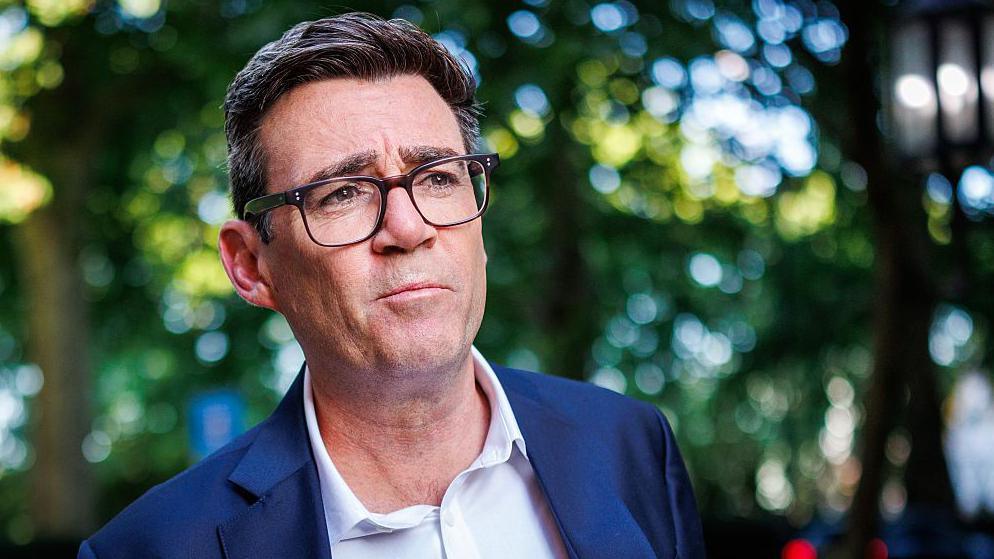
Andy Burnham will promise a new path for Britain in a speech later on Friday, as he is confirmed as the Labour leader.
He will then take over from Sir Keir Starmer as prime minister on Monday.
In his speech at a special party conference in central London, Burnham will say that when he is in Downing Street, the government will be “unashamedly Labour in our priorities” and have the “courage to fix the big things that politics has neglected”.
Makerfield MP Burnham cemented his status as the sole leadership candidate after being backed by 379 Labour MPs and most trade unions linked to the party earlier this week.
-
Burnham’s ‘Manchesterism’ got him to No 10 – but will it work for the UK?
-
Published3 hours ago
-
-
What we know about Andy Burnham’s policies
-
Published19 hours ago
-
-
Burnham faces crucial choice for chancellor as battle for No 11 continues
-
Published1 day ago
-
-
Burnham does not rule out wealth tax
-
Published1 day ago
-
Home Secretary Shabana Mahmood, in her role as the chair of Labour’s ruling national executive committee, will announce Burnham as the new leader at the conference.
It will mark a rapid rise to power following the former Greater Manchester mayor’s by-election win in Makerfield last month.
Labour has trailed Reform UK in opinion polls for almost 18 months and supporters will be hoping Burnham’s arrival as prime minister will reverse their fortunes.
Burnham has given little detail about his policy plans and has not announced who will be appointed to key cabinet roles.
Announcements on cabinet posts are not expected to be made until Monday, when Burnham takes office in Number 10.
But multiple reports suggest Mahmood could be Burnham’s pick for chancellor, with the BBC told there are “live discussions” over this.
In his first speech as Labour leader on Monday, Burnham will say making the economy work for people across the UK will require a “new path to the one we’ve been on for the last 40 years”.
He will also say that the Labour government will be “focused on driving growth in every postcode and returning power to communities” when he becomes prime minister.
And he will say the government will have the “conviction to argue for our plans”.
Promising a “distinctively Labour” programme of economic policies, Burnham will say his plans involve more public control of utilities such as water, and reindustrialisation.
Labour, he will say, will be more united under his leadership and more open to working with other parties on the long-term challenges facing the country.
He will commit to being a leader “for the north and the south, for Scotland, for Wales and for Northern Ireland, and for every town and every city in every nation and region of this great country”.
He will also pay tribute to Sir Keir for winning the general election in 2024 and point to NHS improvements and investment in public services as achievements of the Labour government so far.
Steve Rotherham, mayor of Liverpool City Region and a close ally of the MP for Makerfield, told BBC Radio 4’s Today programme that those claiming Burnham’s premiership will be the same as what came before it just communicated differently were “absolutely deluded”.
He added that his agenda for devolution will help deliver change to communities more quickly than before.
Sir Keir resigned as Labour leader last month, saying he accepted he was not best placed to lead his party into the next general election.
Heavy Labour losses in May’s local elections followed by Burnham’s by-election victory in Makerfield had left Sir Keir facing widespread calls from his own MPs for him to stand aside and allow Burnham to replace him.
When potential leadership contenders Wes Streeting, the former health secretary, and Al Carns, a former defence minister, said they would not challenge Burnham, it paved the way for him to become the next prime minister unopposed.
Sir Keir has said he will support his successor and offer him advice privately, if asked.
Speaking to Sky News during a visit to Ukraine on Thursday, he said he wanted an “orderly transition” and that he had built a “sound foundation” for Burnham.
But there have been questions about Burnham’s unchallenged route to No 10.
Last month John Slinger, the Labour MP for Rugby, told the BBC: “I think the public out there would think we’d slightly lost our minds if we didn’t go through a process where we subject people who aspire to the highest office in the land to completely normal scrutiny.”
He has also faced accusations of avoiding media scrutiny since becoming an MP and announcing his intention to stand as Labour leader.
He has so far given interviews to LBC and Gary Lineker, while he has also hosted an online Q and A session on Reddit.
Conservative leader Kemi Badenoch challenged Burnham during that Q and A, to “come out from hiding, face a proper press conference and submit yourself to scrutiny and some tough questions”.
Burnham responded to it by saying it had only been two weeks since he faced questions from “74,000 members of the public of Makerfield”.
On policy, Burnham offered some details about his blueprint for office in a speech in Manchester earlier this month.
He proposed a new No 10 unit in Manchester, where a team would be tasked with handing local government more control in areas including housing and transport.
In a video posted on social media last night, he reflected on his own family’s experience of the social care system in England, saying: “If there’s one area where I’m going to expend quite a lot of political capital, it’s going to be social care.”
In the early weeks of his premiership, Burnham is planning to undertake a “listening tour” of the UK while Parliament is in recess this summer.
Burnham has signalled that providing extra support for the cost of living will be one of his priorities in government.
He has defended his credibility on economic policy, insisting he will not be “indisciplined” with the public finances.
But the International Monetary Fund (IMF) has warned Burnham’s incoming government to avoid increasing public spending in the face of pressures such as rising household energy bills.
In a new report on the UK, the IMF said the UK should try to stay focused on its plans to grow the economy.
“This calls for a cautious approach to new fiscal pressures: the authorities should be very selective in accommodating new demands and reprioritise, while sticking to the deficit reduction plan,” the report says.
“Future spending reviews should focus on reallocating resources across departments, rather than increasing total spending.”
Get in touch
What questions do you have about the issues in this story?