

This post was originally published on this site.
Ben SchofieldPolitical correspondent, BBC East

Three years ago, staff at one local authority began working a four-day week.
South Cambridgeshire District Council (SCDC) claims the move has already saved nearly £400,000, boosting staff retention and satisfaction, and calls itself an “exceptionally high performing council”.
But the policy is controversial, and the government is warning other authorities not to follow suit.
How can the council get all its work done?
 Ben Schofield/BBC
For retired computer engineer Martin Swales, 78, standing outside his bungalow in the village of Sawston, the maths simply does not add up.
“You’ve lost eight hours a week. How can you make that up?” he said.
Neighbour Stephen Mansfield, 60, called the model “a total joke”.
Residents paid “the same council tax” while staff had it “cushty”, he said.
“I don’t think the service has improved. If you do a four-day week, you’ve got less service, haven’t you?”
 BEN SCHOFIELD/BBC
In October, Local Government Secretary Steve Reed wrote to the council’s Liberal Democrat leader, worried “about the impact… on other local services”.
Bridget Smith replied that when it adopted four-day working, South Cambridgeshire was “suffering more than most councils from problems arising from recruitment and retention challenges”.
But since moving to a 32-hour week, staff turnover had fallen by 41% and job applicants had risen by 123%, she said.
The policy also helped save £399,000 in agency worker fees.
An independent analysis of 27 months’ performance data by the universities of Bradford, Cambridge and Salford concluded the authority had improved or seen no significant change in 21 out of 24 areas since reducing staff hours.
However, researchers could not prove the four-day week trial was responsible for any changes, and said other factors could have played a part.
Contact centre staff answered 7% more calls than previously.
In 2021-22, a little over 65% of complaints were resolved on time. In 2024-25, more than 85% were.
Between January 2023 and March 2025, 100% of emergency housing repairs were completed within 24 hours.
The proportion of major planning applications decided on time increased.
In November, the council’s planning service, shared with Cambridge City Council, was named best in the UK.
Between September 2023 and March 2025, timely bin collections stayed above the 99.7% target in all but one month.
Staff also beat their target for processing housing and council tax benefit changes.
One council staffer, who asked not to be named, said four-day working was a reason they had stayed.
Trade union Unison called it a “game changer”, saying staff saw improvements in mental and physical health while maintaining “excellent services”.
 EMMA HOWGEGO/BBC
The four-day week began as an experiment in January 2023.
Desk-based staff were told they should complete 100% of their tasks in about 80% of their normal hours with no loss of salary.
The council said its employees now worked “around 85%” of their contracted hours.
Now permanent, the scheme has expanded to include all workers, including bin collection teams working across the district and neighbouring Cambridge.
 PA Media
In June 2023, the-then local government minister, Conservative Lee Rowley, demanded the council stop the trial “immediately” as it was “unlikely to demonstrate” value for money.
The government issued two best value notices, asking for weekly data on performance, spending and staffing, but the incoming Labour administration dropped this, saying it wanted to stop “micromanaging local authorities”.
However, the mood shifted, and in his letter in October, Reed focussed on three areas: the speed at which council homes were re-let; tenants’ satisfaction with repairs; and the proportion of housing rent collected.
“If social housing is being built by this government, and your team are unable to move residents into them so that they are standing empty, then I must reiterate my deep disappointment with your conduct,” he wrote.
The council responded, saying it re-let its housing stock as fast as the top quarter of all authorities.
It said repairs were undertaken by an external contractor that did not work a four-day week and that rent arrears were “well below” the national average and affected by cost-of-living pressures.
In December, Reed wrote to all council leaders in England, warning four-day working would be “considered an indicator… of potential failure”.
 Ben Schofield/BBC
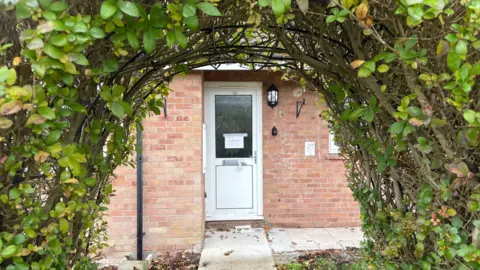
In the South Cambridgeshire village of Arrington, repairs to four council homes took months to complete, some locals claimed.
Jean Bell, 77, recalled how in January 2025 neighbours found water pipes had burst in the bungalow next-door.
The couple who lived there had moved away the previous September, but the water supply had not been switched off, she said, leaving it pouring through walls and ceilings.
 JEAN BELL
Bell, whose bungalow is also council-owned, said it took months for repairs to begin.
She called the four-day week “outrageous” and “ridiculous”.
“They can’t even do the jobs in five days, let alone four days,” she said.
Neighbour Gloria Flack, 74, said the bungalow next to her was empty from about May 2024 to December 2025.
She said the couple who lived there had both died and the property was affected by subsidence caused by tree roots.
 GLORIA FLACK
The retired NHS worker said “the whole of the wall down one side was split”.
She said it took until June 2025 for repairs to begin and that the problem had spread to her home.
Had repairs started in 2024, “it wouldn’t have subsided as much as it had”, she said.
“I kept going back to the council and saying, ‘Look, the cracks are in my building’ and they said, ‘We can’t do anything until after [next-door’s] been finished, and then… we will start on yours.'”
Before the Covid-19 pandemic, SCDC regularly met its target to re-let homes within 17 days, though this target has since increased to 39.
Times spiked during lockdown and had mostly recovered by mid-2022 but started climbing again towards the end of 2023.
The council said the Arrington cases were “exceptional” and that it was in the “top quarter” of all councils for re-letting.
It said some tenants had retained their tenancies while spending time in care homes, possibly giving a false impression of how long their homes were empty.
 Ben Schofield/BBC
Prof Daiga Kamerāde, of the University of Salford, was one of the researchers who studied the council’s data.
She said the policy boosted performance because it could “kickstart organisational change”.
Workplaces cut unnecessary meetings and inefficient systems, she said, and staff were also able to focus better over four days.
 University of Salford
Employees spent more time on recreation and with family, boosting mental and physical health, she said.
“So they come back to work with high energy levels and they can do these four days very efficiently.”
One SCDC officer, who asked not to be named, said they treated their non-working day like a weekend, going to the gym or seeing family.
“It’s good to rest and be prepared for another week at work,” they said.
 BEN SCHOFIELD/BBC
Back in Sawston, kitchen worker Jake Pateman, 31, had noticed no change in services.
“I’m always in favour of a four-day week,” he said.
Office-worker friends had told him that they spent “at least 20% of every day” not fully focussed on their job.
People worked better and more efficiently when given “extra time in their life”, he added.
 Ben Schofield/BBC
Anita Wright, 66, said she felt “fine about it”.
She said: “I suppose that is a bit odd – if they get paid the same – but it doesn’t bother me.”
Despite criticism from both Conservative and Labour ministers, the council says it remains committed to the four-day week.