
This post was originally published on this site.
Becky MortonPolitical reporter

 Reuters
The UK has approved China’s plans for a huge new embassy in central London, despite opponents warning it could be used as a base for spying and pose security risks.
Security Minister Dan Jarvis said intelligence agencies had been “integral” to the process and he was “content any risks are being appropriately managed”.
The decision, which has repeatedly been delayed, had posed a challenge for the government, as it seeks to balance its desire for closer ties with Beijing with warnings of the threat posed by China.
It comes as Sir Keir Starmer is expected to visit Beijing early this year, becoming the first UK prime minister to do so since 2018.
In a letter, the housing department confirmed that Housing Secretary Steve Reed, who is responsible for planning policy, had given permission for the development to go ahead, subject to certain conditions.
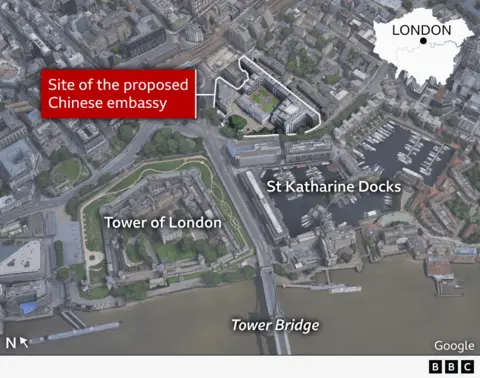
The site at Royal Mint Court is close to the City of London and fibre optic cables that carry vast quantities of highly sensitive data, sparking concerns they could be used by China to infiltrate the UK’s financial system.
However, in its decision letter, the department said there was no suggestion the use of the site as an embassy would interfere with the cables.
It added that no bodies with responsibility for national security, including the Home Office and the Foreign Office, had raised concerns or objected to the proposal on the basis of the proximity of the cables.
Jarvis told MPs the government had “acted to increase the resilience of cables in the area through an extensive series of measures to protect sensitive data”.
The minister argued that the development brought “clear national security advantages”, by consolidating China’s diplomatic premises from seven sites into a single location.
In a joint letter to the home secretary and foreign secretary about the embassy plans, MI5 director general Sir Ken McCallum and GCHQ’s director Anne Keast-Butler said it was “not realistic to expect to be able wholly to eliminate each and every potential risk”.
However, they added a “proportionate” package of national security mitigations had been developed for the site.
Conditions on the planning approval include that the development must begin within three years, and a steering group of local bodies should be established to manage protests outside the site.
Opposition parties and some Labour MPs had called for the project to be blocked. Local residents also oppose the plans and are planning a legal challenge.
Conservative shadow foreign secretary Priti Patel said: “Keir Starmer has sold off our national security to the Chinese Communist Party with his shameful super embassy surrender.”
Liberal Democrat foreign affairs spokesperson Calum Miller said the decision would “amplify China’s surveillance efforts here in the UK and endanger the security of our data – not to speak of the safety of the brave Hong Kongers on British soil”.
He added that it was “categorically wrong” that the prime minister had “embraced these threats to further his flirtation with China”.
Reform UK said the decision was “a serious threat to national security” and “a desperate attempt by the Labour government to cosy up to the Chinese Communist Party”.
China ties
Embassies act as the headquarters for a country’s representatives abroad.
Downing Street said they were “the first line of communication” between nations and “those who don’t accept this basic premise are either naive or recklessly isolationist”.
At 20,000 square metres, China’s proposed new London embassy would be the biggest of its kind anywhere in Europe.
Approval for the site has long been a priority for China’s government, which bought the site for £255m in 2018.
The plans were initially rejected by Tower Hamlets Council in 2022 over safety concerns, but when China resubmitted its application in 2024 the government took over the decision.
Meanwhile, the UK is waiting for its own £100m plan to redevelop the British embassy in Beijing to be approved by China’s authorities.
Rejecting China’s plans would have risked setting back diplomatic relations between the two countries.
Since winning power, Labour has sought closer trade ties with China, with Chancellor Rachel Reeves among several senior government figures to visit the country.
However, critics have argued the threat of spying by the Chinese state and its intimidation against dissidents abroad are reasons for a more cautious relationship.