
Councils warned of risks of high street pedestrianisation
-
Published
The UK government has warned councils against ill-considered plans to pedestrianise high streets in England.
In evidence submitted to an inquiry by MPs, the Ministry of Housing, Communities and Local Government (MHCLG) said pedestrianisation can make high streets “more attractive, safe and welcoming”.
But the department added that “the process needs to be well considered”, warning that removing traffic could make high streets less accessible and damage local economies.
“Local leaders pursuing pedestrianisation must be aware of the risks and work to mitigate them, within a broader spatial strategy,” the evidence says.
The evidence was submitted, external to the Housing, Communities and Local Government Committee, which is investigating the action needed to revitalise England’s high streets.
An MHCLG spokesperson said the government had not issued formal guidance to local authorities on pedestrianisation.
The government is due to publish a new strategy on high streets later this year.
“We support local leaders to make their own choices about pedestrianisation based on the needs of their communities,” the spokesperson said.
“Our upcoming high streets strategy will also set out more detail on how we are bringing high streets back to life and making sure they are accessible for everyone.”
Studies suggest banning cars from high streets has become increasingly common in city and town centres across the UK.
Some councils attempted pedestrianisation experiments during the Covid pandemic, which spurred debates about the use of outdoor public spaces.
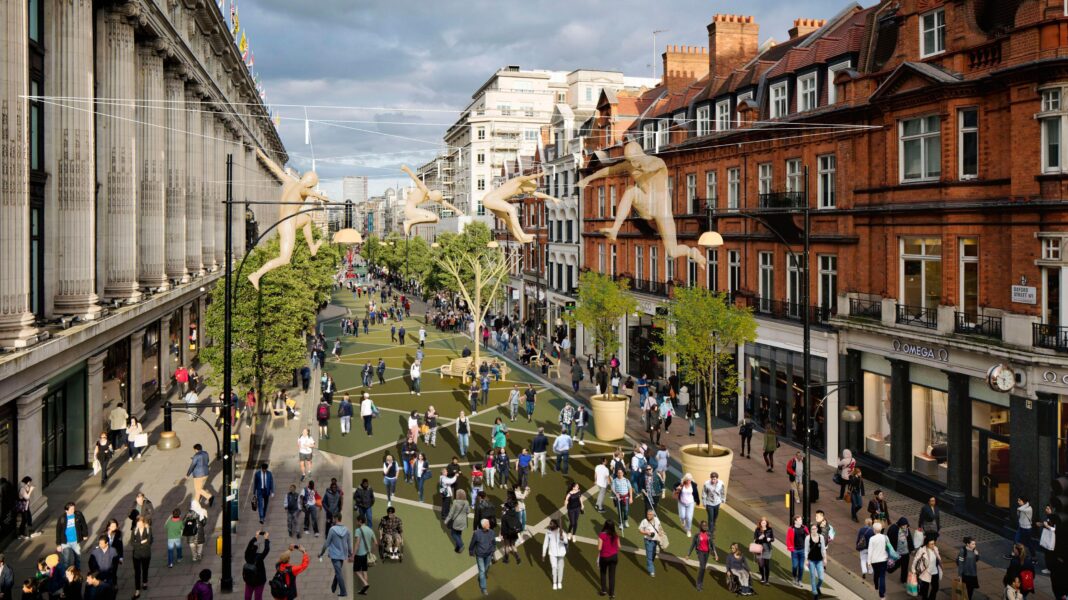
But the pedestrianisation of some high streets has proved contentious, particularly in London, London Mayor Sadiq Khan has clashed with the local council over plans to make Oxford Street traffic-free.
Parts of Oxford Street will be pedestrianised from 26 October.
The BBC has asked the mayor’s office for comment on the government’s evidence.
Most pedestrianisation schemes are immediately countered by some level of local opposition, said Professor Lee Ivett, who heads the School of Architecture at the University of the Built Environment.
He told the BBC that while opposition usually focuses on short-term disruption to local businesses, evidence does suggest that pedestrianisation increases the economic viability of high streets in the long run.
But he said pedestrianisation had to be paired with improvements in public transport to realise those economic benefits.
“If you want to defeat the argument that a reduction in the amount of traffic will reduce the amount of trade, then you need to also be able to make an argument that an investment in public transport infrastructure is actually going to be the vehicle that still keeps providing accessibility to the centre,” Professor Ivett said.
In urban design guidance and previous high street strategies, the UK government has supported making high streets more attractive and people-friendly.
The last high street strategy – which was published in 2021 when the Conservatives were in power – said the government wanted to see more town and city centres “designed with a sense of place and to be attractive to people walking, cycling and using public transport”.
But the government’s approach to date has focused on giving local authorities the tools and flexibility to make their own decisions on pedestrianisation.
Pedestrianising roads can be a long and complicated legal process, involving consultations with residents and impact assessments.
It has taken a decade for London Mayor Sadiq Khan’s proposal to pedestrianise parts of Oxford Street to come to fruition, after he first suggested it in 2016.
Elsewhere some pedestrianisation trials have failed. Last month, West Berkshire Council ended Newbury’s evening pedestrianisation trial, after it was opposed by 75% of respondents to a public consultation.
In contrast, the majority of Stevenson Square in Manchester’s Northern Quarter has transitioned into a permanent pedestrian-friendly space, following a successful trial.
-
-
Published26 September
-
-
-
Published29 August
-
-
-
Published4 days ago
-