
This post was originally published on this site.
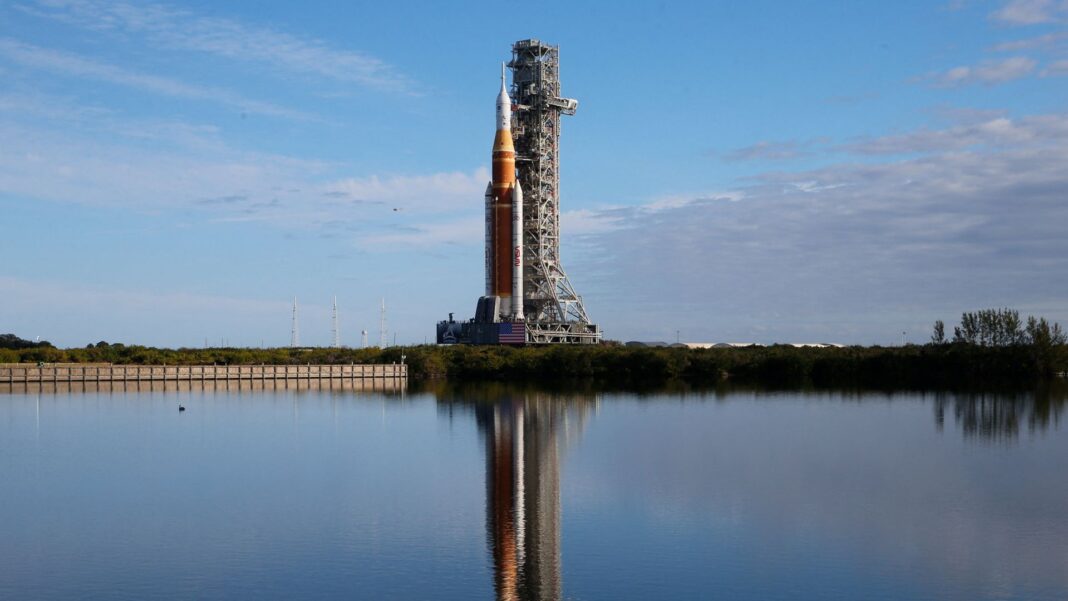
NASA’s enormous rocket that will soon carry astronauts around the moon has reached its launch pad.
The painstaking 11.5-hour journey from the hangar saw the rocket move upright for four miles, loaded on to the back of a Crawler Transporter 2.
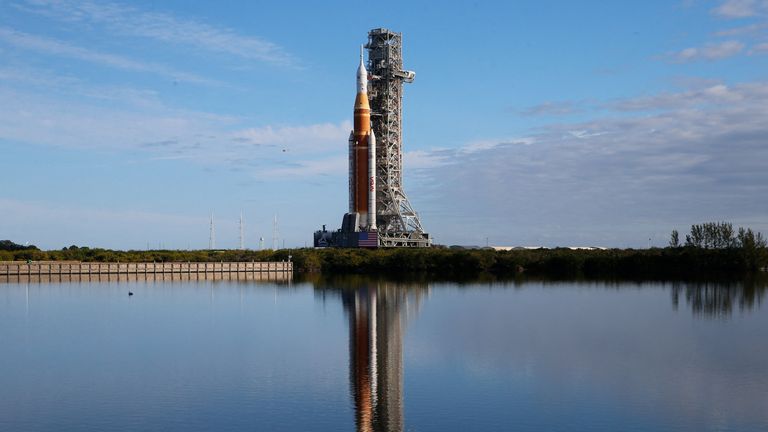
The Space Launch System rocket, with the Orion crew capsule, rolls to the launch pad. Pic: Reuters
The transporter itself weighs 3 million kilograms and is roughly half the size of a football pitch, while the rocket is taller than Big Ben.
The transporter burned a litre of diesel every 3.5m of the trip, travelling at just one mile per hour most of the time.
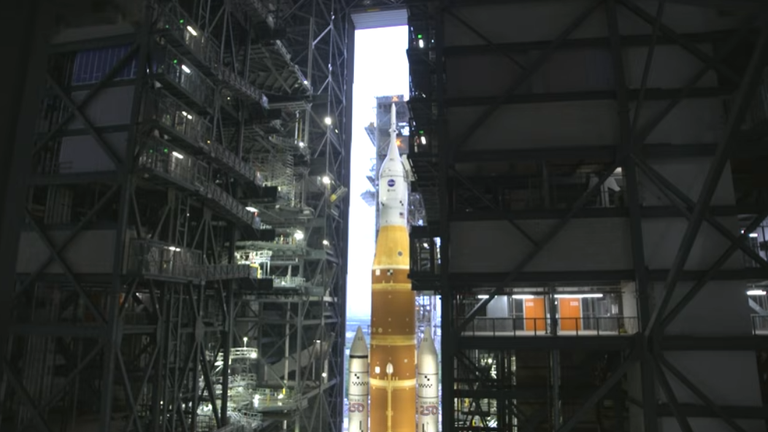
NASA’s Vehicle Assembly Building as Artemis 2 rocket moves to launch pad. Pic: AP
Artemis 2 is scheduled for lift-off next month and will see four astronauts travel around the moon for the first time in 50 years.
The next mission, Artemis 3, plans to land NASA astronauts on the moon’s surface.
As the rocket was making its way to the launch pad, the four astronauts told reporters what they planned on taking into space with them.
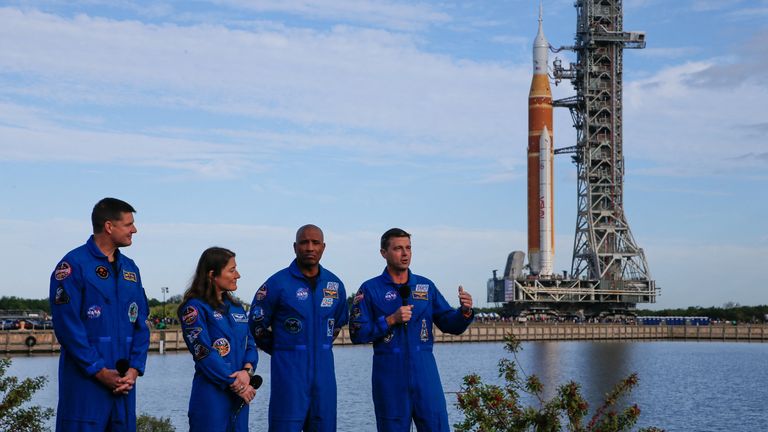
Artemis II Commander Reid Wiseman speaks at Cape Canaveral. Pic: Reuters
Mission commander Reid Wiseman said he has a blank piece of paper and a pen and pencil.
“I can’t wait to write some thoughts on that. I don’t know what to expect, and I don’t want to go in with any preconceived notions,” he said.
Mission pilot Victor Glover will take his Bible with him, along with an heirloom from each of his daughters and his wife.
“For me, it’s handwritten notes from people I love,” said mission specialist Christina Koch.
“The idea I can hold in my hands way out there something that they held in their hands. It’s really special to me.”
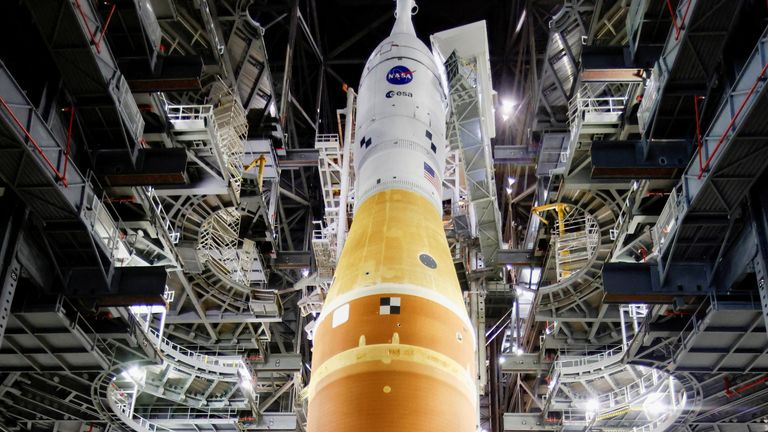
NASA’s Space Launch System rocket with the Orion crew capsule. Pic: Reuters
Mission specialist Jeremy Hansen said he’s put four moon pendants worn by his wife and children on to the rocket.
“I collected them back this summer and now they’re on that vehicle, rolling to the pad,” he said.
Although the Artemis rocket is 13m shorter than the Saturn V that launched the Apollo missions, it’s about 15% more powerful.
It has 8.8 million pounds of thrust, roughly the same as 28 jumbo jets and can lift 27 tonnes to deep space.
Because of its size, it needs to reach a speed of 24,000mph to break free of the Earth’s gravity and head to the moon.
Read more space stories:
ISS astronauts back after first ever emergency return
Racing to replace the International Space Station
Inside the lab trying to protect the astronauts of the future
Once the rocket is safely on its launch pad, crews will start even more rigorous testing.
The fuelling test, called a “wet dress rehearsal”, is scheduled to take place on 2 February, four days before the first launch window.
Based on the rocket’s performance during that test, NASA will decide if Artemis 2 will be ready for a 6 February launch.
In addition to the fuelling tests, NASA will need to perform a series of Space Launch System rocket and Orion crew capsule checks, as well as a run through with the Artemis 2 astronaut crew.