

This post was originally published on this site.
‘I feel like I dug my own grave’: The workers caught in the AI transition
 Image source, Bloomberg via Getty Images
-
Published
For 15 years, single mother Lisa made a living from content writing.
She began writing straight out of college, freelanced for years and eventually followed a path taken by many young Filipinos: joining a multinational in the country’s booming outsourcing industry.
Lisa says she never felt the need to use artificial intelligence (AI) in her work.
“I can say that I am able to do my job, I meet deadlines. In my opinion, there is no need for [AI],” she told the BBC.
Eight months into her latest role, and one month before the position was due to become permanent, she was made redundant.
In the months before, Lisa says a public relations agency had been tasked with producing AI-generated material that she and her colleagues were asked to edit. She says her skills were used to train the AI on the company writing style.
“I feel like I dug my own grave,” she says. “We were the ones who trained the artificial intelligence that replaced us.”
Lisa, not her real name, is one of several former outsourcing employees the BBC spoke to who asked to remain anonymous. They signed confidentiality agreements in return for severance pay, and fear that speaking publicly could hurt their chances of finding work in an industry which has a small network.
Their experiences offer an insight into a question confronting emerging economies like the Philippines: what happens when AI begins to automate the jobs that helped lift millions of people into the middle classes?
Building an industry
Every evening around 5pm, streams of workers wearing company lanyards spill out of high-rise offices in the district of Cubao in Manila.
It’s one of several areas of the capital where multinational companies have premises – providing all sorts of outsourcing work including call centres, accounting, software development and marketing copy services for clients thousands of miles away.
For over two decades, these business districts have symbolised one of the Philippines’ biggest economic success stories.
Beginning in the early 2000s, the country was promoted as an English-speaking alternative to India for what’s called business process outsourcing (BPO).
Successive governments offered tax incentives, invested in infrastructure and encouraged multinational companies to set up large operations.
Global groups like Accenture, Concentrix and Teleperformance built sprawling campuses, employing hundreds of thousands of Filipinos.
Today, the outsourcing industry employs roughly 1.9 million people, and generates $40bn (£30.1bn) in revenues every year, accounting for about 10% of the Philippines’ economy.
But experts say the industry is disproportionately vulnerable to the impact of AI.
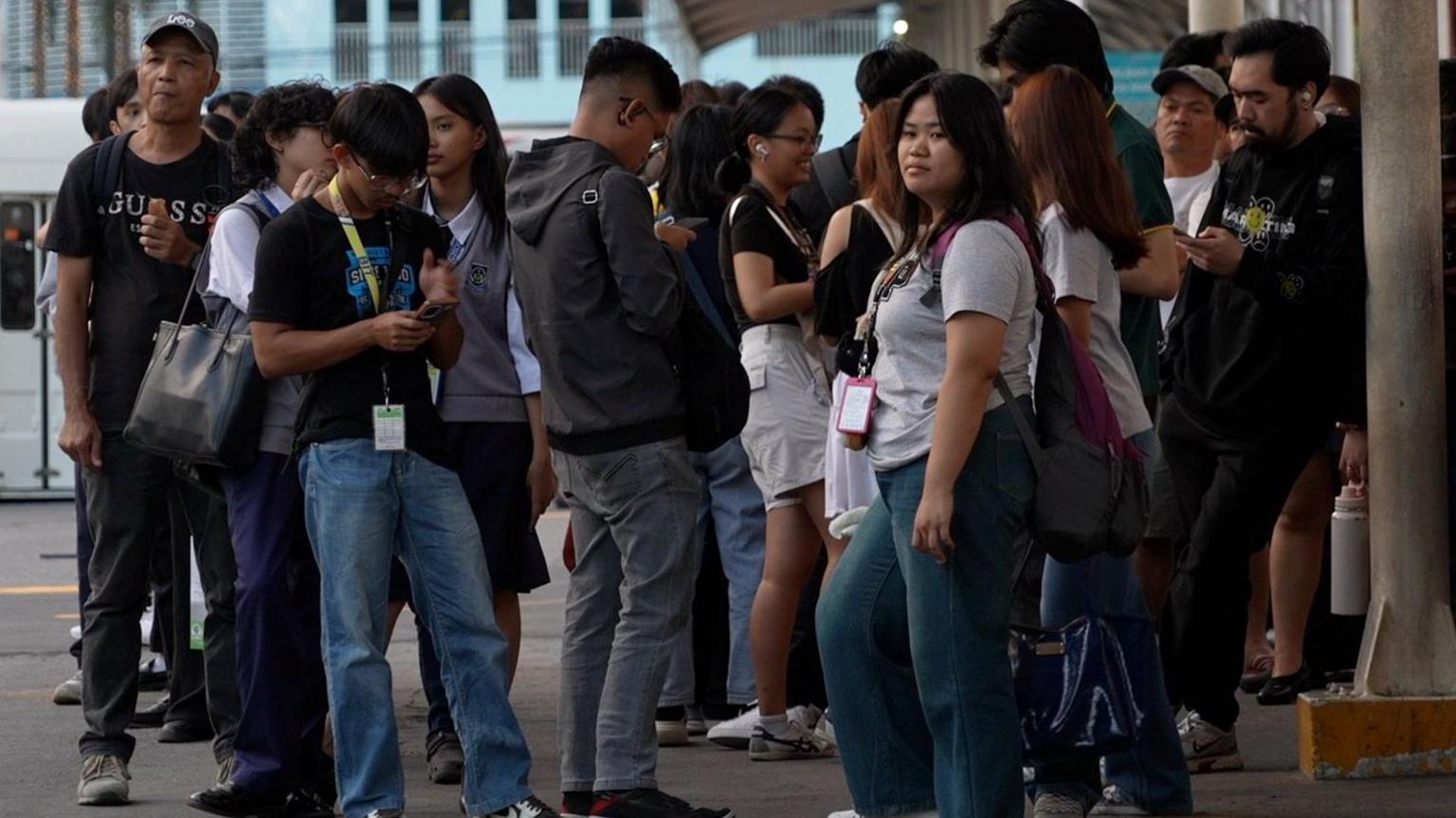
The International Labour Organization estimates that 12.7 million Filipinos – more than one in four workers – are employed in occupations exposed to generative AI, the highest share in South East Asia.
The organisation expects many roles to change rather than disappear but the types of service jobs that people do in the Philippines leaves it particularly at risk.
Jack Madrid, president of the IT and Business Process Association of the Philippines (IBPAP), admits that AI is being adopted by the sector.
More than two-thirds of IBPAP’s members are already running AI pilots, he says.
“Agentic AI has the potential to automate at a much more accelerated pace,” Madrid says. “Obviously, there’s a layer of jobs that are automatable or have been automated.”
But he adds that the vast majority of affected workers have been redeployed within the same organisations.
Madrid says any weakness in hiring reflects more than the impact of AI.
“We’ve seen a slowdown in investment decisions on whether certain job functions or processes should be offshored,” he says, pointing to slower global demand and uncertainty over how companies will ultimately deploy the technology.
Even so, he acknowledges the challenge. “We cannot do enough to be prepared,” he says. “The importance of reskilling” cannot be overstated.
The pressure to automate
Mary, another former content writer whose name we’ve changed, says her employer encouraged the use of AI as a productivity tool.
Instead of making her job easier, she says it created additional responsibilities.
“We had to edit more, fact-check more because the data AI produced was inaccurate,” she says. “Technically it was more work for us.”
Like Lisa, she was later made redundant.
Companies are under pressure to implement AI, to reduce costs and increase productivity, experts say.
Teleperformance, the world’s largest call centre operator and one of the Philippines’ biggest private employers, has said AI offers an opportunity to augment rather than replace its workforce.
The company expects AI to handle routine interactions while human agents move into more complex roles.
Teleperformance has also said it plans to retrain employees.
Accenture has similarly said that generative AI will reshape almost every job rather than eliminate positions.
The firm has promised to invest billions of dollars in AI capabilities and workforce training.
Concentrix – which is the biggest outsourcing firm in the Philippines – says its AI systems should remain under human oversight and has committed to training employees in the new technology.
Some Filipino managers are uneasy about AI and want to slow down adoption, according to Paul Quintos, from the University of the Philippines-Diliman.
They are concerned about how much of the domestic workforce might be displaced.
“But there’s tremendous pressure from foreign clients to adopt AI,” he says. “It’s a major cost-cutting measure.”
Philippine outsourcing companies compete directly with rivals in India and elsewhere for contracts from multinational corporations.
Increasingly, those clients expect suppliers not only to provide cheaper labour, but also to integrate AI into the services they deliver.
Despite hundreds of billions of dollars being invested globally in AI, Quintos says there is still limited evidence about how much productivity many workplace tools actually deliver.
“There is a term called ‘AI washing’,” he says.
Some layoffs are presented as being driven by AI when companies are in fact responding to weaker demand or slowing economic conditions, Quintos says.
Attributing redundancies to AI, he adds, can make restructuring appear like technological progress rather than a response to market conditions.
The next transition
Labour groups have told the BBC that existing employment laws in the Philippines govern redundancy but offer little guidance on how companies should introduce AI into workplaces or consult employees over its use.
The Philippines’ outsourcing sector is also non-unionised, leaving many workers with little formal say over how new technologies are deployed.
The government says that it, and the private sector have a responsibility to retrain workers, and risks falling behind competitors like India and Singapore.
“To be completely honest, I think we’re slightly behind. We have to catch up,” says Leandro Aguirre of the Philippines Department of Information and Communications Technology.
“We have to double our efforts to put our people in a position where they will not be displaced but actually thrive in this growing AI race.”
The government has committed to upskilling more than 300,000 outsourcing workers, but Aguirre acknowledges that the Philippines may need to rethink the economic model that helped make it an outsourcing centre.
“We relied heavily on foreign direct investment,” he says. “But I think we also need to focus on local talent and local companies.”
The ambition, he says, is to build home-grown AI companies capable of creating higher-value jobs.
Aguirre rejects calls for sweeping new AI legislation, arguing that existing labour, privacy and consumer protection laws can be adapted more quickly through regulatory guidance.
“The benefits of AI have to trickle down to people,” he says. “It can’t just benefit employers.”
For more than 20 years, the Philippines built one of the world’s most successful outsourcing industries by selling the skills of its people to multinational companies.
AI may not end that model, but it is certainly changing it, and risks leaving some workers behind.
Additional reporting by Jaltson Akkanath Chummar and Regine Cabato