
This post was originally published on this site.
Last year was a horrible year for the active fund-management industry. Investors have consistently been pulling money from active investment funds over the past decade, but outflows accelerated in 2025. According to data compiled by Bloomberg Intelligence, more than $1trillion flowed out of US active mutual funds last year, up from around $600billion in 2024. Investors moved into passive exchange-traded funds (ETFs), adding more than $600billion last year. The trend is much the same in the UK, albeit with smaller numbers.
This might appear to suggest the end is nigh for the UK’s listed fund-management sector, but that’s not entirely the case. Figures available indicate that only two of the listed managers are on track to report a decline in assets under management (AUM), according to analysis from Peel Hunt. Those managers are Liontrust and Impax Asset Management, which lost two key mandates from St James’s Place. That will drag group AUM down by as much as 23.3% for the year.
Sign up to Money Morning
Don’t miss the latest investment and personal finances news, market analysis, plus money-saving tips with our free twice-daily newsletter
Don’t miss the latest investment and personal finances news, market analysis, plus money-saving tips with our free twice-daily newsletter
Polar Capital’s deep roots in technology
It’s hard to argue that technology and healthcare won’t continue to attract investors’ interest over the next decade. These sectors might encounter some turbulence along the way, but tech and healthcare will remain two of the most exciting and promising thematic trends. Under the new CEO’s stewardship, Polar plans to double down on the markets that have helped it become one of the UK’s top boutique fund managers.
The group’s roots are in technology. It was created by Brian Ashford-Russell and Tim Woolley, who left their positions at the Henderson Technology Trust, managed by Henderson Investors, to set up the new boutique in 2001. Backed by Caledonia Investments, the self-managed investment trust Polar grew quickly despite the dotcom bubble, reaching $2billion in AUM by 2005. Henderson Technology Trust, launched in 1996, became the Polar Capital Technology Trust, a core of the group’s fund range. Since launch, the tech trust has returned 14.7% per annum (to 30 April 2025) by correctly timing key turning points in the tech world, such as the rise of Big Data in 2010 and AI as early as 2017.
The firm’s flagship open-ended tech fund, the Global Technology Fund, was launched at Polar’s inception. Today, it’s far bigger than the trust, although they’re both managed by the same team. The key difference is concentration. The trust has 91 positions, compared with 65 for the open-ended vehicle. But the trust is more concentrated, with 53% of the portfolio in the top-ten holdings, compared with 47% for the open-ended fund.
Iain Evans is a promising new boss
In September, Iain Evans was appointed CEO after 21 years with the company. Evans is planning on doubling down on what’s worked for Polar – specialism in a few key sectors with select acquisitions. This desire to focus on what works is refreshing in a sector that often appears to be struggling for direction. Many managers have panicked at the rise of passive funds, often wasting money on bolt-on acquisitions in the hopes of achieving growth or expanding into new markets.
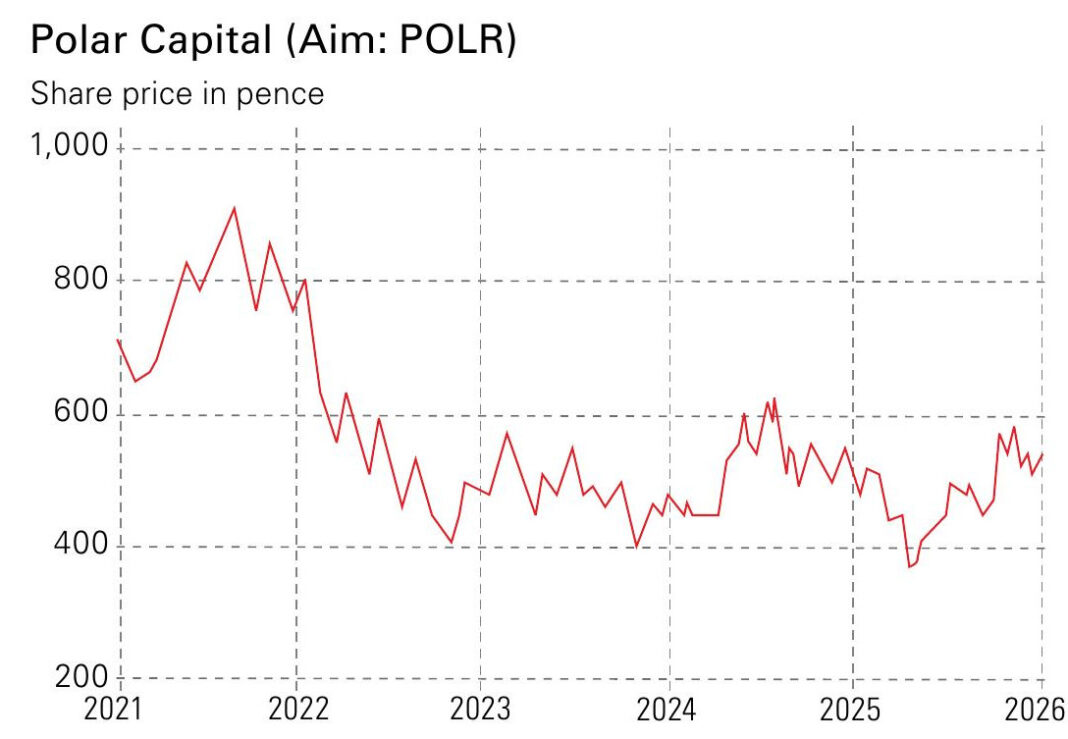
Polar is doing the opposite. While that may leave the company at the mercy of the performance of technology, it stands out in a struggling sector. However, the market is not taking its edge into account. Instead, investors are lumping Polar in with struggling managers such as Liontrust and Impax as its valuation sits near the bottom of the range for its fund-management peers.
At the time of writing, shares in Polar Capital are trading at a forward price-to-earnings ratio (p/e) of ten, according to Panmure Liberum, and nine according to Peel Hunt. That’s a deep discount to the fund-manager sector average of 16 (including wealth managers). Fund-managers’ earnings are cyclical compared with the more stable earnings from wealth management, so the shares deserve a discount to the sector average, but a gap of more than 43% seems excessive. Panmure Liberum believes 20% would be more appropriate.
There’s also the company’s dividend. Polar earns its money in both regular fund-management and performance fees. On its asset base of £23.2billion, Polar Capital booked management fees of £86.8million in the first six months of fiscal 2025. For the year ended March 2025, it booked a management fee yield of 78 basis points (0.78%), generating net management fees of £178.3million. It also earned performance fees of £16million for the year, up several million compared with 2024. These could hit £28 million in 2026, Panmure estimates. Although regular management fees already cover Polar’s dividend, the additional performance fees mean the company’s 8.7% yield is more than covered by earnings per share, and should remain so for the foreseeable future.
All in all, Polar offers a cheap, leveraged way to play the global demand for tech stocks, with a market-beating dividend yield on offer as well.
This article was first published in MoneyWeek’s magazine. Enjoy exclusive early access to news, opinion and analysis from our team of financial experts with a MoneyWeek subscription.