
This post was originally published on this site.
Unlock the Editor’s Digest for free
Roula Khalaf, Editor of the FT, selects her favourite stories in this weekly newsletter.
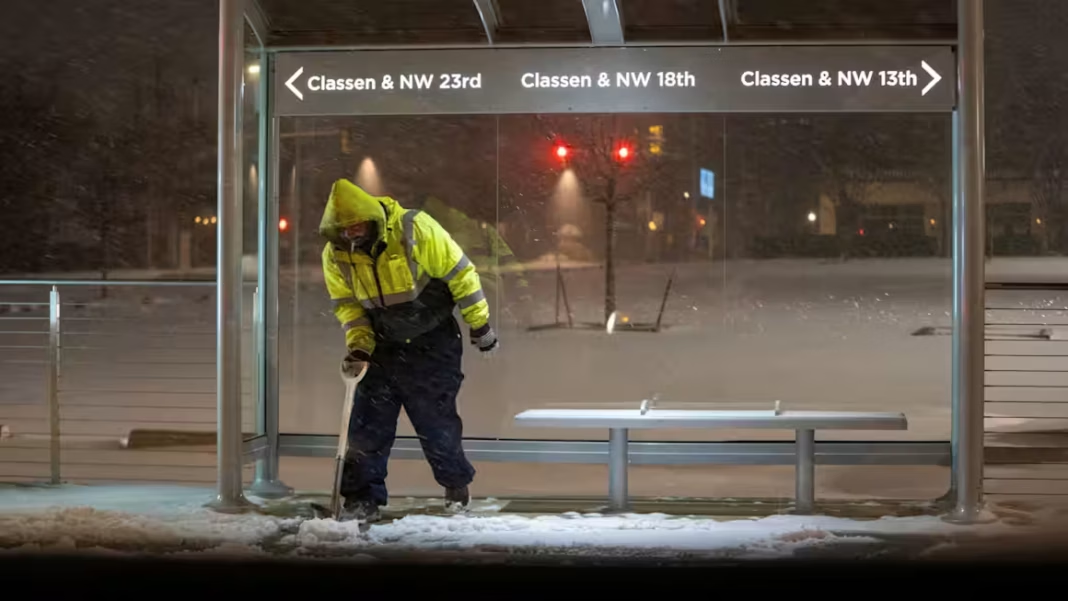
A severe winter storm ripping across the south and east of the US has caused mass power outages and the cancellation of thousands of flights.
More than 100,000 people across the country have been left without power, according to tracking website Poweroutage.com. Over half are in Texas, around 20,000 in Louisiana and 10,000 in New Mexico.
More than 12,000 weekend flights have been cancelled, along with 14,000 delays, leaving passengers stranded at airports across the US.
Over 40 per cent of the country is under a winter storm warning. On Tuesday the National Weather Service issued winter storm watches for various areas across the country from Friday until Monday.
President Donald Trump announced emergency declarations to deal with the impact of the storms in South Carolina and Virginia.
“With the help of FEMA and our State partners, we will keep everyone safe, and make sure both States have the support they need,” he posted on Truth Social.

As Winter Storm Fern travels eastward, power companies are on alert for snow, freezing rain and sleet to hit the grid system, with helicopters and line construction crews being dispatched to identify damage and carry out swift repairs.
Georgia Power urged its customers to prepare for two- to three-day outages, while Dominion Energy in Virginia warned that icy conditions could knock out power in the region for days.
Governors in states including Virginia, North Carolina, South Carolina and Georgia have declared a state of emergency. On Thursday Energy Secretary Chris Wright ordered grid operators to make over 35 gigawatts of backup generation available to prevent blackouts.
Power outages cost the US $44bn last year, according to the Department of Energy’s National Laboratories.
Fern is drawing comparisons to Winter Storm Uri, which led to mass blackouts and loss of life across Texas in 2021. Temperatures are expected to drop to the low teens and single digits Fahrenheit, with wind-chill factors of minus 10 to zero Fahrenheit.
Ercot, the grid operator for Texas, has said it is ready for the storm and has sufficient generation to meet demand.
“The same risk of power outages due to lower natural gas production still applies, as natural gas wells can freeze in temperatures below freezing,” said Mark Callahan, director of Americas Natural Gas Pricing at S&P Global Energy. “However, conditions for this storm are not as bad, and work has been done since 2021 to winterise the grid for such events.”
While the state is better prepared due to grid modernisation efforts and the rise of home generators, “the buffers in the system are much more constrained” by rising power demand from data centres and electrification of household appliances, said Didi Caldwell, chief executive of Global Location Strategies.
PJM, the grid operator which serves more than 67mn people in the north-east and Midwest, said temperatures could reach single digits Fahrenheit across the region and dip below zero in the west.
“This is a formidable arctic cold front coming our way,” said Mike Bryson, senior vice-president of operations at PJM. “We will be relying on our generation fleet to perform as well as they did during last year’s record winter peak.”
Natural gas is trading at elevated levels, with prices around $28 at Henry Hub, Louisiana, $34 in Chicago, and $60 to $100 in the North East and East Coast on Friday, noted analysts at S&P.
However, this is “much lower than the $1,000 prices we saw during Uri”, said Callahan.
Retailers Amazon and Door Dash said they would balance deliveries of consumer staples while prioritising the safety of their workers. At least 21 Walmarts across the country are closed.