
This post was originally published on this site.
Hafsa Khaliland
Nick Eardley

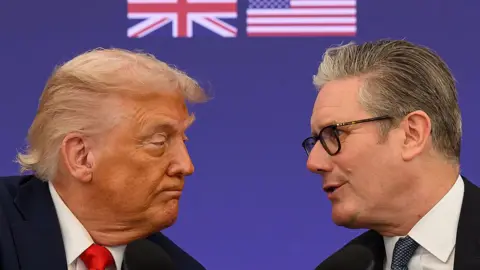
Prime Minister Sir Keir Starmer has said Donald Trump’s plan to impose tariffs on the UK and European allies until a deal is struck for the US to take over Greenland was “completely wrong”.
The US president on Saturday vowed to place a 10% levy “on any and all goods” exported to the US from 1 February, which would rise to 25% on 1 June.
Sir Keir, who so far has maintained a strong relationship with Trump, said the UK would be pursuing the matter directly with the White House.
The Trump administration has been ramping up calls for the US to take control of Greenland, a Danish territory in the Arctic, on national security grounds, alarming both European allies and those living on the island.
As well as the UK, Trump said the new tariffs would apply to products from Denmark, Norway, Sweden, France, Germany, the Netherlands and Finland.
The UK was the first nation to strike a deal to reverse or cut some earlier tariffs imposed by the US, while Sir Keir has acted as a key intermediary between Washington and Europe on ending the war in Ukraine.
But the UK recently joined other European nations in defending Denmark’s ownership of Greenland as the Trump administration’s rhetoric on the issue escalated, and was among several countries to deploy troops to Greenland’s capital Nuuk earlier this week as part of a so-called reconnaissance mission.
Faced with striking a careful balance between allies increasingly at odds, Sir Keir reiterated his position that Greenland was part of Denmark and its future was a matter for the two alone to decide.
“We have also made clear that Arctic security matters for the whole of Nato and allies should all do more together to address the threat from Russia across different parts of the Arctic,” he said on Saturday.
“Applying tariffs on allies for pursuing the collective security of Nato allies is completely wrong. We will of course be pursuing this directly with the US administration.”
By saying that Nato needs to do more to ensure Arctic security, Sir Keir is sending a message to Trump that the UK is willing to play a part – in a similar way to how European countries took on more financial responsibility for Ukraine.
But his comments represent a rare public rebuke of the US president and mark an important test for the US-UK “special relationship”.
Trump’s fresh tariff threat has also drawn criticism from across the UK political spectrum.
Conservative leader Kemi Badenoch called it a “terrible idea” that will be “yet another burden for businesses” across the country.
“The sovereignty of Greenland should only be decided by the people of Greenland,” she said, adding: “On this, I agree with Keir Starmer.”
Meanwhile, Lib Dem leader Sir Ed Davey said “Starmer’s US policy lies in tatters” with Trump “now punishing the UK and Nato allies just for doing the right thing”.
Reform UK leader Nigel Farage, historically an ally of Trump, said “we don’t always agree with the US government and in this case we certainly don’t”, adding that “these tariffs will hurt us”.
The Green Party’s parliamentary leader Ellie Chowns called the decision “unhinged”, and said Trump “treats the international stage like a schoolyard playground, attempting to bully” countries into compliance.
Trump stepping up Greenland pursuit
Trump has argued the US requires Greenland for its national security and expressed his interest in the territory soon after his second term in the White House began.
Greenland’s location between North America and the Arctic makes it well placed for early warning systems in the event of missile attacks and for monitoring vessels in the region.
The US already has more than 100 military personnel stationed at its missile-monitoring station on Greenland’s north-western tip and, under existing agreements with Denmark, the US has the power to bring as many troops as it wants to Greenland.
In recent years, there has been increased interest in Greenland’s natural resources, including rare earth minerals, uranium and iron, which are becoming easier to access as climate change thaws its ice sheet.
Trump has not ruled out using military force, but his Truth Social post announcing the tariffs on Saturday focused on reaching a deal for the “complete and total purchase” of the island.
He also reiterated his assertion that Russia and China wished to gain Greenland.
“There is not a thing that Denmark can do about it,” he wrote. “They currently have two dogsleds as protection, one added recently.”
Trump said Denmark’s supporters had created “a level of risk in play that is not tenable or sustainable”, adding: “Therefore, it is imperative that, in order to protect Global Peace and Security, strong measures be taken so that this potentially perilous situation end quickly.”
Denmark has repeatedly stressed Greenland was not for sale and that an attack on its territory would spell the end of the Nato military alliance. Greenland, which has been drifting towards independence, has said it would rather remain Danish than become American.
Tariffs are taxes on foreign products paid to the government imposing them by the companies importing them, not the exporting countries themselves.
However, the levies can harm those economies as those companies may decide to import fewer products due to the extra cost. In many cases, the higher costs are passed onto the consumer.
The British Chamber of Commerce’s head of trade policy William Bain said the fresh US tariffs would be “more bad news” for UK exporters already struggling with those already in place.
“We know trade is one way to boost the economy and the success of transatlantic trade depends on reducing, not raising, tariffs,” he added, urging the government to “negotiate calmly” to avoid the new levies coming into force.