
This post was originally published on this site.
Trump says AI safety fears a ‘hoax’ as he rejects calls for greater safeguards
To play this video you need to enable JavaScript in your browser.
This video can not be played
-
Published
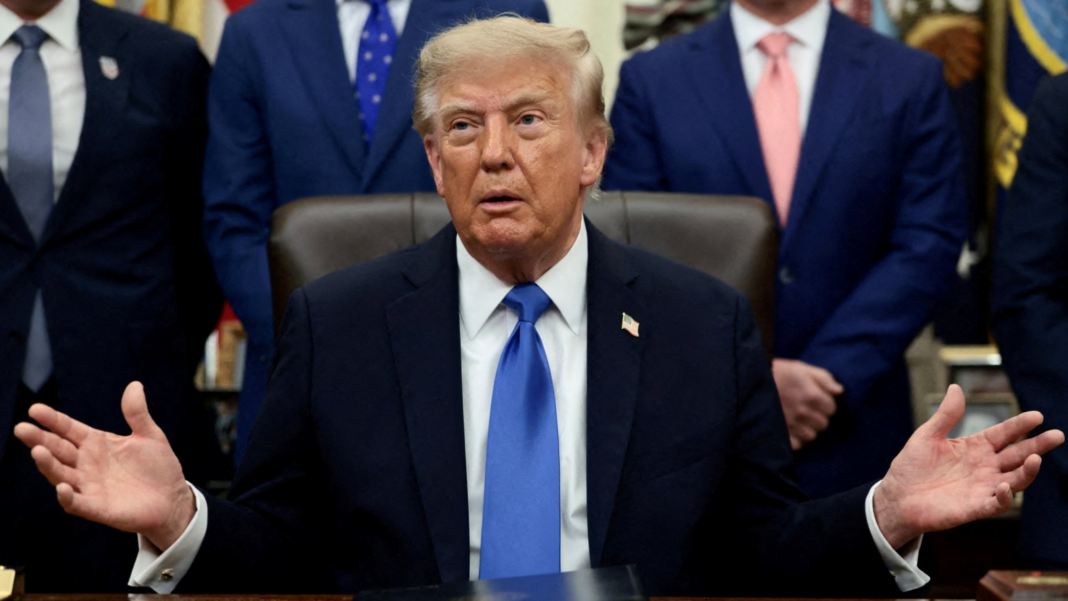
US President Donald Trump has said fears about the safety of AI are a “hoax”, as he criticised calls to have more guardrails for the fast-moving technology.
It comes after Jack Clark, a co-founder of AI giant Anthropic, told the BBC that a “kill switch” for dangerous AI that can be checked by a third party may need to be mandatory for the industry.
Clark’s comments followed warnings about the risks the technology poses to humanity that have been raised in recent days by several executives and staff at leading AI firms.
Those concerns triggered a selloff in shares of some tech firms on Monday as investors weighed the impact of a potential slowdown in the development of AI.
In a series of social media posts on Monday, the US president compared warnings about AI to the “Global Warming Scam”, that he said was “being perpetrated by the Radical Left Dumocrats”.
Trump also called himself “the Hoax Buster”, likening concerns about the safety of the technology to “the RUSSIA, RUSSIA, RUSSIA HOAX”.
In an earlier post, he wrote: “There is a SICK conspiracy going on against AI and Data Centers, and the only one that is happy about it is China. WHOEVER WINS AI, WINS!”
On Monday, Chinese state media said experts had warned that “Washington’s growing anxiety over China’s rapid AI development appears to be increasingly distorting its policy priorities”.
“They know that China has become a strong competitor in AI, and worry that if the US slows down development or tightens regulation, China could catch up even faster,” Xin Qiang, a professor of American Studies at Fudan University, told the Global Times.
Clark, who is one of Anthropic’s seven founders, said earlier on Monday that a way of shutting off AI software completely if it gets too dangerous was something society “might want to eventually pass rules around”.
He added that “most labs have different ways of being able to pull the plug”, including Anthropic, but said lawmakers may need to enforce having one.
Clark’s comments add to the growing number of tech industry and political figures calling for better safeguards.
On Monday, Microsoft AI became the latest major company to discuss limiting the models it is developing, as it published an outline document on what it called “humanist AI”.
The firm’s chief executive Mustafa Suleyman told business news channel CNBC that it had been working on the new guidance for months and had decided to publish it now due to the current debate around the technology.
-
AI regulation faces political deadlock as calls grow for Congress to act
-
Published1 hour ago
-
-
Why are there concerns AI could threaten humanity, and how real are they?
-
Published15 hours ago
-
-
China criticises idea it is in ‘malicious competition’ over AI
-
Published16 hours ago
-
In an indication of how concerns over the technology have been thrust into the spotlight, two high-profile figures on opposite sides of US politics are set to appear at the same event calling for a re-evaluation of AI policy.
Former Trump chief strategist Steve Bannon and veteran progressive Senator Bernie Sanders are due to speak at the “Pro-Human Assembly” in Washington on Tuesday.
According to its website the gathering “aims to define a shared vision and articulate a better, more human-centric path for AI development”.
Sanders told BBC’s Newsnight last week that “we have got to do something immediately to stop the uncontrolled growth of AI”.
“You’ve got the existential threat of the possibility of humanity being wiped out,” he said.
The debate over the potential dangers posed by the technology intensified in recent days after a post by Jacob Coxon, a researcher who left Anthropic over concerns AI could wipe out humanity, went viral.
In response, Anthropic scientist Evan Hubinger said he thought the possibility of AI causing human extinction “within the next decade” was more than 10%.
This weekend, Anthropic chief executive Dario Amodei called for the pace of AI development to slow and be more closely monitored, as the company has done before, though some have questioned the motivations behind this.
Amodei also said that any action to rein in AI should be done “without sacrificing commercial advantage”.
The bosses of two rival AI firms, Sam Altman of OpenAI and Elon Musk of xAI, have also said they agree with Amodei’s proposal for industry-wide deceleration and regulation, as well as independent monitoring of AI model development.