
UK growth forecast upgraded but higher energy prices to hit economy next year
-
Published
The UK economy is forecast to grow by more than previously expected this year before higher energy prices and interest rates hit the economy in 2027, the International Monetary Fund (IMF) said.
The organisation’s latest report, which is closely watched by the government, said the UK economy would expand by 1.3% in 2026, up from the 1% it predicted in July, before slowing in 2027.
Economies across the world have proved more resilient to the energy price shock caused by the US-Iran war, the IMF said, but it warned the economic fallout from the conflict remained “highly uncertain”.
Chancellor John Healey said the government would look to “provide some breathing space” for households in the Budget.
Healey is making the final preparations to Andy Burnham’s new-look government’s tax and spending plans, which will be announced on 28 October.
Government borrowing costs have surged, placing pressure on the chancellor to ensure his plans are credible in the eyes of financial markets, which the UK relies on to borrow money.
But IMF chief economist Silvana Tenreyro told BBC News on Tuesday that the UK’s process of managing its debts is now leading the major G7 economies.
“As you know, the UK has already started the consolidation process and it is the country that basically stands out, along with India”, she said.
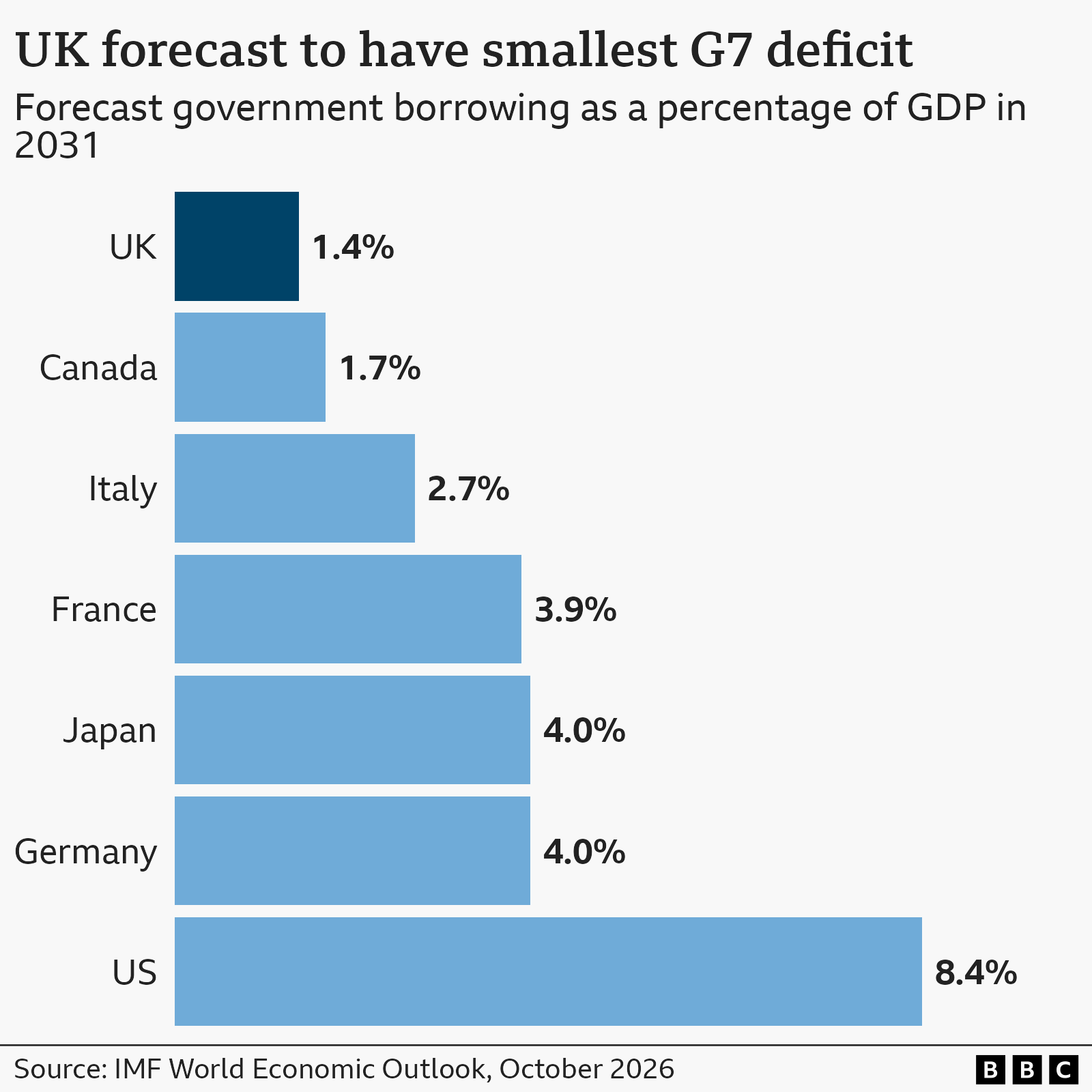
The organisation said the UK is one of the only major economies on course to stabilise levels of national debt. The UK is also projected to have the lowest annual borrowing in the G7 in 2031.
Asked if the UK was one of the countries the IMF was telling to reduce borrowing, Tenreyro said that the country had begun the process already and should “stay the course”.
The head of the IMF has previously called on the world’s advanced economies to cut borrowing and reduce debt levels.
While the IMF’s forecasts are closely watched, the figures are only a prediction, a best estimate, of what will happen in the future. Forecasts often turn out to be incorrect due to world events.
Also, the chancellor’s spending decisions at the Budget will be based on predictions from the UK’s official forecaster, the Office for Budget Responsibility, not the IMF.
The predictions in the IMF’s latest World Economic Outlook suggest:
-
the UK is expected to have the second-fastest growing economy in the G7 this year along with Germany
-
UK growth is set to slow next year to 1.2% as higher energy prices and long-term interest rates hit household spending and business investment
-
UK inflation is expected to average 3.3% this year, and the IMF has increased its forecast for inflation next year to 2.8%.
-
the IMF said the global economy was “proving resilient” despite the ongoing war in the Middle East, helped by the investment surge in AI.
‘Slow bicycle race’
Healey acknowledged that wars in the Middle East and Europe were “hitting people in the UK and around the world”, but added that “Britain’s economy is showing strong international resilience”.
When the economy is growing, businesses tend to invest more, more jobs are created and people, on average, tend to feel better off. The opposite can occur if the economy stagnates or shrinks.
Sir Howard Davies, former deputy governor of the Bank of England, told the BBC the IMF’s growth forecast was “better than it might have been”, but noted that for 2027 it remained “more pessimistic”.
“We’re still growing slowly. It’s almost like saying we’re winning a slow bicycle race here because other people are going backwards a bit more rapidly than we are,” he added.
Sir Howard said the UK was “a bit of a sideshow” when it comes to the global economy and the IMF was more focused on how much the US is adding to its debt pile.
“That is what is putting pressure on interest rates all over the world and that is what is affecting us as well. Unless the US does something about its deficit, we can expect interest rates to be higher, which of course increases our debt interest costs,” he said.
He added that the IMF was giving the UK credit in its forecast for tax rises which it might not end up actually putting through.
Economists have suggested Healey faces having to find £35bn to avoid cuts to public spending while meeting defence promises in his first Budget.
On Tuesday, the Resolution Foundation called on the chancellor to “make repairs” to the public finances, but said well-targeted support was needed for those “struggling to heat their homes”.
Andrew Griffith, Conservative shadow chancellor, said if Healey “reaches for more tax rises” in his Budget, “he is choosing slower growth and working people will pay for it”.
Get in touch
How have you been affected by the issues in this story? Share your experience

Sign up for our Politics Essential newsletter to keep up with the inner workings of Westminster and beyond.