
This post was originally published on this site.
114 days and counting – how damaging is Alcaraz’s wrist injury?
-
Published
When Carlos Alcaraz walked off the court at Rod Laver Arena in January, he was on top of the world.
At 22, he had just completed the career Grand Slam, defeating all-time great Novak Djokovic in the Australian Open final, winning his seventh major overall and his third of the most recent four.
A few months earlier he had decimated his rival Jannik Sinner in the US Open final in what was the most impressive performance of his illustrious career to date.
But the Spaniard has now missed the French Open and Wimbledon, going 114 days without playing a competitive match due to a wrist injury he suffered in Barcelona in April.
After returning to training, he has now withdrawn from the upcoming Cincinnati Open, and with the US Open less than a month away, Alcaraz’s ability to defend his title is in serious doubt.
So, why exactly is Alcaraz’s injury proving so troublesome, and how problematic can wrist issues be for tennis players in the long run?
How bad is Alcaraz’s injury and how common are wrist issues?
Alcaraz has been suffering from tenosynovitis, a painful inflammation of the fluid-filled sheath that surrounds the tendon on the inside of the wrist.
Tenosynovitis is typically caused by repetitive movements like gripping and swinging a tennis racket, and can lead to swelling and ongoing tenderness.
Minor cases can take weeks to recover, mostly managed by rest, but more severe issues can require significant physiotherapy and potentially even surgery, with recovery taking up to a year.
Alcaraz has not undergone surgery, but his latest withdrawal will take him to over four months out injured, and for a portion of that he was unable to use a racket at all.
Wrist injuries are particularly worrisome for tennis players because the joint plays a key role in every contact between the racket and ball – the way the wrist rolls through a shot helps generate power, and its dexterity is vital for delicate touches like drop shots, which Alcaraz has demonstrated an impressive mastery of in his career so far.
The lack of muscle surrounding the bones and tendons in the wrists also makes rebuilding strength difficult, meaning the length of absences can be difficult to predict.
“They’re much tougher injuries,” 1996 Wimbledon champion Richard Krajicek told Tennis365.
“It’s really difficult to reset when you start playing again [after this type injury]. You need to go step by step.
“It’s not as clear-cut as tearing the ligaments in your ankle, which [you know takes] three or four months and then you can play again.”
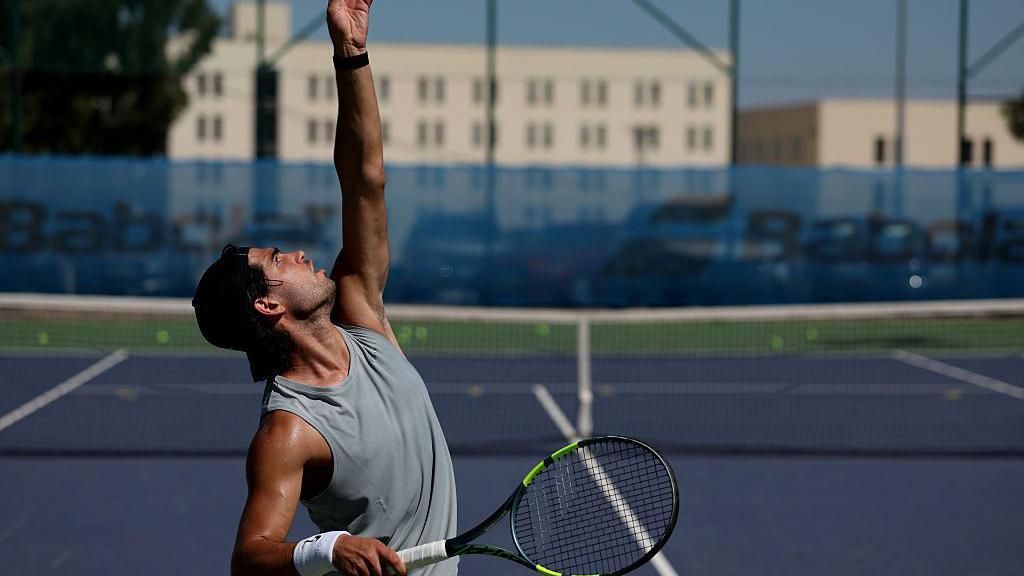 Image source, Getty Images
As tennis has become quicker, with the majority of players on both tours hitting hard from the baseline and using a double-handed backhand, the ability to generate power and topspin has become even more important, increasing the strain on players’ wrists.
Grand Slam winners Dominic Thiem and Juan Martin Del Potro both suffered recurring wrist injuries throughout their careers which eventually led to their retirements.
“Wrist injuries are becoming more significant in the game”, says James Ross, a physiotherapist who works with players at Grand Slams and other tournaments.
“A big factor is technological improvements – rackets and strings are better, so the ball is coming at you with more force and you’ve got to be able to absorb that.
“Tennis players also have a more gruelling schedule than ever before, putting more strain on the joints, and the balls are inconsistent between tournaments – changes like that mean the body has to adapt and that presents an injury risk.”
Why can returning from a wrist injury prove so difficult?
Alcaraz won his last match, beating a qualifier in the opening round of the Barcelona Open, but was in visible discomfort and withdrew before the following round.
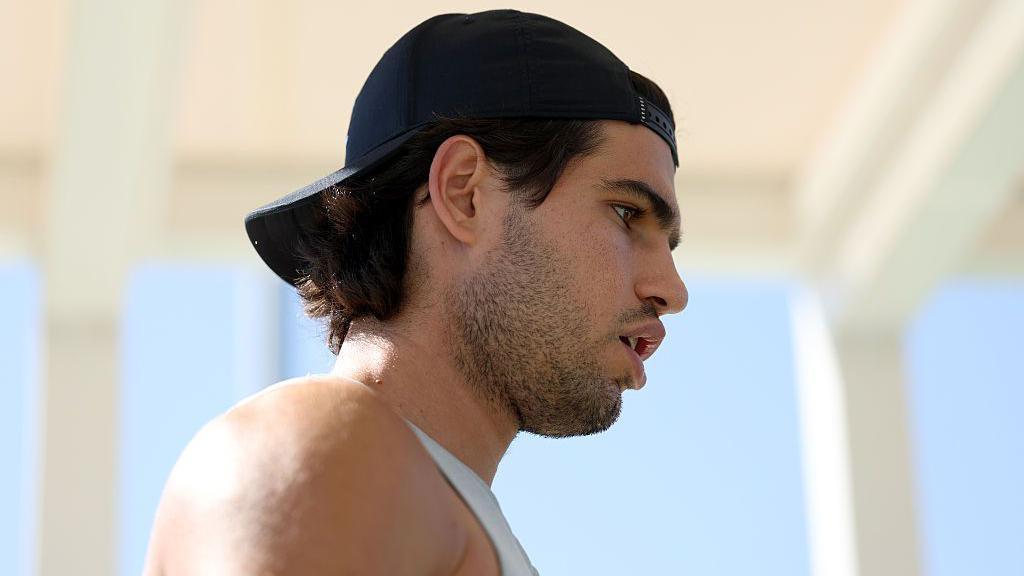
Photographs and videos were posted to his social media channels showing him participating in a training session in Murcia on Tuesday, sporting the longer hair he has grown out during his absence.
A competitive return is still a few weeks off at least, however, meaning he will at best be carrying almost five months’ worth of rust into the US Open, or at worst won’t be able to play at all.
But with wrist injuries in tennis, waiting longer can help prevent the problem becoming recurrent.
“The biggest risk of injury is a previous injury – if you have had it once, you are more likely to have it in the future”, Ross adds.
“If a player can get back over a period of a few months and they don’t have a reoccurrence, generally they will be ok.
“But some things can become chronic and the pressure of the sport to come back, earn money by playing, and keep your ranking points, is a risk.”
One of the key challenges a wrist injury presents is psychological – once a player has suffered a painful injury in the joint which controls so much of their technique, it can be difficult to fully trust it again.
“Wrists aren’t easy”, said Andy Murray towards the end of his career, having suffered injuries in both wrists in his early 20s.
“When the ball is low you know you really have to use your wrist to get the ball up and down, or when the ball is coming fast and quite high you need to use your wrist a lot to bring the ball down.
“It’s difficult when you try to come back [from a wrist injury], because the pain that you feel when you initially hurt it, mentally it’s very difficult to let go of.”
 Image source, Getty Images
How does Alcaraz’s absence compare to modern legends?
Two missed Grand Slams are possibly about to become three for Alcaraz, who is suffering the kind of extended absence from tennis which other modern greats have managed to avoid.
Roger Federer didn’t miss two consecutive Grand Slams until he was aged 38 and far beyond his physical prime, while Rafael Nadal missed two when he was 26, but the second of those was due to illness rather than injury.
Novak Djokovic has never missed more than a single major, and rival Sinner has played in every single Grand Slam since his first in 2019.
Before his injury, Alcaraz had been performing at an extremely impressive average of two Grand Slam titles per year. Continuing at that pace would have him level with Djokovic’s record of 24 by 2034, when he will be only 31.
Alcaraz will hope to return to top form as soon as he is back on court, but reaching the same level of performance following a wrist injury isn’t easy.
“The wrist doesn’t get great blood supply and it doesn’t heal very quickly,” says Ross. “It takes real time to build strength in it and the management is very complex.
“Restoring confidence is down to how rehab goes – you can feel amazing and then get a setback, and it’s how you deal with that.
“We also treat injuries as windows of opportunity – you might not be able to hit a tennis ball right now, but let’s work on your cardiovascular fitness, work on the core and lower body, or see how you mentally decompress and cope with having a holiday.
“You really have to keep the player motivated.”