
Marketing has changed more in the past year than in the decade before it. That sounds like hyperbole, but it’s not. Generative AI has hit our industry the same way the internet once did, and it is changing how marketing actually works.
The buyer’s journey looks different, because people now research and increasingly buy through AI tools instead of a page of blue links. The tools and processes we use to do marketing work have changed, because so much of it can now be generated, built, or automated. And the jobs themselves are shifting, with new marketing roles appearing and existing ones being redefined.
What follows are the AI marketing trends I have watched play out firsthand over the past year. This is not speculation. Every one is backed by real evidence, because the trend shows up in search interest itself: the terms people look up, the tools they are chasing, and the demand that climbs or fades as marketing reorganizes itself around AI.
1. New marketing job titles are being invented in real time
New channels and new tools bring new roles. As our definition of “good marketing” changes quickly, so do the expectations placed on the people hired to do it, and the job titles themselves are being rewritten in real time.
The common threads in these new roles are shifts toward being AI-native, systematizing workflows, and thinking one level of abstraction higher than before. The clearest example is the move from content marketing to content engineering. Instead of being the person who writes the article, you become the person who designs the system that produces good articles.
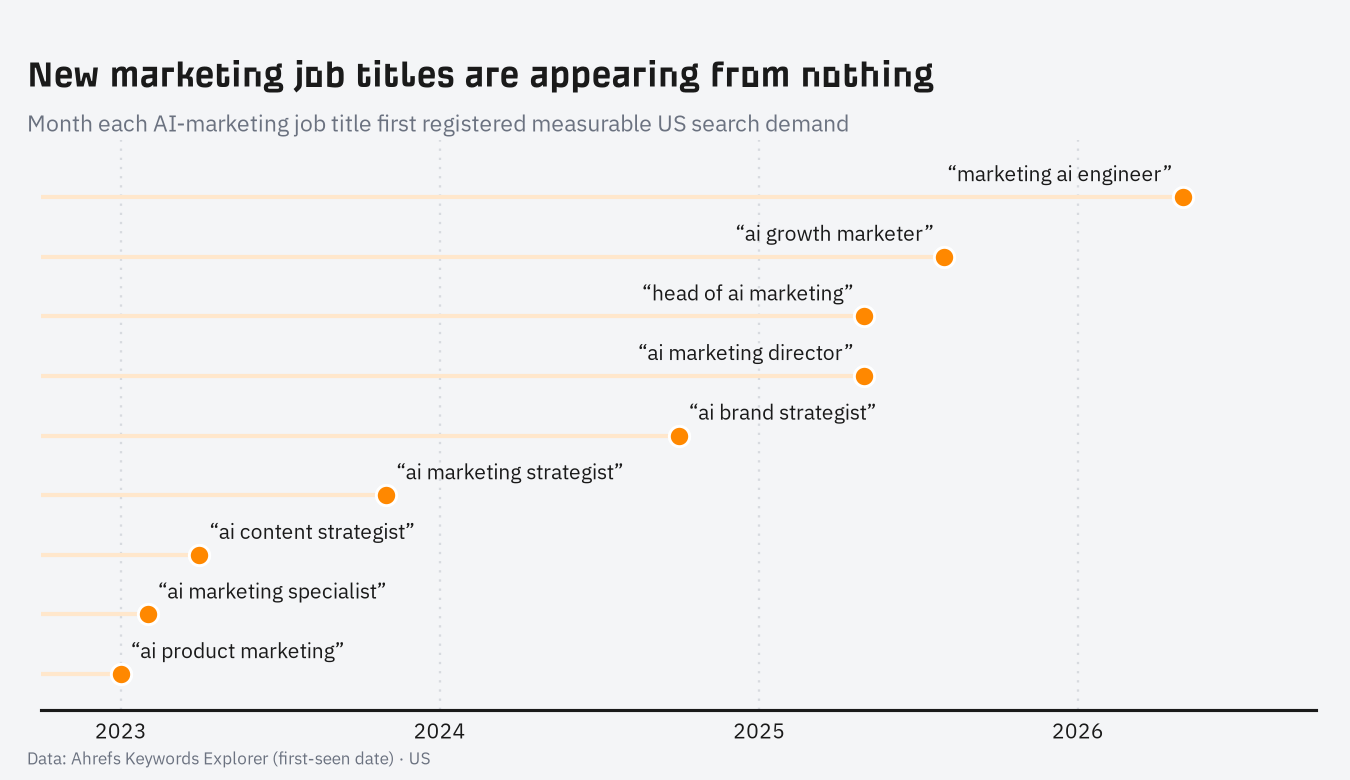
Month each new AI-marketing job title first registered measurable US search demand (Ahrefs Keywords Explorer).
You can watch this happen in the search data. Job-title searches that did not exist a couple of years ago are now real: ‘ai marketing director’, ‘head of ai marketing’, and ‘marketing ai engineer’ all first appeared between 2025 and 2026. The volumes are still small, because the roles are new, but the vocabulary is materializing out of nothing.
It is not all one direction, though. ‘Prompt engineer’, the poster-child AI job of 2023, is already folding into other titles. The specific titles will keep changing; but what won’t change is the need for marketers who design and systematize their work, a level of abstraction up from producing it by hand.
Further reading
2. AI content generation has gone mainstream
AI content generation has finally gone mainstream. People spent a few years skirting around it, using it quietly and not saying much about it. That phase is over. It is now a standard part of how most marketing teams work, and two things changed at once to get us here.
First, the tools got a lot better. Skill files, agentic models, and the infrastructure around them mean you can now produce genuinely good work with AI instead of generic filler. Second, the risk mostly went away. Google has said openly that it is fine with AI-generated content. The only real danger was ever publishing low-quality content at scale, and that was a problem long before AI turned up.
Our own research backs this up. We analyzed a million pages across 100,000 search results and found AI-generated content ranking everywhere, including the top three positions, with fully AI-written pages showing up at position one. There is a gentle gradient, where heavier AI use lines up with slightly lower rankings, but that looks like a quality effect rather than a penalty on AI itself. Or, as the study title puts it: Google does not punish AI content, it punishes bad content.
So AI generation is now just another tool in the kit, and it is not only about writing. The largest search demand in this whole space is for AI image and video generation, not text. Every company is using some version of this now. If you are not, you are the exception (and maybe not in a good way).
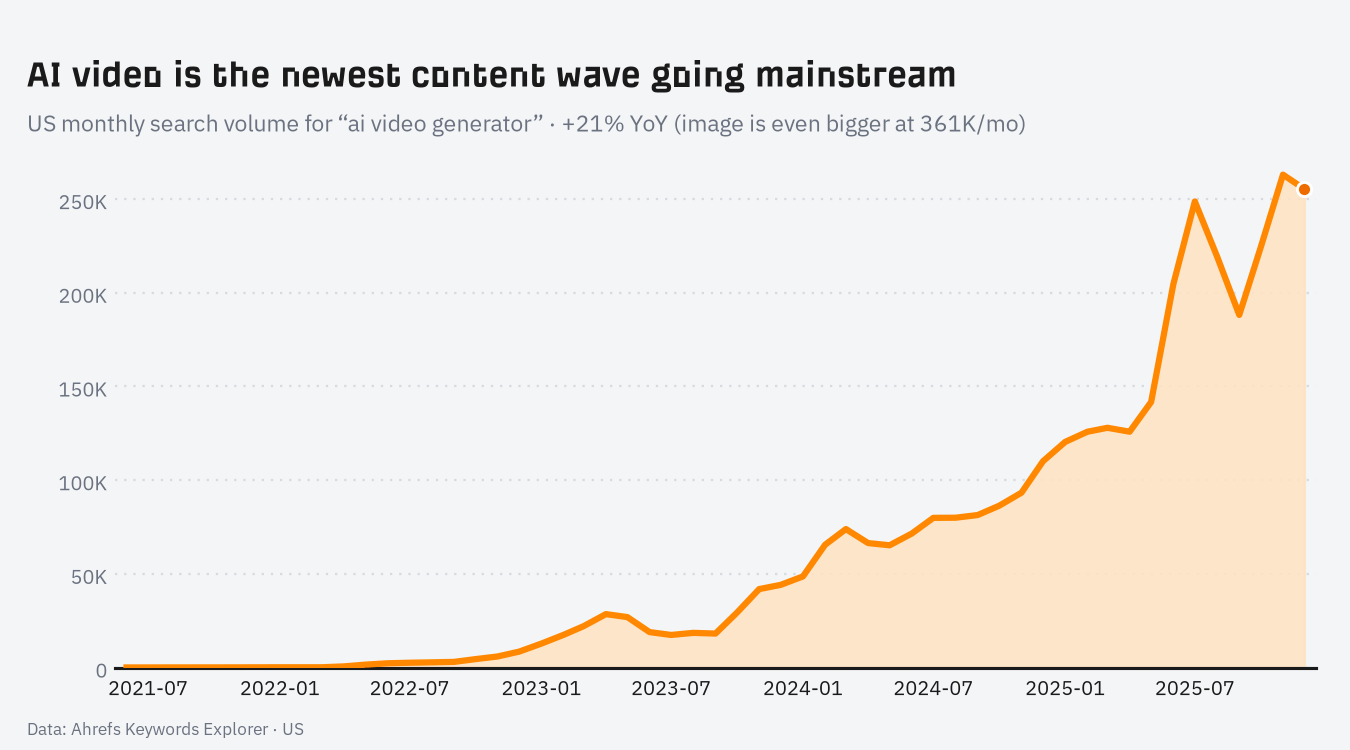
Monthly US search volume for “ai video generator,” the newest AI content wave (image is even bigger at 361K/mo).
Further reading
3. A new marketing channel: AI visibility, GEO, AEO, and LLMO
AI search engines have cemented themselves in how we all use the web. Plenty of people now start with ChatGPT or an AI Overview instead of a list of blue links. That shift has created a set of brand-new marketing channels, focused entirely on being visible inside those tools, and you can see the appetite for them in the search data.
The clearest sign is the rise of new disciplines. Generative Engine Optimization and Answer Engine Optimization, GEO and AEO, are the new craft of getting cited and recommended by AI answers, and they are not going anywhere. Searches for generative engine optimization are up 84% year over year to 7,200 a month, and the whole cluster of related terms is climbing with it.
Alongside the disciplines, an entire industry of AI visibility tools has appeared, almost all of it born in 2025. The numbers are steep: searches for ‘ai visibility tools’ like Ahrefs Brand Radar are up 266% year over year, ‘ai visibility tracker’ up 156%, and ‘ai visibility’ itself up 145%.
So while we will spend part of this article on channels that are waning, and Google traffic in particular is down, the more useful story is the opposite. New channels are opening up, the ground is still wide open, and everyone is racing to be the first and the most visible inside them.
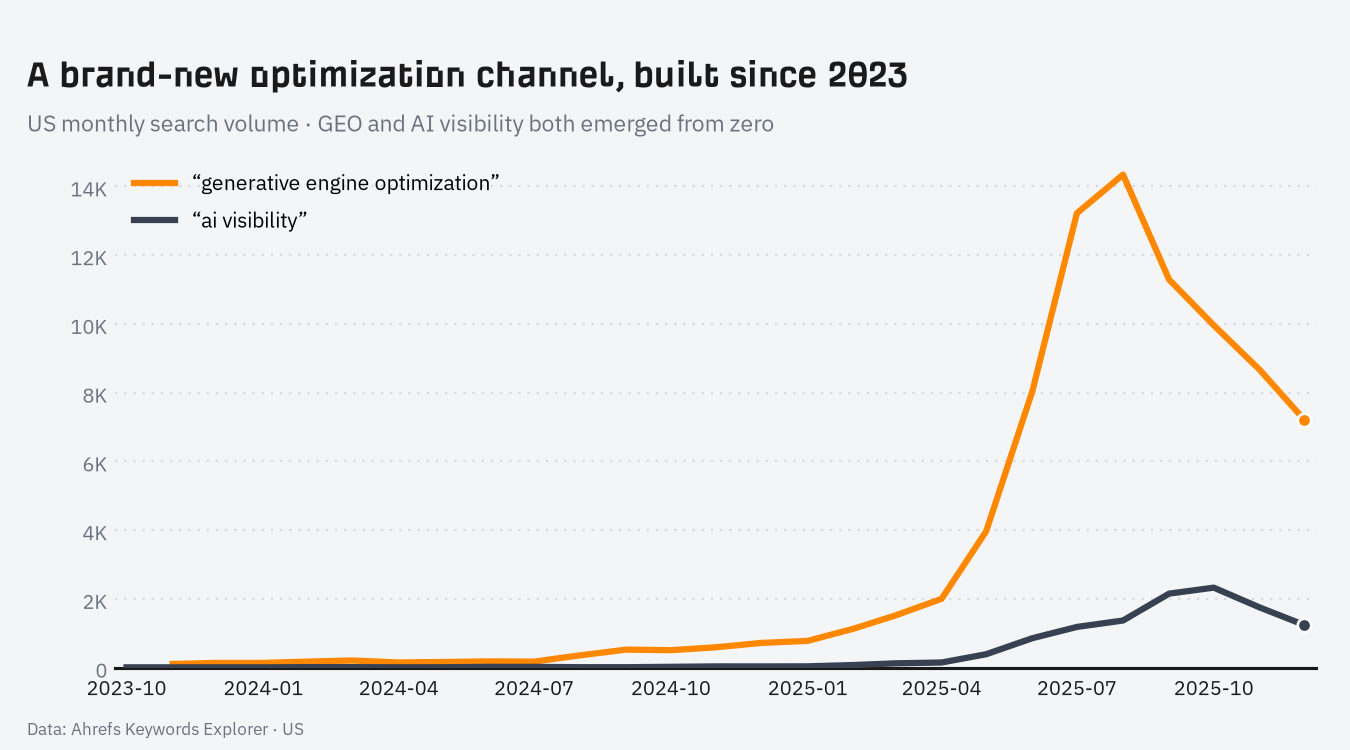
Monthly US search volume for GEO and AI visibility, both emerged from zero since 2023 (Ahrefs Keywords Explorer).
Track your brand’s visibility in AI answers with Brand Radar
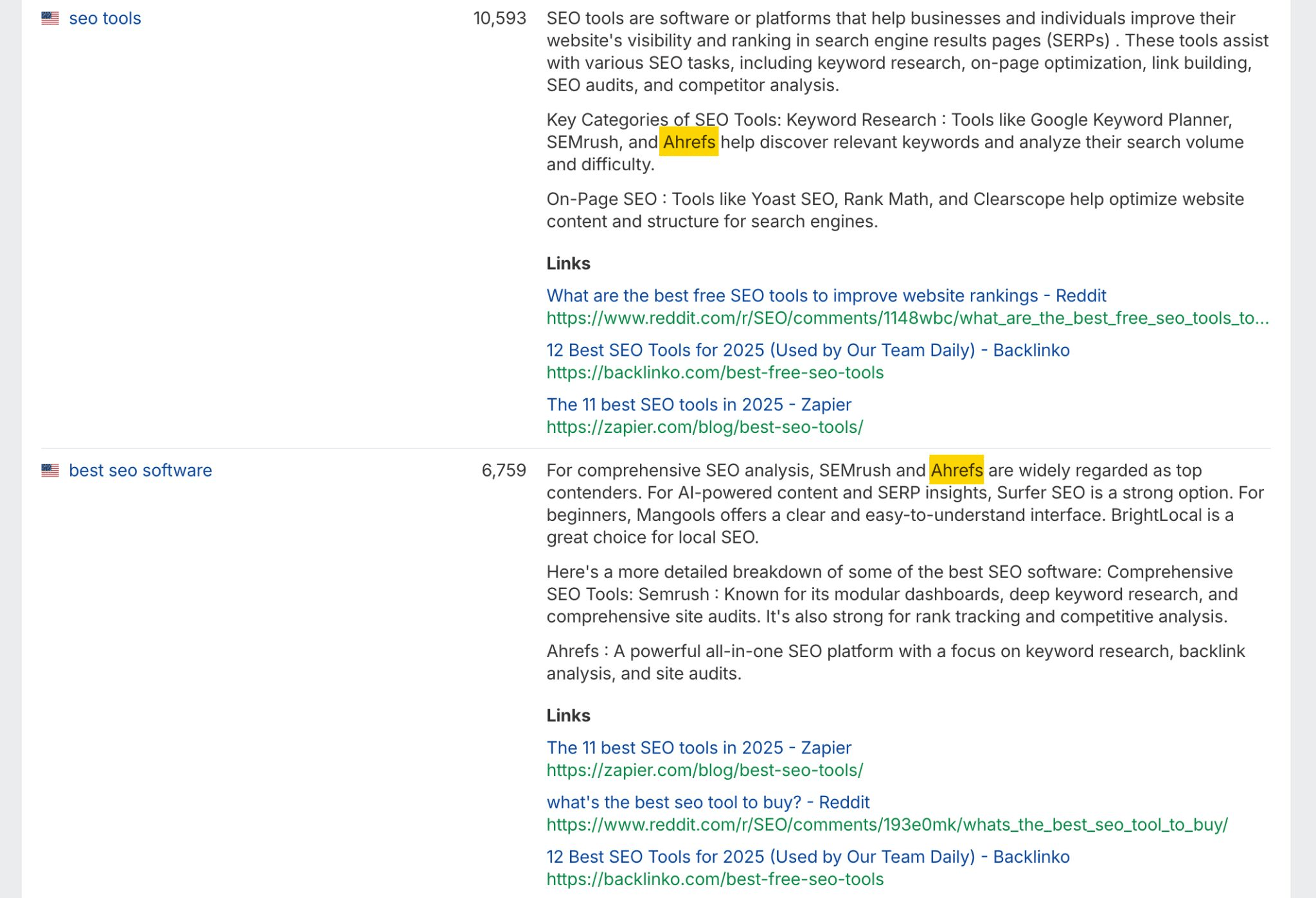
Brand Radar is built for exactly this new channel. Point it at your brand and you can see which prompts and keywords trigger AI-generated mentions of you, which competitors get named instead, and how often each AI engine cites your pages as a source. A practical way to start: track the handful of questions your buyers actually ask, note where you are missing from the answer, and use those gaps to prioritize the content and digital PR that will get you cited. It is the closest thing there is to a rank tracker for AI answers.
Further reading
4. Agentic everything: marketing, commerce, and search that takes action
With agentic harnesses, skill files, and steadily better capabilities, something that felt like a pipe dream a year ago is now genuinely feasible: AI agents can research and buy products on a person’s behalf.
Almost every major AI tool now has a browser built in that the model can control, so it can move around the web, compare options, and complete a purchase without a human clicking anything. And websites are starting to make themselves accessible to these agents, the same way they optimize for human visitors.
You can see the appetite in the search data. ‘Agentic ai’ is now a 111,000-a-month search term, up 37% year over year, with ‘ai agents’ at 46,000 a month and agentic commerce climbing too. Marketing to agents specifically is still the frontier: terms like ‘marketing to ai agents’ and ‘agent experience optimization’ barely register yet and only appeared in 2025. That is rather the point. It is brand new, and mostly unclaimed.
We’re seeing more of the buying process moving inside the model and out of the buyer’s head. As marketers, that changes our job. We still have to persuade people, but increasingly we also have to persuade the agents that research and recommend on their behalf. It is worth starting to prepare for that now, while almost nobody else is.
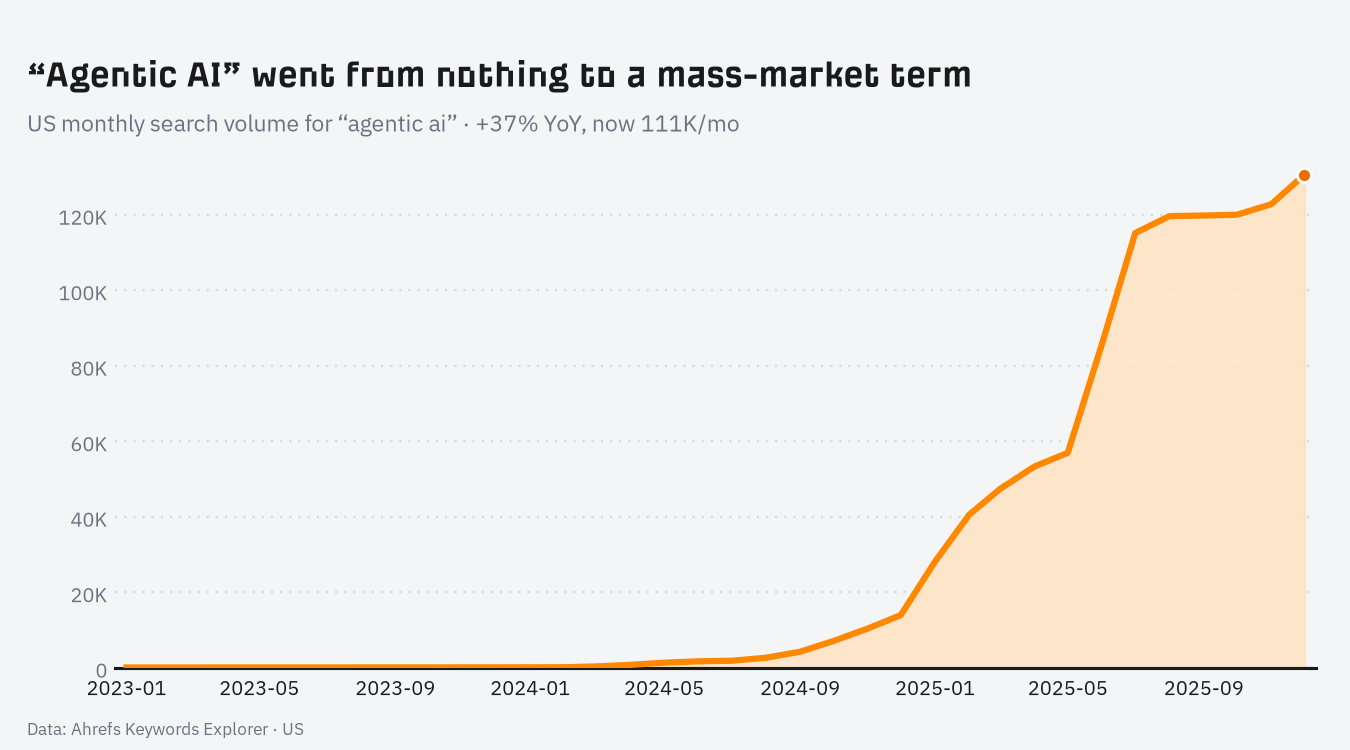
Monthly US search volume for “agentic ai,” up 37% year over year to 111K/mo.
Further reading
5. Build vs. buy: it’s never been easier to build your own tools
Every business has always faced the same question: buy a tool to solve a problem, or build one yourself. Building used to lose almost by default, because it meant developer time, ongoing maintenance, and support you probably did not have.
But that has changed. It is now close to trivial for an individual marketer to build the exact tool they need, shaped the way they want it. The demand shows it plainly: ‘claude code’ is a 508,000-a-month search term, ‘vibe coding’ 86,000, ‘cursor ai’ 83,000, and ‘lovable’ 23,000 despite not existing before 2024. These are not developer-only tools anymore.
We have felt this at Ahrefs directly. Using Letaido, I have built dozens of custom tools, and in a few cases retired paid products I was already subscribed to in favor of something I built to fit exactly. I recently cancelled my Squarespace subscription and moved all of my personal sites to static sites managed by AI. None of that needed a developer.
For marketers selling software, this changes how you position. When your prospect could build a rough version themselves in an afternoon, you need a clear reason to buy instead, the things a vibe-coded tool cannot easily match. And you need to make your product easy to plug into whatever they have already built. Being hard to replicate, or being the best thing to integrate with, is the new moat.
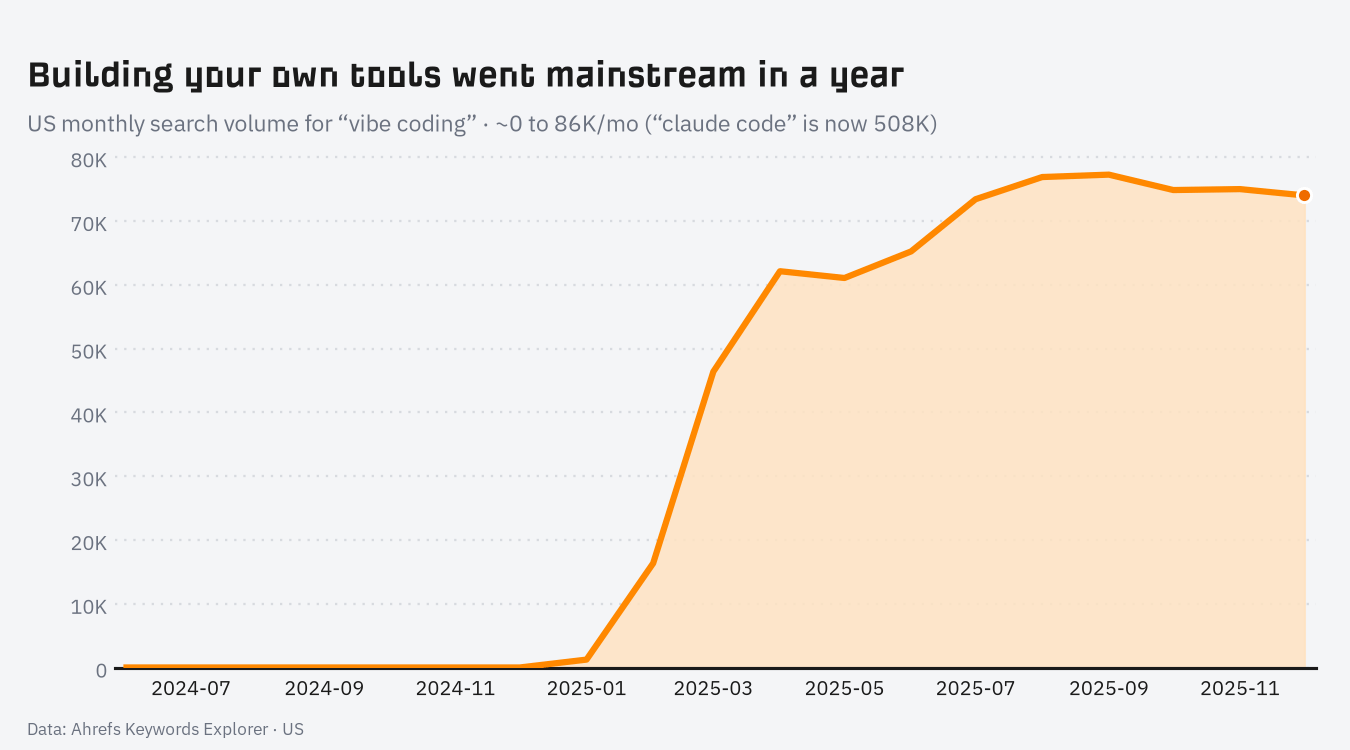
Monthly US search volume for “vibe coding,” from near-zero to 86K/mo in a year (“claude code” is now 508K).
Further reading
6. Attribution gets harder: AI influences buyers without leaving a trace
Marketing attribution has always been shakier than people admit. Even SEO, one of the more measurable channels, was never as clean as the Looker dashboards suggested: there are always halo effects and second-order consequences you cannot trace back to a single source. But attribution is more opaque now than it has ever been, and AI is the reason.
Google increasingly keeps people on its own results, surfacing answers from websites without sending an attributable click back. Our study found that AI Overviews cut clicks to the top-ranking result by 58%. ChatGPT and the other AI engines do the same thing: they take your content, hand the useful parts straight to the user, and never tell you who read it.
In a cohort of roughly 75,000 sites, Google’s share of referral traffic fell from 35% to 24% in about a year, and the AI tools picking up that influence send almost nothing you can measure. ChatGPT accounts for 0.32% of referrals and carries essentially the entire AI category, while Claude, Perplexity, and Gemini are—in traffic terms, at least—still basically rounding errors.
But consumer demand has not gone away. If anything, it may be larger, because people can research and buy faster and more autonomously with AI. But you cannot lean on attribution the way you used to. Much like the shift to vibe marketing, you increasingly have to trust the vibes of your own marketing, use your judgment, and stop treating the attribution dashboard as the whole truth.
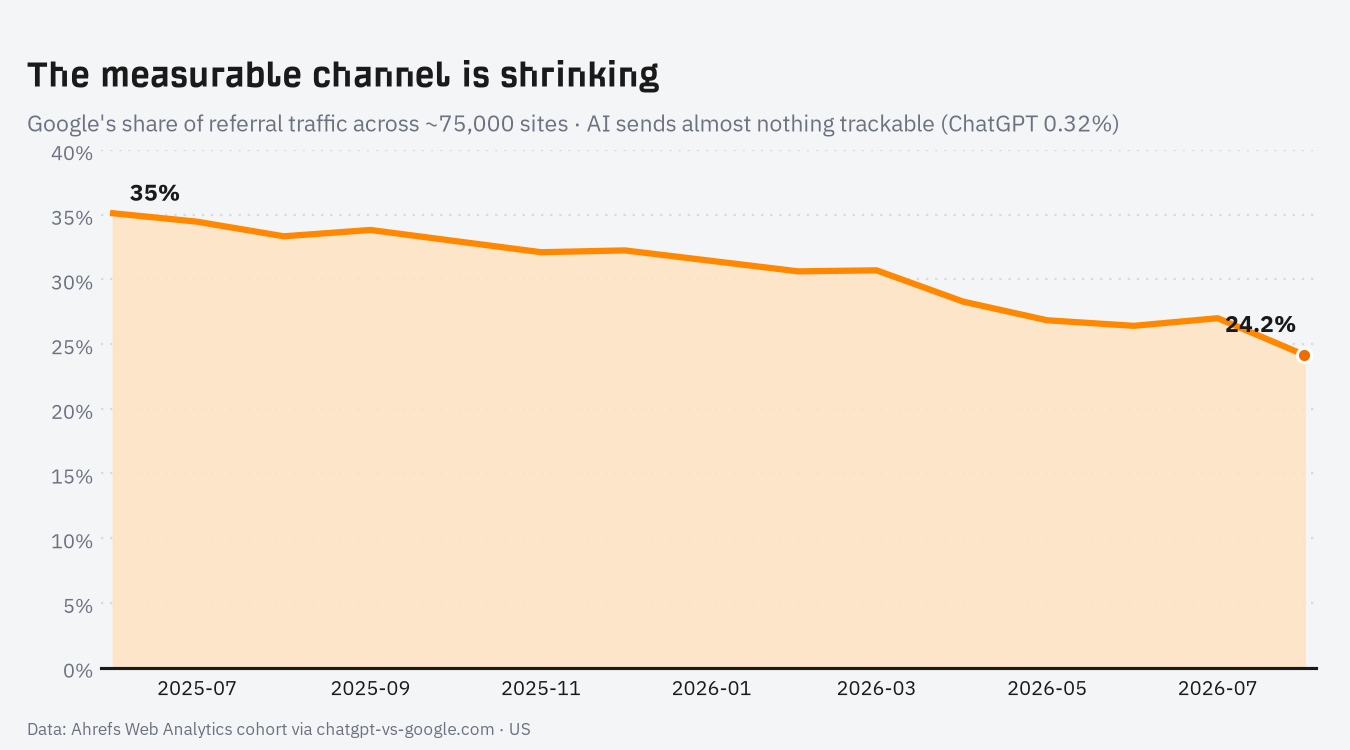
Google’s share of referral traffic across ~75,000 sites, falling from 35% to 24% while AI sends almost nothing trackable (Ahrefs Web Analytics cohort).
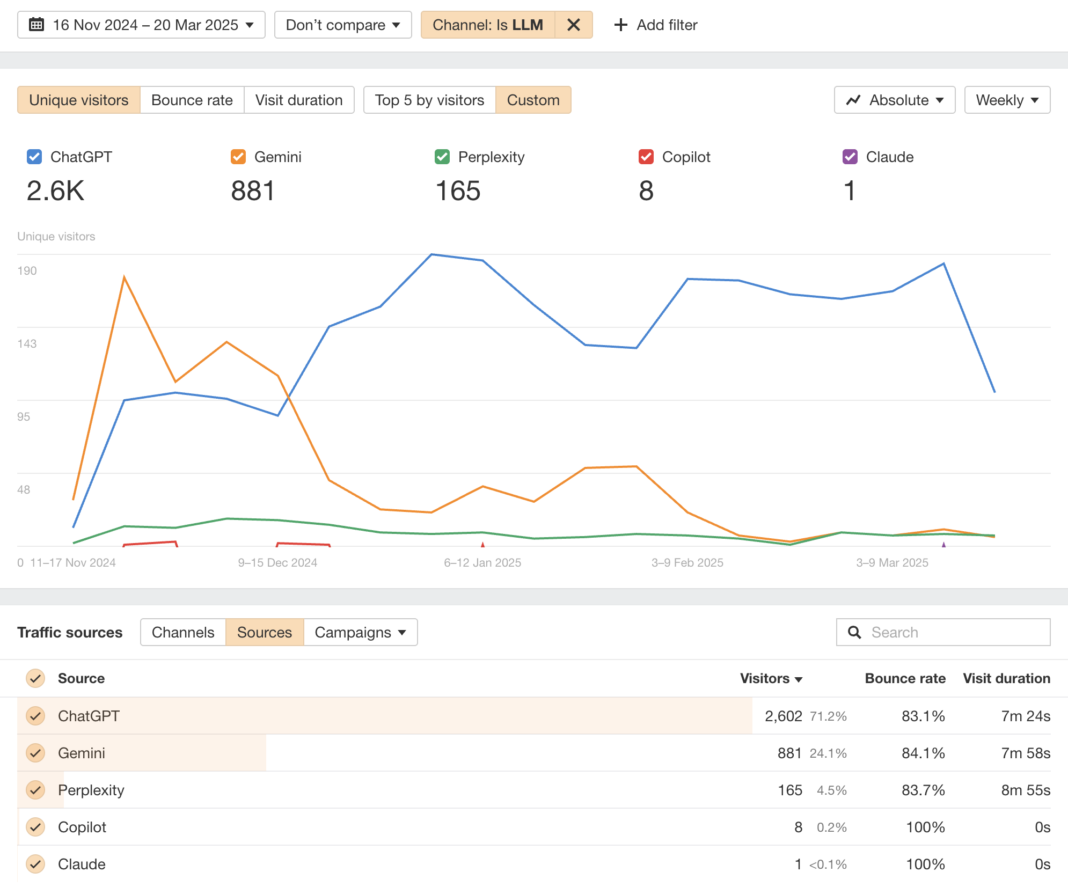
Measure your AI traffic with Ahrefs Web Analytics
Web Analytics is a free, privacy-friendly way to claw back some of that lost visibility. Add the LLM channel filter and you can see exactly which AI platforms are sending you visitors, how that traffic is trending week over week, and how engaged those visitors are next to your other channels. It will not capture every bit of AI influence, because so much of it never produces a click, but it turns an invisible channel into something you can actually watch and report on. Check it monthly to spot which content is starting to earn AI referrals, then do more of what works.
Further reading
7. AI-native tactics: synthetic UGC, avatars, and influencers
A big part of good marketing is picking your tailwinds: moving spend away from channels with diminishing returns and toward the ones that are growing on their own, ideally the ones that compound over time. Right now, some of the clearest tailwinds are the new AI-native tactics riding on top of the new AI channels.
Two stand out: AI influencers and AI-generated UGC. Rather than paying a creator for every video, brands are generating synthetic creators and user-style content at close to zero marginal cost. You can see the demand in the search data. Searches for ‘ai ugc’ are up 36% year over year, ‘ai avatars’ up 13%, and ‘ai influencers’ up 12%. The volumes are still small, but the direction is clear and steady.
It is early, and a fair amount of it looks cheap today. But the economics are difficult to argue with. Once you can produce endless on-brand creative and a tireless synthetic face for your brand at almost no cost, performance teams measured on output and spend will find it very hard to say no. This is one worth experimenting with before your competitors make it look normal.
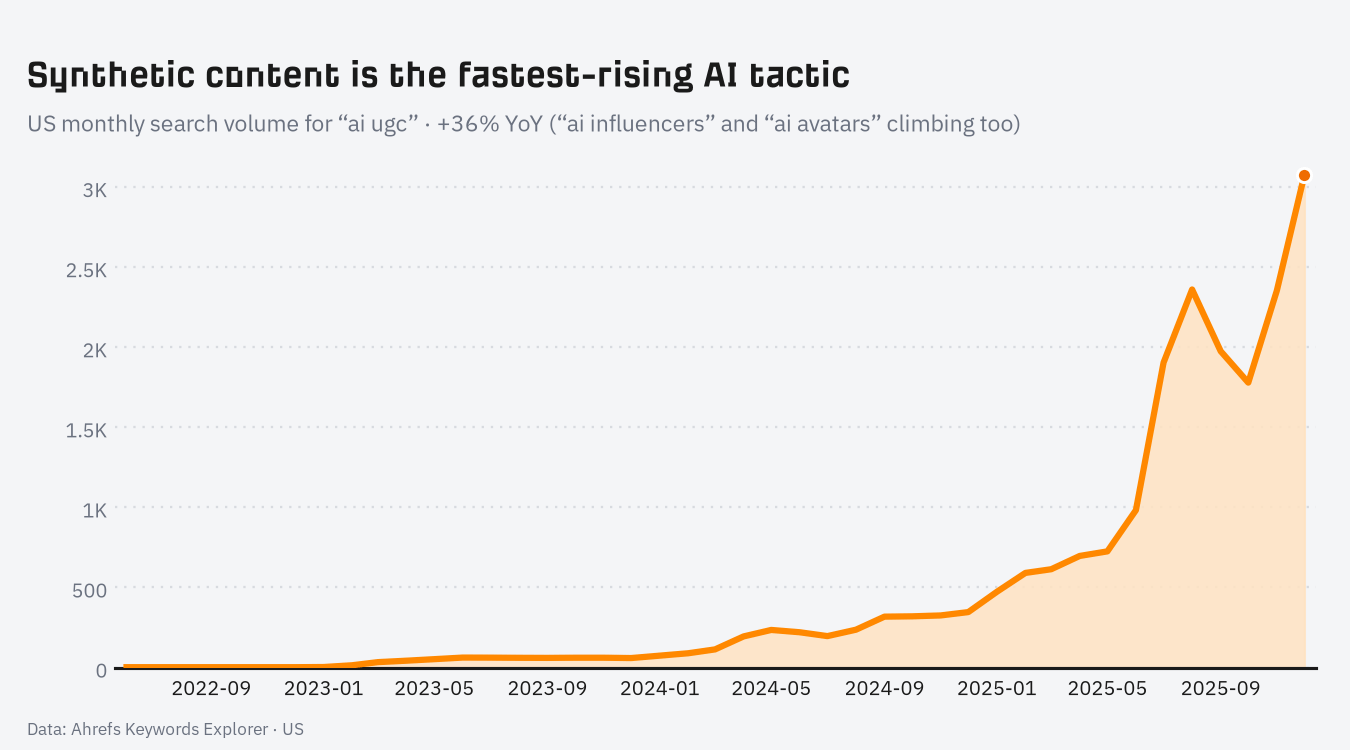
Monthly US search volume for “ai ugc,” up 36% year over year.
Further reading
8. Marketing gets more cross-functional as AI blurs the lines
Generative AI is quietly forcing marketing teams to work together in a way they mostly did not before. AI visibility, whether you show up in ChatGPT, AI Overviews, or the rest, is not the output of any single team. It is the combined result of work that has traditionally been split across siloed departments.
Break down what actually feeds AI visibility and you can map each piece to a different department. Whether an AI recommends you depends on your content (does it answer the question well), your SEO (can it be found and is it topically authoritative), your digital PR (is your brand mentioned and cited across the web), and your paid and brand marketing (do real people search for you by name). Developers sit underneath all of it, making sure the site is accessible to AI crawlers in the first place. No one department owns more than a slice.
There is no AI marketing playbook yet. It is still being written, in public, by everyone at once. There is no AI marketing department either. New roles and functions will keep emerging, some will merge, and some will disappear. In the meantime, the practical move is to get comfortable working shoulder to shoulder with your counterparts in the teams you used to just hand off to. The brands that figure out how to pull SEO, PR, paid, content, and engineering in the same direction will be the ones that show up when it counts.
Further reading