

This post was originally published on this site.
When Rebecca Knaak’s stoppage-time winner flew into Liverpool’s net on Sunday, ensuring Manchester City had one hand on the Women’s Super League title, manager Andree Jeglertz’s mask slipped.
Captain Alex Greenwood leapt into his arms and the usually cool Swedish boss could no longer contain his excitement and relief.
It was an early celebration of their first WSL title in a decade, which arrived three days later when Arsenal failed to beat Brighton.
When City’s success was confirmed and the celebrations began in a room at the Joie Stadium where the team had been watching the match, Jeglertz called Greenwood over, smiled and said: “We did it.”
It was understated – but ever since he was a young football fan watching Swedish side Malmo, the former trainee school teacher has never been one to get carried away.
To play this video you need to enable JavaScript in your browser.
This video can not be played
Growing up in Malmo, a city in southern Sweden, he played street football with other kids and lived next door to an Englishman who encouraged him to watch the Premier League on TV.
Like most children in that region, Jeglertz was in a football club by the age of five, and in that “safe environment” he grew up obsessed with sport, unlike his younger brother.
“[He] wasn’t competitive – he played football but he didn’t have that big interest in it like I had,” Jeglertz says. “I always wanted to train a lot and have always been a very determined person. I thought: ‘I want to be on this level, I want to reach this.’
“I wanted training to be a proper format, not just to do things randomly – I’ve never been good in that. It has to be with some structure. It’s still like that.”
The 54-year-old watched local team Malmo with his father and was in the Munich stands when they lost 1-0 to Nottingham Forest in the 1979 European Cup final.
“My dad is a big football fan. He played when he was younger so we went to a lot of games in my hometown,” he says. “I remember watching games in the stadium and we went every weekend. It’s always been a part of my life.”
When Jeglertz became a professional he played for Malmo, but soon realised he would not make it to the top, despite earning three caps for Sweden Under-21s.
It was then that he began studying to become a teacher, taking after his mother and following his “curiosity to get to know people”.
“When I realised I was not going to be as good as I had hoped for, that was tough – but I really loved the sport,” he adds.
“I educated myself as a teacher. I really loved the relationship between people and wanted to combine that, so continue working inside football and with people.
“Coaching was quite natural to go into. I was interested in the game already and I was always captain or had a leading role.”
Outside of football, Jeglertz is a devoted father. He married former footballer Ulrika and they have two children – daughter Cornelia and a son, Adam.
When Cornelia was a baby, the Jeglertz family moved to Umea in eastern Sweden and into a small neighbourhood two miles outside the main city.
It was where Jeglertz took on his first major managerial role, going on to win the Champions League in 2004 with a squad that included Brazil legend Marta.
 Getty Images
His work took the family to Stockholm five years later as Jeglertz took over at Djurgardens, before becoming Finland’s head coach, and later Denmark’s.
“He’s still only my dad – he’s not the famous coach that he is to other people,” says daughter Cornelia. “To me, he’s a very caring and a very present dad, even though we have lived in different countries and cities for many years.
“He’s very interested in me and my friends. I think it’s a privilege that we have been able to follow him around, see his accomplishments and see the world.”
Before sitting down for his interview with BBC Sport, Jeglertz says he saw his family a week before. They travelled to Manchester and had dinner in the Ancoats area.
It has become a frequent spot for the curry-loving Jeglertz, who has also taken classes to study wine culture and its relationship with food.
Friend Lars-Gunnar Skoog, a fitness coach who worked with Jeglertz for 10 years, still keeps in touch with him and describes him as “very sociable”.
“He has a terrible taste in music – he doesn’t know who Taylor Swift is. He only knows really old artists,” Skoog jokes.
“He takes care of his family but when he is home, he still likes to train. We do running and strength training together.
“When we were at Umea, we went to Turkey every year for pre-season training. All the coaches would run together at 7am. I told him we had to run slower but he would push everyone and we all got injured. We blamed him!
“But we had lots of good memories. When he comes back to Umea, he will call all of us and get us together for a big dinner.”
Jeglertz is known for his calmness and level-headedness. He is light-hearted in public, often seen posing for photos with fans, and is always engaging with media.
For January signing Sam Coffey, it is part of what makes her boss successful.
“He’s a funny guy,” she says. “He’s really secure in himself. When you have that in a manager, it gives you security as a player.
“He’s very calm and composed but also drives really high standards for us. He’s tactically really smart and just a really good person.
“He cares a lot about every person on the team. When you have a manager like that, I think you see it in the results.”
He rarely gets carried away in the dugout. Even as a child watching Malmo in the stands, Jeglertz says he was calm, and is the same in front of his children.
“I have never seen him differently. Of course, he can be angry, like when I was a kid and being naughty. But not in a way that I can remember,” explains Cornelia.
“He’s always been very careful with how he puts his words out there so it doesn’t hit strongly. He’s careful so that everybody can feel seen and feel good around him.”
When it comes to Manchester City, Jeglertz admits he has a “little bit more feelings” than he shows, but has learned to hide them.
Speaking in January, he said: “One of our biggest jobs as coaches is to balance the team’s emotions. If the players are frustrated or feel they are disappointed, I have to be the positive person and the one picking them up.
“If we are scoring and doing well, I need to be the balanced one. That is one of my key things. The players need to know I’m almost always the same person.”
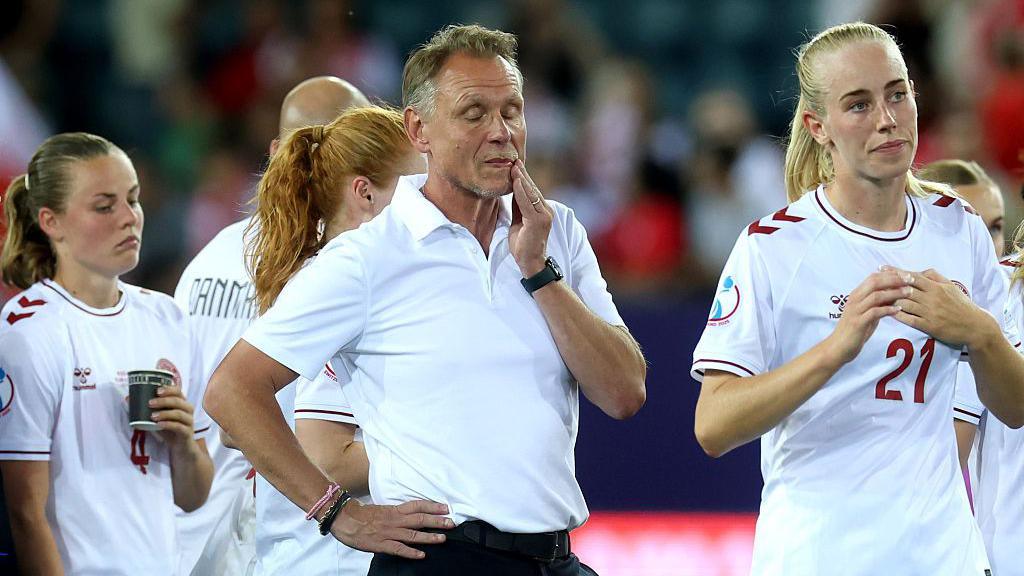
But Skoog, who lived with Jeglertz for two days a week during their time working together at Linkoping, has seen how the Swedish coach really reacts to defeat.
“He is very professional in the media and after the games in the dressing room. But when he came home, he would be sad and analyse the game again,” Skoog says.
“He looked at what he did wrong and what he could do differently. Andree’s coaching career has been 80% successful so he hasn’t had too much failure. He is not as used to it.”
 Getty Images
Manchester City vice-captain Kerstin Casparij has described Jeglertz as the “papa” of the group, emphasising his ability to make everyone feel part of the family.
The boss encourages players to speak up in meetings, contribute to tactical gameplans, and urges them to express themselves on the pitch.
“He’s someone I can go to about pretty much anything and he’s the same with everyone. It’s not just me because I’m the captain,” Greenwood says.
While at Linkoping, Skoog says Jeglertz would leave the house at 7am and get home at 6pm, working extra hours on training plans and video analysis.
Within two weeks, “players loved him” because of his commitment and took confidence from his detailed plans.
“His whole life is football – he is obsessed with it. He would speak on the phone with players and watch games. He is a perfectionist,” Skoog says.
“Maybe why he has been so successful as a coach and why the players love him, is because he gives 110% always.
“He talked a lot to the players and listened to them. If they said something good, he let them try it on the pitch. He was not dictating things.
“The players felt they could have input in the training sessions because he listened. It wasn’t like that before he came – players weren’t used to that.”
Much like his approach to life, Jeglertz’s football philosophy centres on people and getting the best out of everyone.
To him, players need to be decision-makers on the pitch. They need to be unpredictable, creative and flexible. But most of all, they need to be a team.
“There was always a strong team spirit. In Umea, the other teams hated us. It was us against them, always. He was good at making us feel strong together,” Skoog adds.
Jeglertz has always loved Dutch football and was a fan of Johan Cruyff. He reads books by other coaches and is constantly testing new methods.
He became more interested in physical fitness and adopted a 4-3-3 formation, which he has developed while at Manchester City.
“Andree was a modern trainer. He was very accurate with his planning of every training session,” Skoog reflects of their time in Umea in the mid-2000s.
“Every session was like they were playing the game. He was very serious. He had a great ability to push players – if they became lazy, he would push them.
“It was high quality training. He started off with video analysis and we would talk a lot about football in the evenings.”
Greenwood says Jeglertz “demands high standards” every day at City and that has helped them develop a winning mentality.
“Everyone feels very comfortable to be themselves. It’s the safest dressing room and everyone feels comfortable to have their say,” said Greenwood.
“Andree is a really calm guy but at the same time he is really intense. His door is always open and he really understands the human level and that’s really important, especially with women.”
Jeglertz has enjoyed his first season in charge at City, joking that the 3-2 win over Arsenal made him feel 10 years older and that he was left speechless after their impressive 5-1 win against Chelsea in February.
He was at the Joie Stadium on a night off in November to watch England Under-23s, which included some of City’s youngsters, and signed autographs for fans.
His pre-match team talks have been recorded and posted publicly on the club’s website each week and his family have been gearing up to celebrate City’s success, glued to the TV throughout April and May to watch their games.
“I have never seen so many articles and so many pictures of him,” Cornelia says. “It’s talked about so much more than it was before. I think that’s great to see so much women’s coverage – it is a big change.
“I think that makes me more proud, that he’s part of that change.”
Jeglertz’s impact has been instant but he is keen to learn and hopes to enjoy more success in the future.
“A happy football player, is a good football player, he says. “This is their life. They are fortunate to work with their hobby. The best teams, that succeed, are ones that enjoy going to work.
“You can have success one year but if you want to build something for the future you need to create an environment where everyone says: ‘Wow, I don’t want to go home from work’.
“When I look back on my coaching career, I would like to have been working at the highest level always. I hope to have met different people that enrich my life.”