

This post was originally published on this site.
 Getty Images
It feels like this Premier League season has been defined by set-piece drama.
Not just the goals that have been scored, but the constant grappling, pushing, pulling and wrestling.
It appeared to reach a head in February, when about 15 Manchester United and Everton players camped inside the six-yard box.
Players were being thrown to the floor before the ball was in play. It was carnage.
“You get the feeling now that referees really don’t want to get involved in any of it,” Everton manager David Moyes said.
Do not be fooled into thinking this is just a Premier League problem.
BBC Sport recently attended an event with Roberto Rosetti, the head of Uefa’s referees.
The first thing the Italian concentrated on was examples of goalkeepers being pressurised at set-pieces.
Arsenal have been the kings of it, crowding and surrounding goalkeepers at corners, finding ways to create space and score from set-pieces.
Fast forward to Sunday, and the season-defining VAR intervention which had major repercussions for Arsenal‘s title chances – and West Ham‘s hopes of remaining in the Premier League.
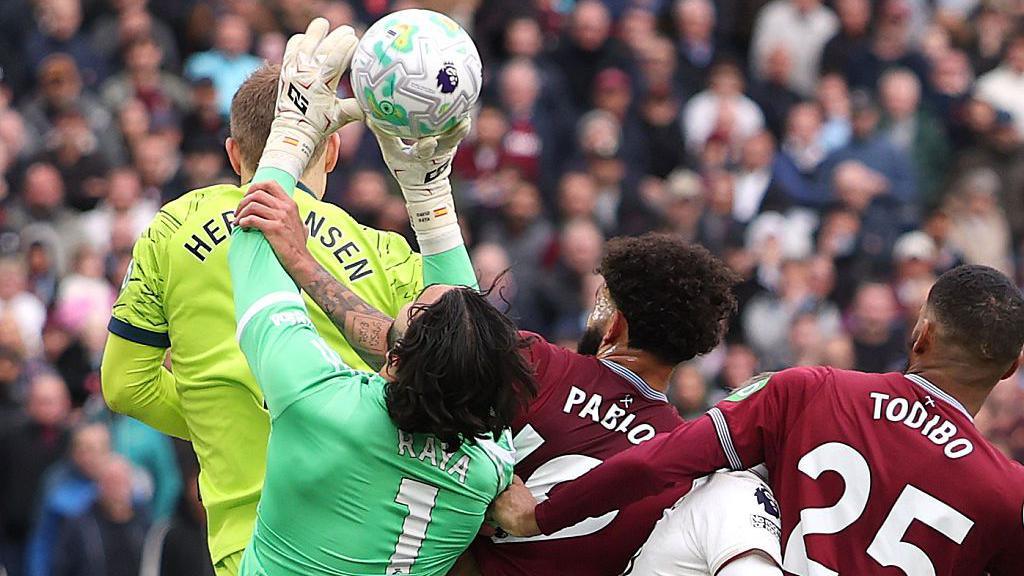
There was pushing and pulling going on all over the place, but Pablo was penalised for a foul on Arsenal goalkeeper David Raya. The VAR intervened to disallow it, and the Gunners claimed a crucial 1-0 win.
Considering the Gunners’ set-piece prowess this season – 21 of their 68 league goals (31%) have come this way – there was a certain irony that such a defining moment resulted in the opposition having a goal ruled out.
Breaking down the disallowed goal – and the five ‘fouls’ in the build-up
To play this video you need to enable JavaScript in your browser.
This video can not be played
Jarrod Bowen stood over the ball by the corner flag. There was so much going on in the penalty area as he delivered a cross.
A melee ensued before Callum Wilson blasted a shot over the line. Salvation for the Hammers? Enter the video assistant referee, Darren England.
You cannot blame the VAR for taking his time. This was such a huge moment with five potential fouls buried among the bodies.
Whatever decision England made was going to be the subject of intense scrutiny.
Let’s break it down step-by-step, consider the potential fouls and what the VAR would be looking for.
Soucek on Havertz
In the chronology of fouls, this was the first potential incident.
The two players were at the near post, with Kai Havertz in front facing the ball. Tomas Soucek was climbing over the back of the Germany international.
As the ball was in the air, the Arsenal forward ended up on the floor with Soucek on top of him.
The VAR will take into account that the players were not in the area where the ball was going to land – Havertz was not going to be prevented from playing it.
That Soucek was facing the ball goes in his favour, too.
All in all, the VAR would have allowed this to go.
Odegaard on Tobido
A straight-forward situation to judge.
Both Martin Odegaard and Jean-Clair Todibo were engaged in mutual holding. When this is the case no one party is judged to be committing an offence – essentially, they are both as bad as each other.
Odegaard had an arm round the waist of the West Ham attacker, who had his arm around the Norway international’s shoulder.
Trossard on Pablo
The battle between Leandro Trossard and Pablo started just outside the six-yard box as the ball was kicked.
They were both holding on to each other at first before Pablo tried to make a run towards goal.
This was when Trossard, with his back to the play, grabbed Pablo around the waist.
Based on what we have seen this season, it was not enough for a penalty as Pablo was able to move to the flight of the ball and was not dragged down.
However, this was the incident which may have been of most interest to the VAR outside the foul on Raya.
Pablo on Raya
After moving into the six-yard area under pressure from Trossard, Pablo engaged with David Raya.
Crucially, he did so in a way which impeded the goalkeeper from being able to claim or play the ball.
Pablo had his arm directly across the Spain international, and was holding the goalkeeper’s left arm with his hand.
This restricted Raya in two ways. His right arm was pinned down by Pablo’s left biceps, and his left forearm was being held too.
For the VAR, this clearly impacted the goalkeeper’s ability to play the ball.
Tobido was pulling the back of Raya’s shirt, too, but it was Pablo committing the crucial foul.
Rice on Mavropanos
Declan Rice had his arms around the waist of West Ham‘s Konstantinos Mavropanos.
There was the potential for this to be a penalty, as it was a clear non-footballing action.
However, it happened almost simultaneously with Pablo’s challenge on Raya.
The foul which had the material impact on the passage of play was prioritised.
And that was Raya’s attempt to play the ball.
Other incidents this season, explained.
 Getty Images
For all the talk about jostling and pushing, West Ham‘s is the only goal to be ruled out for it on VAR review this season.
Four goals have been chalked off for a foul, but not for this reason.
Seventeen penalties have been awarded for pulling and holding this season, five of them through VAR. Three more spot-kicks should have been given through missed VAR interventions.
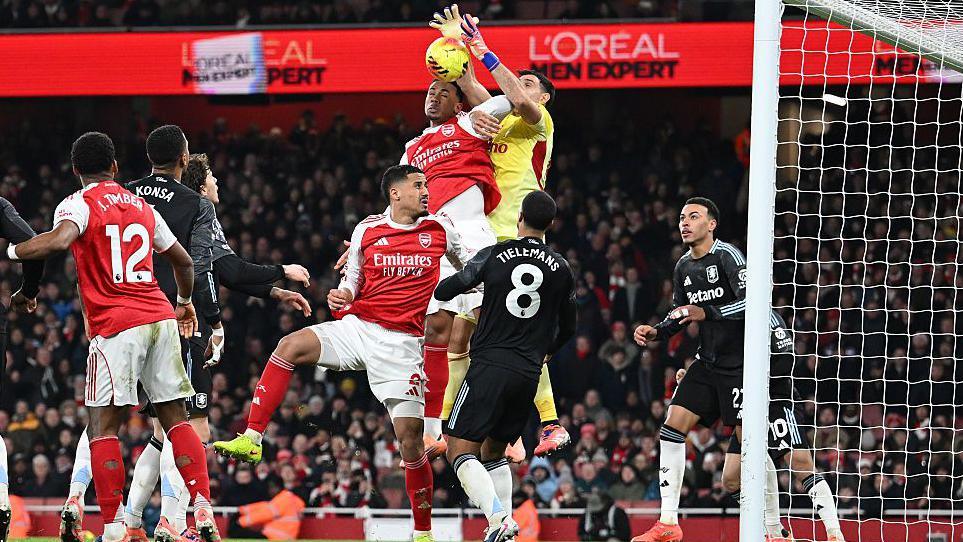
Much has been made of similar incidents this season, two involving the Gunners.
Man United 0-1 Arsenal: Saliba on Bayindir
Arsenal scored from a corner when William Saliba put an arm on the chest of Manchester United goalkeeper Altay Bayindir. The France international was clearly putting pressure on him.
Saliba briefly touched the arm of Bayindir but only when the ball was in flight, and not in any way which prevented the keeper from attempting to reach the ball.
The key match incidents panel said: “There is contact between all the players around the goalkeeper but there is no pushing or holding offence by the attacking player.”
Arsenal 4-1 Aston Villa: Gabriel on Martinez
The Gunners scored the opening goal from a corner, as Gabriel jumped with Emiliano Martinez with his elbow raised.
There may have been a small amount of contact on the goalkeeper’s arm, but it was not judged to be impactful.
With no holding or clear restricting of movement, the key match incidents panel said there was “no foul”.
Man City 3-1 Bournemouth: Brooks on Donnarumma
Bournemouth‘s David Brooks was holding the arm of Manchester City‘s Gianluigi Donnarumma, who then flapped at the ball before Tyler Adams scored.
Crucially, Brooks released the hold on Donnarumma before the Italian tried to challenge for the ball.
The key match incidents panel said that Brooks “lets go as the ball comes across” and therefore “the panel supported the referee’s call of goal”.
Where did it start and is this a problem elsewhere?
Tony Pulis and Sam Allardyce were early to prioritise set-plays, before Sean Dyche figured out the current blueprint, albeit with less success than Arsenal have had.
Arteta’s Arsenal and the tactics they have used have paved the way for how corners have dominated the Premier League this season.
Allardyce’s approach was heavily data-led. He would position his players in zones where the ball mathematically had the highest chance of landing.
Pulis and Allardyce’s focus on corners was a smart allocation of time and resources but the routines lacked some of the ingredients Nicolas Jover, ex-Brentford and current Arsenal set-piece coach, later introduced.
Corners this season have become most effective as in-swingers played into a crowded six yard box.
Neither Allardyce nor Pulis’s sides crowded the six-yard box as much as Arsenal and the rest of the league now do.
Dyche’s Burnley side of 2019-2020 moved things on. They played crosses into this area, only three or four yards out, while preventing keepers from being able to claim the ball.
Tactically, that Burnley side were ahead of the curve but as with everything in football, player quality matters, as they didn’t score as many goals with the tactic.
For Arsenal, the quality of their crossers in Declan Rice and Bukayo Saka, paired with the aerial threat of Gabriel, is key.
The Gunners’ success caught the attention of the league, with most teams following suit this season, notably Manchester United, Chelsea, and Tottenham.
What might be done?
To play this video you need to enable JavaScript in your browser.
This video can not be played
Lots of grappling happens before the ball is in play, and a referee can do no more than stop the game and order a retake.
This does not really prevent it happening again. And again.
This is not just defenders holding on to attackers. Everyone has been at it, an unedifying trend throughout the campaign.
At the end of every season, PGMO canvasses the opinions of stakeholders – coaches, captains, fans, media rights holders – on issues with how the game is refereed in the Premier League.
It is used to gauge opinion outside of the referees’ own echo chamber, and away from the headlines.
In the past it has led to a tweak to handball, for instance.
This summer, hair pulling and grappling in the box might come up.
Maybe referees will try to clamp down and issue more yellow cards before the ball is in play.
Because right row there seem to be five or six potential fouls on every corner.
Former Premier League assistant referee Darren Cann told Match of the Day that he would make a drastic change.
“I feel that the time has come now for a law change whereby no attackers are allowed in the six-yard box before the corner is taken,” Cann said.
“Lots of teams grapple at corners, sometimes before the ball has come into play, and then obviously the referee can’t give a penalty, can’t give an indirect free-kick, if the ball is not in play.
“So this would create that natural separation and eradicate these kind of situations.”
Another suggestion is to make the play ‘live’ as soon as the ball is placed in the quadrant.
The law change would mean penalties and free-kicks could be given for fouls made before the corner is taken.
It creates a buffer between the set-up of the play, and the ball being delivered into the box.
It could remove the potential fouls as the ball is about to be delivered, as players would need to disengaged for a few seconds before this.
The other option, of course, is that teams change the way they play and stop trying to find the minor gains by pushing the laws to the absolute limit.
That sounds like wishful thinking.