
This post was originally published on this site.
New ‘No 10 North’ plan will rebalance power in Britain, Burnham promises
To play this video you need to enable JavaScript in your browser.
This video can not be played
-
Published
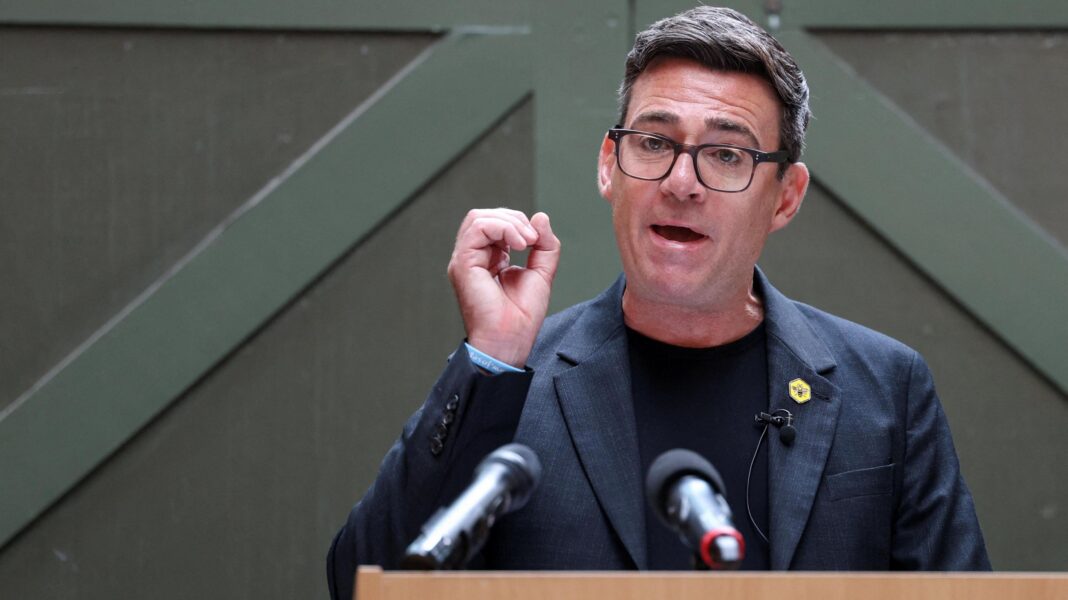
A new Downing Street team based in Manchester and labelled ‘No 10 North’ will “oversee the biggest rebalancing of power our country has ever seen”, Andy Burnham has said in his first speech since launching a bid to be the next prime minister.
In a speech which outlined his broader vision, he pledged to redistribute power across the UK in an effort to “drive good growth in every postcode”.
He also promised the biggest council house building programme since the post-war period; a “complete rethink” of education and cuts to welfare.
Conservative leader Kemi Badenoch said Burnham backed devolution because he “doesn’t know what to do so he wants to pass the problem to someone else”.
Burnham announced his intention to stand as prime minister to replace Sir Keir Starmer last Monday, shortly after being elected as the MP for Makerfield.
So far, he is the only Labour MP to announce, and if he remains the sole candidate he could become the next prime minister as early as 20 July.
Speaking at the People’s History Museum, Burnham addressed an audience which included Steve Rotheram, Tracy Brabin and Oliver Coppard – his former mayoral colleagues from Liverpool, West Yorkshire and South Yorkshire.
He provided an overview of the direction his government would take but did not provide a detailed plan and, unusually for a political speech, did not take questions at the end.
His key message was a commitment to devolving power to local communities away from senior civil servants in Whitehall, which Burnham said had “blocked” progress in Manchester.
“It is time for Whitehall to accept that growth cannot be ordered from the top down – it can only be nurtured from the bottom up.”
He did not spell out what would be given to different areas but suggested regions would see “greater public control of essential services” such as water, energy and transport and that London could have more say over education and housing.
He also said there would be “new opportunities to extend devolution in Scotland, Wales and Northern Ireland by taking power deeper down”.
“The people of Dundee and Bangor feel just as distant from Holyrood and the Senedd as they do from Westminster,” he added.
He argued that distributing power across the country would “give Britain the circuit-breaker it needs”.
The new No 10 North unit would, he said, be the tool to achieve this, making “power flow” across the country and supporting regions in three tasks – reform of essential utilities, reindustrialisation and regeneration.
Labour’s 2024 manifesto promised to roll out devolution powers to new areas and to extend powers in those areas where mayors and combined authorities were already established.
In February 2025, Angela Rayner, then the local government secretary, announced plans for six mayors in Cheshire and Warrington, Cumbria, Essex, Hampshire and Solent, Norfolk and Suffolk, and Sussex and Brighton.
-
What are Andy Burnham’s potential policies for No 10?
-
Published2 hours ago
-
-
Henry Zeffman: Andy Burnham offers a blueprint for his premiership
-
Published6 hours ago
-
One of the biggest rows between Labour backbench MPs and Sir Keir concerned his attempts to cut the welfare bill.
Burnham has previously said he wouldn’t be “squeamish” about reducing the bill and his speech promised to find cuts in a “way that is fair and lasting”, adding: “Where young people need mental health support, that will be provided as part of in-work support.”
He also said employment support could be devolved to mayors and that more help should be provided through the grassroots organisations that “people trust… rather than going to places that they fear”.
Former Labour minister Alan Milburn, who served alongside Burnham in the last Labour government, is currently carrying out a review into ways of getting young people into work.
Burnham said he was taking his findings seriously and that there needed to be a “complete rethink of how we support the next generation to succeed”, adding: “It has to start with the education system.”
He said that the school system should no longer be focused on university, and promised a greater emphasis on technical education.
On tax, he reiterated his plan to change business rates in order to support pubs and high street businesses.
“Rather than being a marker of decline, shouldn’t we make our high streets the symbols of Britain’s renaissance,” he said.
In a bid to reassure the financial markets, he said his plans would be backed by “the stability that comes from sound public finances”, promising a “10 year mission to raise people’s living standards”.
He acknowledged that “people can’t wait forever for change”, saying: “I will do my very best to deliver it, and whilst not taking risks the public finances, will seek to give Britain some breathing space as soon as I can.”
Since Sir Keir’s resignation, there has been speculation about who Burnham will pick for the top jobs in his cabinet, particularly for the position of chancellor.
During his speech, Burnham said he would not make any announcements about appointments until the end of the leadership contest.
This week, Burnham will begin having meetings with the civil service to prepare for the transition of power.
Sir Keir authorised these so-called access talks, which are usually granted to opposition parties ahead of a general election.
Speaking before Burnham’s speech, Badenoch said: “A lot of politicians hide behind devolution because they don’t have any answers.
“So they say ‘why don’t we let local people take it up’ but they don’t give them the real tools for power.
“We have seen so much go wrong because right now politicians have outsourced decisions.”
Liberal Democrat leader Sir Ed Davey said “People have heard this sort of talk before only to be badly let down because nothing changes – Burnham mustn’t repeat that mistake.
“If he’s serious about firing up growth and cutting the cost of living, Burnham must ditch Labour’s old red lines on Europe and take Britain into the single market.”
Reform UK leader Nigel Farage said: “Devolution can work, but if you have a No 10 in the south and a No 10 in the north, they will naturally fight against each other.”
“Devolution can work,” he said but added: “The big national issues that people want to be solved will not be solved by devolution.”
Green Party leader of England and Wales Zack Polanski said: “What is the value of giving local government more powers if it cannot afford to use them?
“Labour has done little to restore council budgets that were slashed under the Conservatives, and Burnham’s commitment today to stick to the so-called fiscal rules ensures continued austerity and cuts to vital services.”
The SNP’s Westminster leader Dave Doogan said there was “nothing of substance for Scotland in these proposals – and nothing that will fundamentally improve people’s lives”.

Sign up for our Politics Essential newsletter to keep up with the inner workings of Westminster and beyond.