
This post was originally published on this site.
Burnham plans to work some days in Manchester as PM
-
Published
Andy Burnham plans to spend some of his working week in Manchester if he becomes prime minister, the BBC has been told.
It is not clear whether he will spend a set number of days there, or whether there will be a more informal arrangement.
But he plans to split his time between Downing Street and the North West, it is understood.
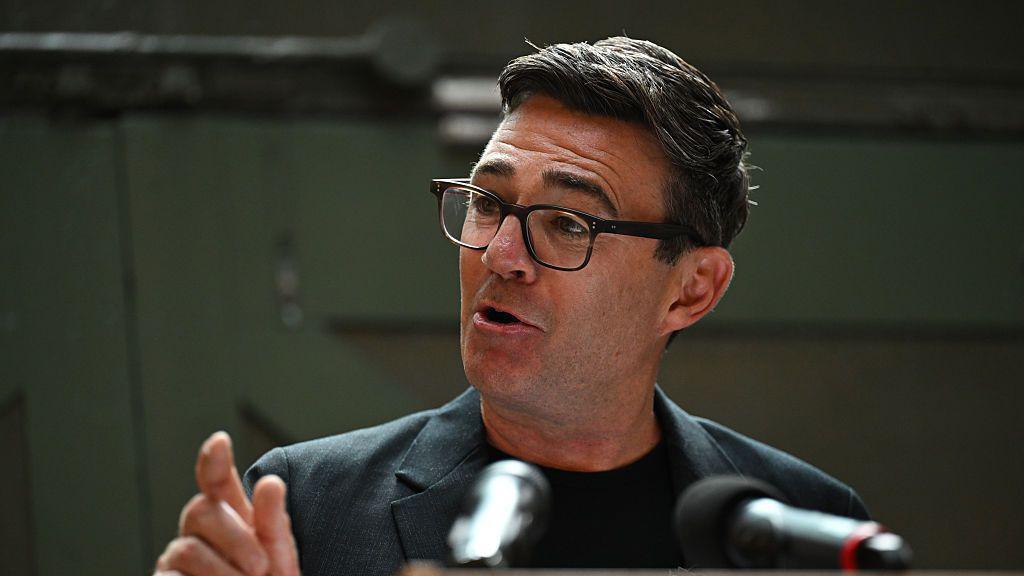
In his first speech since launching his Labour leadership bid, Burnham announced on Monday he would create a new “No 10 North” unit in Manchester if he replaces outgoing PM Sir Keir Starmer.
Burnham’s allies hope his presence in the city would be a strong symbol of his commitment to devolve power away from Westminster.
The former mayor of Greater Manchester announced his intention to stand to replace Sir Keir last Monday, shortly after being elected as the MP for Makerfield.
So far, he is the only Labour MP to announce a leadership bid. If he remains the sole candidate, he could become the next prime minister as early as 20 July.
Past prime ministers, including Sir Tony Blair and Gordon Brown, have spent some time away from London in their constituencies, but those around Burnham say his arrangements would be different to the norm.
If Burnham chose to not to make Downing Street his main home, he would become the first prime minister since Labour premier Harold Wilson not to reside primarily in the famous London building.
Wilson lived in No 10 during his first term in office between 1964 and 1970, but opted to live at Lord North Street, a short walk from Parliament, during his second premiership between 1974 and 1976.
‘Rebalancing of power’
The last prime minister not to live in Downing Street at all was Lord Salisbury at the end of the 19th century.
In his speech on Monday outlining a broader vision of his prospective government, Burnham said the new No 10 North unit would “oversee the biggest rebalancing of power our country has ever seen”.
He said the unit would be tasked with giving English regions more control in several areas, including housing and transport.
He indicated that key economic decisions would be devolved to local communities away from senior civil servants in Whitehall, transferring power from the Treasury to his new team.
“The political direction I set will not be up for negotiation,” Burnham said.
Burnham would not be the first prime minister to try to challenge the centrality of the Treasury’s role in Whitehall.
Wilson in the 1960s attempted to weaken the department by creating the Department of Economic Affairs to handle long-term economic planning – but this ultimately failed.

Get in touch
Do you have any comments or questions about this story?