

This post was originally published on this site.
Eriksen to begin rehab in Denmark after collapse
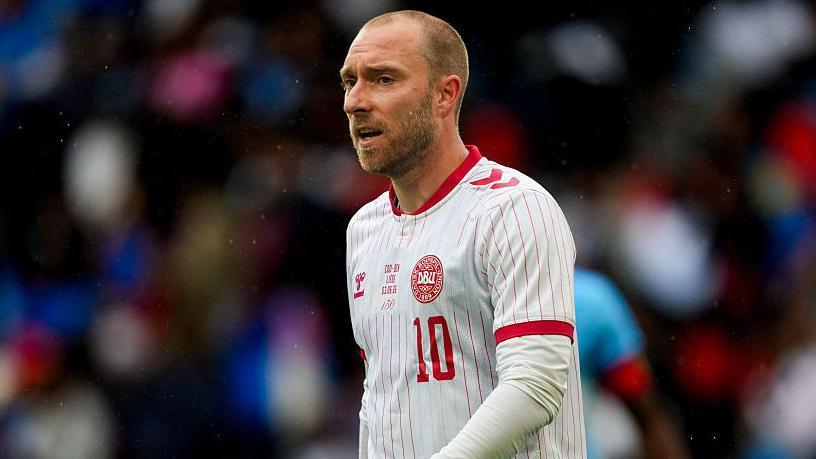 Image source, Getty Images
-
Published
Christian Eriksen will begin individual rehabilitation in Denmark after collapsing during a friendly last month.
He collapsed during a match against Ukraine in Odense in June, with the game being stopped on 65 minutes and abandoned shortly after. The 34-year-old midfielder was able to walk from the field.
The former Manchester United and Tottenham midfielder was fitted with an implantable cardioverter defibrillator (ICD) – a type of pacemaker – after suffering a cardiac arrest during a Euro 2020 match against Finland in 2021.
Following last month’s incident, he said it “was a different situation from what happened in 2021” and explained his ICD “did exactly what it was designed to do: protect me when I needed it”.
He also said he was “doing well” and was at home with his family.
Eriksen plays for German side Wolfsburg, who have confirmed he will “shortly begin an individual rehabilitation programme”.
“Following discussions with VfL managing director Dieter Hecking, it was decided that the 34-year-old will complete it in his native Denmark,” the club added.
“VfL remain in regular contact with Christian and the doctors overseeing his treatment. We continue to wish Christian all the very best with his rehabilitation.”
-
How Eriksen’s heart device kicked into action
-
Published8 June
-
-
How can athletes play with ICDs, and what happens when one goes off?
-
Published8 June
-
Eriksen was unable to play for Serie A side Inter Milan after his initial cardiac arrest at the Euros because of rules in Italy prohibiting players from competing if they have ICDs, but he resumed his career with Brentford in 2022, eight months after his first on-pitch incident.
He then spent three years with Manchester United and has played for Wolfsburg since September 2025 – the Premier League and Bundesliga both allow players with an ICD to compete.
An ICD is a device about half the size of a mobile phone with thin wires leading to the area around the heart.
There are two main types of ICD.
One is fitted under the skin, usually near the armpit, and acts like a mini defibrillator.
The other type is usually fitted in the space just below the collarbone and, like a pacemaker, can also send a regular electrical signal if it detects the heart is beating too slowly.
-
-
Published8 June
-
-
-
Published8 June
-