
This post was originally published on this site.
Do declassified files support Trump’s election security claims?
-
Published
In a 26-minute speech from the White House, President Donald Trump revived some familiar claims about US election fraud and interference.
Standing in the East Room – the same venue where Barack Obama announced the killing of Osama bin Laden in 2011 – Trump said the current election system was “catastrophically short” of being secure and that hundreds of declassified intelligence files would reveal these “shocking vulnerabilities”.
BBC Verify has reviewed these documents, although some of them have been heavily redacted.
There appear to be no bombshell revelations and no evidence that interference or fraud actually changed the outcome of previous elections – including the 2020 contest which Trump lost.
Here are some key themes.
What do files show about Chinese interference?
Many of Donald Trump’s most successful political narratives have a villain – a malign actor that presents a pressing threat that demands attention.
In Thursday night’s speech, China took centre stage as Trump’s villain and he presented Beijing as a nefarious force engaging in “sinister election meddling”.
The released documents provide support for claims that China took steps to acquire voter data – some of which is in the public domain or available for purchase – and explored ways to influence public opinion.
That’s well short of the kind of election tampering that Trump at times implied and smaller in scale than actions taken by Russia in 2016, which received a single mention from the president.
A previously released 2021 report by the US National Intelligence Council, external (NIC) found with “high confidence” that China did not interfere in the 2020 US election.
In his address Trump said: “Over a period of years starting during the 2020 election cycle, the People’s Republic of China carried out what is believed to be the largest compromise of election data in history, resulting in China’s illicit acquisition of 220 million US voter files.”
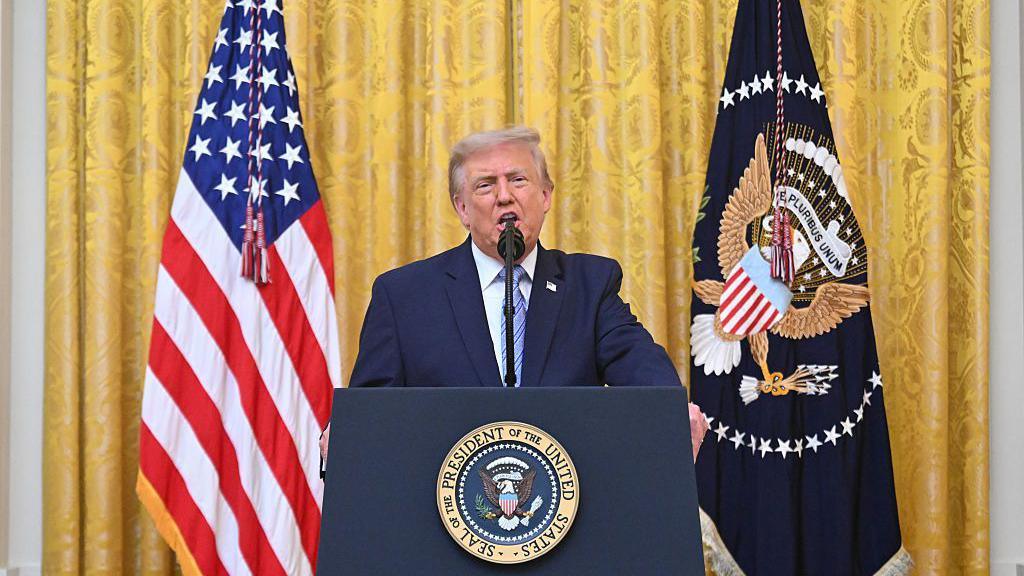 Image source, Getty Images
He claimed that “tens of millions of voters’ data in 18 states” had been “bought, stolen or hacked by China”.
The White House later published four sets, external of “election integrity” documents, which BBC Verify has analysed. Within these files is a statement, external by the “Government Transparency Task Force” dated 13 July 2026.
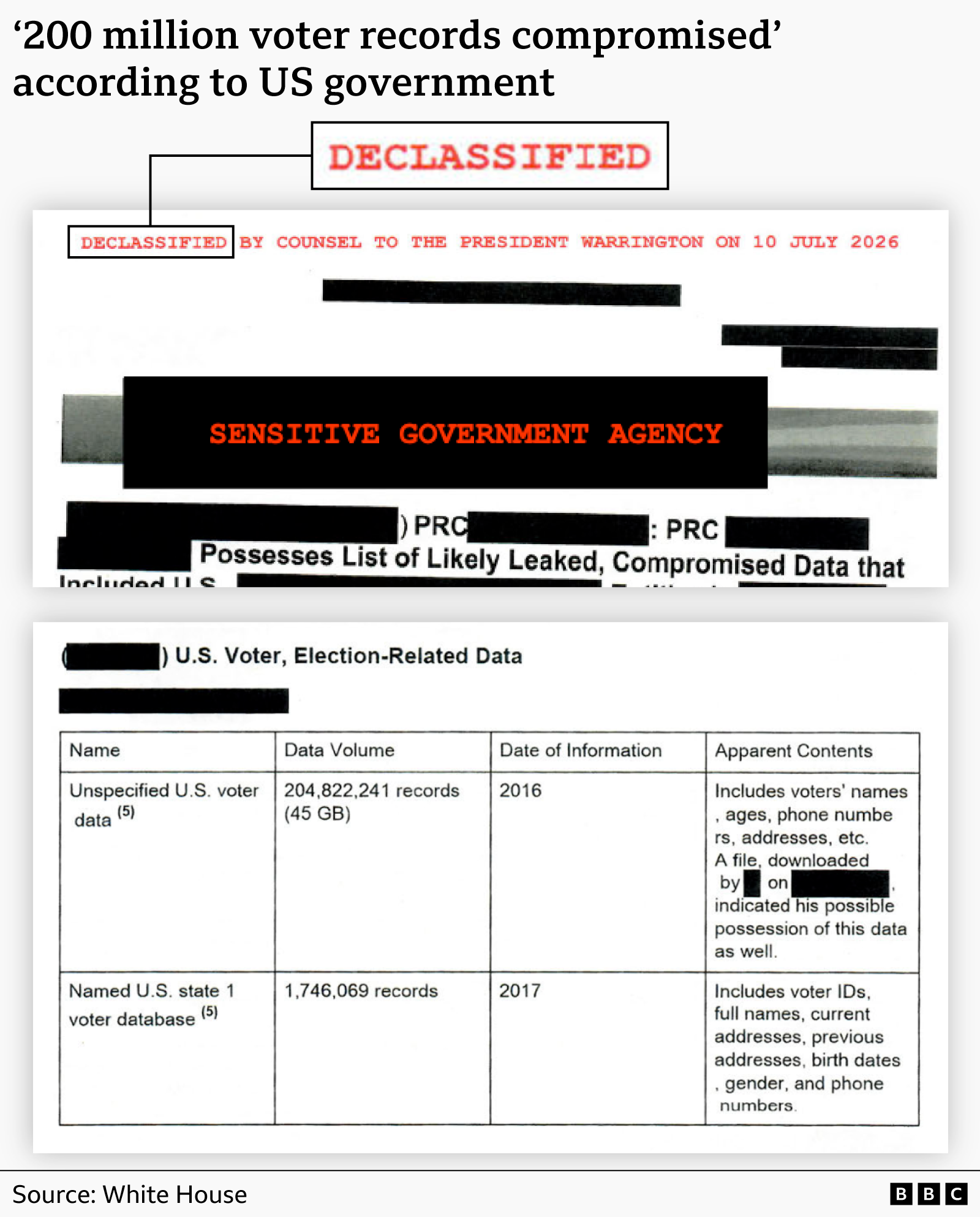
Without specifying a timeframe, it said that “the declassified intelligence reveals that voter registration rolls from at least 18 states have been compromised by the People’s Republic of China (PRC)”. It added: “Additional intelligence records reveal that more than 200 million voter records were also compromised by the PRC, without state-specific affiliations.”
One heavily redacted document, external – marked “declassified” – mentions the PRC and “likely leaked, compromised data”. The same document includes a table, external with a row labelled “unspecified U.S. voter data”, which shows 204,822,241 records and is dated 2016. But it is heavily redacted making it difficult to work out the full context of the table.
What do files say about voting machines?
Protecting America’s “election infrastructure” has been a bipartisan goal for years. The US made efforts to establish standards to strengthen and streamline the mechanics of voting after the contested 2000 presidential election and again following evidence of Russian election interference in the 2016 election.
While election procedures are managed by state governments, most votes are now recorded on some form of paper ballot.
Trump may have a more partisan purpose behind his re-airing of these claims. He appears to be using these concerns to cast doubt on the 2020 presidential election he lost and to potentially question the validity of future elections.
In his speech Trump said previously classified US intelligence assessments proved that the US government had known voting machines “are extremely exposed to attack”.
“As one assessment states, we judged that the United States’ adversaries, including, at a minimum, Russia, China, Iran, North Korea, as well as non-state groups have the capability to compromise US election infrastructure,” he said.
The documents released by the Trump administration include a January 2020 declassified NIC assessment, external of vulnerabilities in the election of that year, which acknowledged that “ballot and voting machine preparation is vulnerable to cyber, supply chain, or insider threats”.
It said that machines with no paper backup were “particularly vulnerable to cyber operations”.
However, the NIC assessment also stated that “security and mitigation measures used in these processes, and the distribution of voting machine storage facilities countrywide, would make it difficult for an adversary to coordinate a campaign to manipulate voting results across an entire state or multiple states”.
The specific assessment Trump may have been referring to is another declassified NIC report from August 2020, external, which said “foreign states or other actors may seek to compromise our election infrastructure”.
It is also important to note that Trump has taken steps to cut funding and undermine the independence of some of the government programmes and agencies that have been tasked in recent years with monitoring election security.
What do files say about claims of voting fraud in Michigan?
Michigan, a battleground state Trump won in 2016 and 2024 but lost in 2020, has long been central to the president’s allegations of voting fraud.
It was one of the few states he specifically mentioned on Thursday night. In this instance, however, the concerns appear to centre on voter registration drives, not actual balloting.
Political parties often rely on paid efforts to gather signatures for ballot drives and to register new voters when volunteers are in short supply. That can create negative incentives when people are paid by the signature.
Trump claims there was significant evidence of fraud in Michigan before the 2020 election that had “been buried and covered up”.
The files released by the White House show election officials in the city of Muskegon were investigating allegations of fraudulent voter registration applications in October 2020 and one document mentions “8,000 to 10,000 registrations”.
The case was referred to police and the FBI tested a sample of applications and found that 91 out of 107 applications “returned no results in database checks”.
The case was active for almost five years until the FBI closed it on 25 September 2025, stating the “investigation to date did not identify a criminal violation”.
Trump says he has now asked FBI director Kash Patel to fully investigate the matter.
However, local news reported, external at the time that police were looking into the matter after Muskegon election officials identified “irregularities” with some voter register applications.
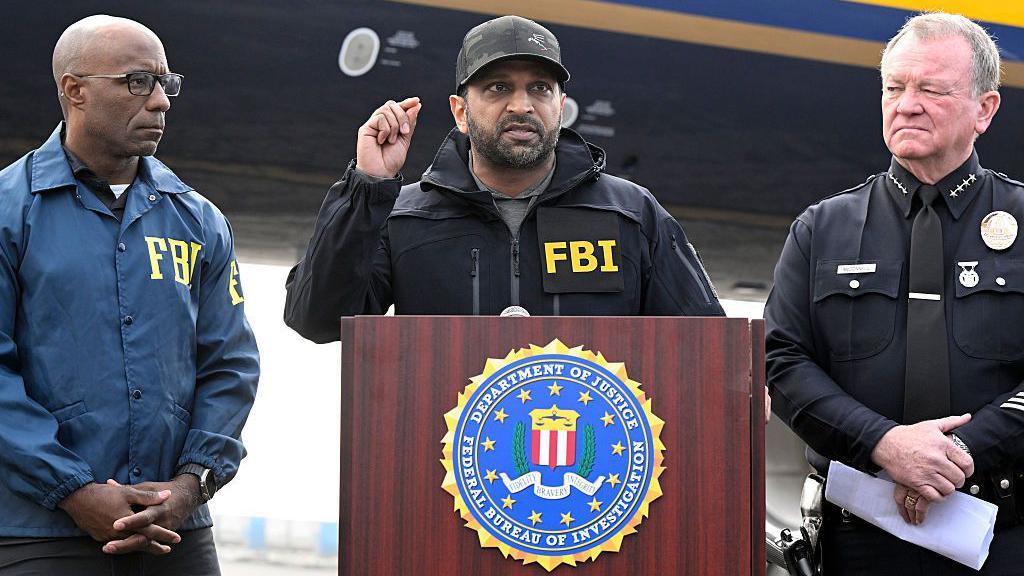 Image source, Getty Images
What do files say about non-citizens and voting?
Trump provided some very specific numbers when he spoke about non-citizens being allegedly registered to vote.
He announced the White House was “releasing the results of a stunning investigation by the Department of Homeland Security (DHS)” which he said had “identified approximately 278,000 non-citizens who are registered to vote in federal elections”.
A one-page DHS document which was released states that “over 250,000 non-citizens are illegally registered to vote in just the four US states for which public data files have been reviewed”.
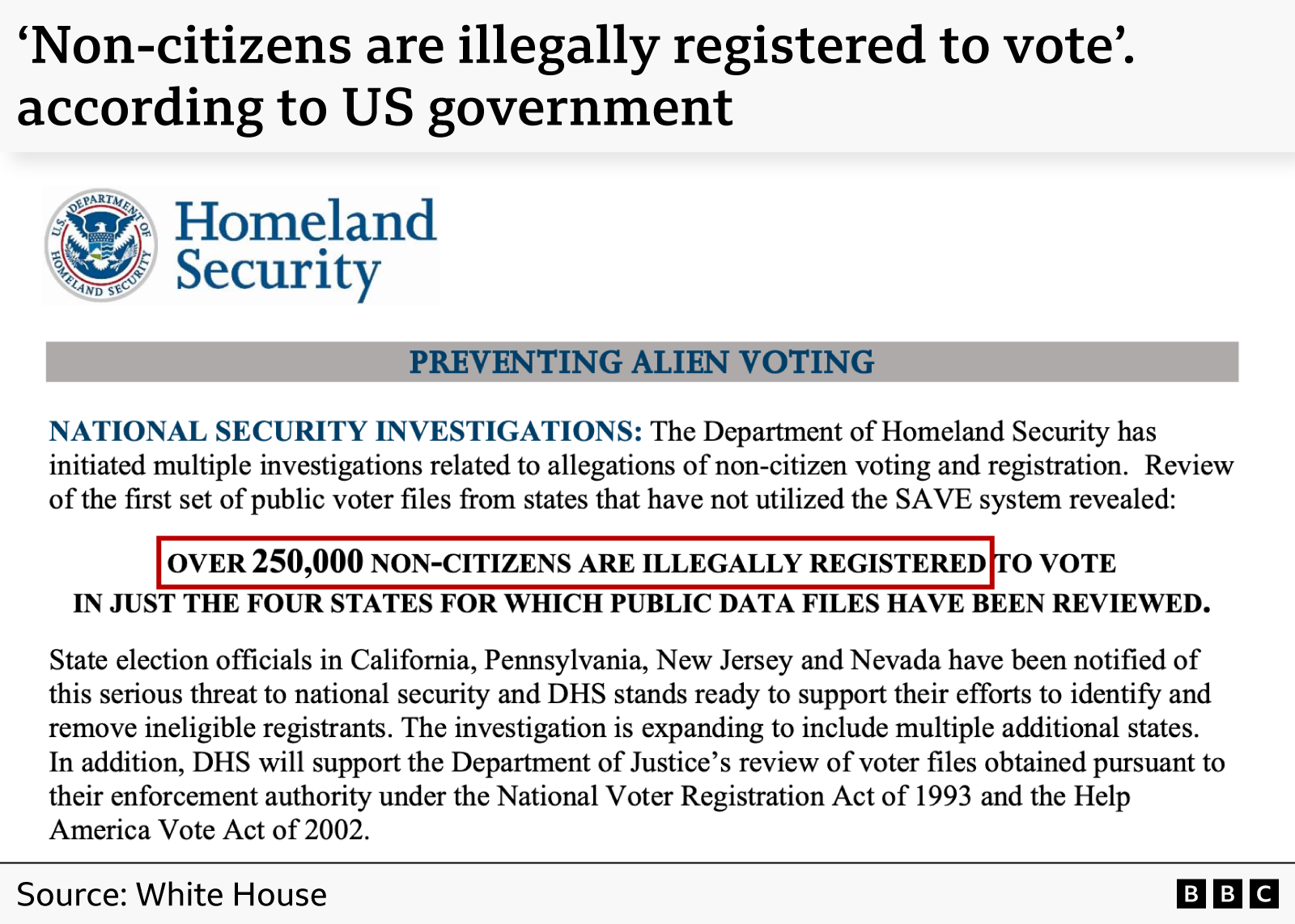
The document does not, however, link to these files or show any other evidence for this figure or provide an explanation of how the numbers were collected and verified.
Without further information, it is impossible to ascertain their validity.
There have been very few documented instances of non-citizens casting ballots in past elections.
Trump, however, regularly asserts that Democrats rely on the votes of millions of undocumented migrants. It is one of the reasons he argues that if his proposed election-security legislation is enacted by Congress, Republicans would solidly control the American government.