
This post was originally published on this site.
Holiday shoppers increasingly move between social feeds, direct messages, creator recommendations and physical stores before making a purchase. Meta is giving small businesses a new set of free resources designed to help them prepare for that fragmented customer journey before the year’s busiest retail period begins.
The company has introduced the Meta Holiday Insights Center, an online hub that combines consumer research, platform benchmarks and guidance for businesses planning seasonal marketing campaigns. The center also includes the Meta Holiday Playbook: Small Business Edition, a step-by-step advertising guide aimed at companies with limited time, staff and marketing experience.
According to eMarketer, holiday retail sales are projected to reach $1.4 trillion, while ecommerce is expected to grow 2.5 times faster than in-store sales. Meta’s guidance also draws on a company-commissioned Ipsos survey of 14,473 holiday shoppers across 18 countries, conducted in November 2025.
Because the findings focus on people who use Meta technologies, businesses should not assume the results represent every customer or industry. However, the data highlights several ways social media is influencing product discovery, customer service and purchasing decisions.
Social Profiles Increasingly Function as Digital Storefronts
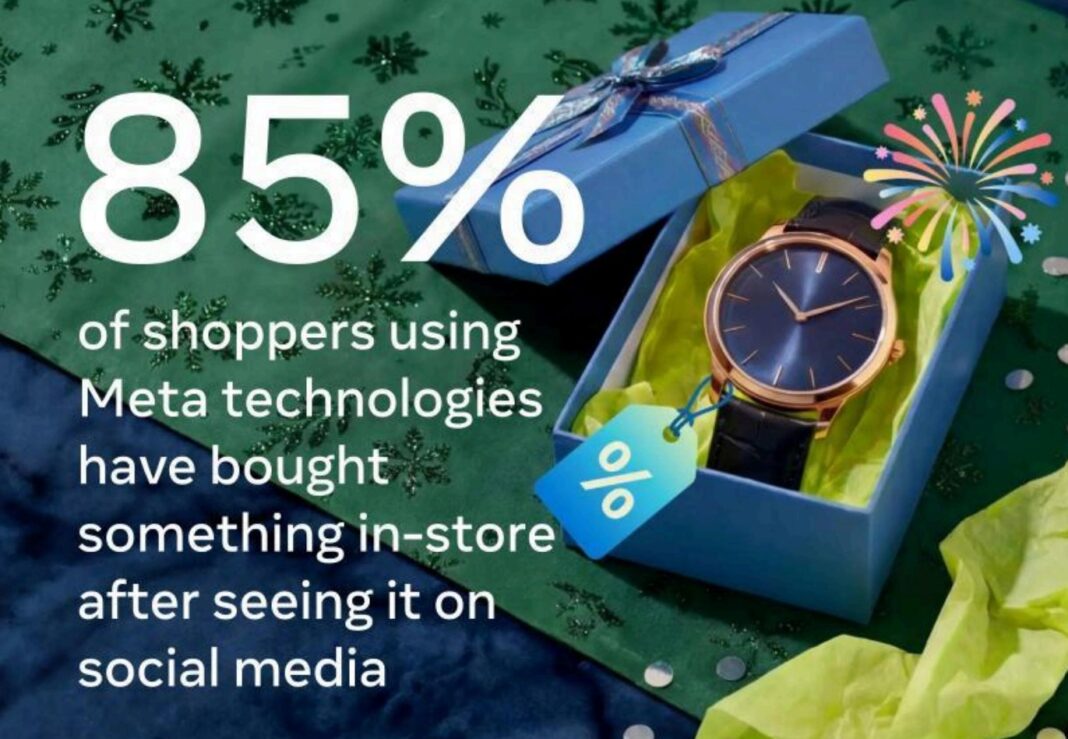
Meta reports that 85% of shoppers using its technologies have purchased something in a physical store after seeing it on social media. Nearly one-third said they do so frequently.
For a local retailer, restaurant or service provider, that finding reinforces the value of maintaining an accurate Facebook Page and Instagram Business Profile. Holiday hours, contact information, product availability and store locations should be current before seasonal traffic increases.
Businesses can also use short-form videos to demonstrate products, show employees preparing holiday orders or highlight popular gift options. Meta recommends using its Edits app to create Reels, although owners can apply the broader strategy through any production tool that fits their workflow.
The immediate opportunity does not require an advertising budget. A business that consistently publishes useful product content and responds to comments can build awareness before paying to expand its reach.
The challenge is maintaining that activity during a period when employees may already be handling more orders, customer questions and fulfillment work. Small businesses should establish a manageable posting schedule rather than trying to publish continuously. A few clear, timely posts may provide more value than a high volume of rushed content.
Customer Messages Are Becoming Part of the Sales Process
Direct messaging is also moving beyond conventional customer service. According to Meta, 59% of surveyed shoppers have messaged a business during the holiday season through Messenger, Instagram Direct or WhatsApp.
Among those shoppers, 33% used messaging to discover products and 26% used it to complete a payment. That means a delayed response can cost a business more than goodwill. It may result in a lost order.
Meta recommends configuring welcome messages, away messages and frequently asked questions in Messenger. Businesses can also activate AI-generated replies in Instagram Direct for selected audiences or use the WhatsApp Business app to display products and automatically greet customers.
These tools may help an owner answer routine questions about availability, shipping, store hours and return policies without manually writing every response. They can be particularly useful for businesses that receive inquiries after normal operating hours.
Automation still requires oversight. An outdated answer about inventory, delivery deadlines or pricing could frustrate customers. Owners should review automated responses before the holiday rush and assign someone to monitor conversations that require human judgment.
Meta Positions AI as a Seasonal Support System
Artificial intelligence is influencing both sides of the transaction. Meta says nearly one in four global shoppers used AI while shopping for the holidays last year, and the company expects adoption to increase.
For businesses, Meta is continuing the global rollout of Meta Business Agent. The system can answer questions using information specific to a company, recommend products from its catalog, assist with sales and identify patterns in customer conversations.
Vanessa Ugalde, owner of jewelry and decorations business Piedra Nómada, described the time-saving potential of the tool.
“Before Meta Business Agent, when customers messaged me with questions, it took a lot of time away from being able to get other things done. Now, Meta Business Agent responds to provide immediate customer service, and I follow up as needed.”
Meta is also connecting AI more directly to advertising. Its AI business assistant can provide campaign recommendations and help resolve issues inside Ads Manager and Meta Business Suite. Meta Ads AI Connectors allow businesses to create, manage and analyze campaigns through compatible AI tools they already use.
For small companies, the practical value depends on the quality of the underlying business information. Product descriptions, prices, policies and catalog data must be accurate if an AI system is expected to provide reliable answers. Owners should also test how the agent handles unusual questions before allowing it to interact broadly with customers.
Local Creators May Offer an Alternative to Celebrity Endorsements
Meta’s research found that 94% of surveyed shoppers look to creators for holiday shopping guidance, while 57% said creator content directly affects their purchases.
Small businesses do not necessarily need a national influencer to act on that trend. A local creator with a smaller but engaged following may provide stronger access to a relevant community.
Businesses can use Instagram’s Creator Marketplace to search for potential partners. After receiving permission, they can also convert a creator’s organic post into a partnership ad through the Partnership Ads Hub.
Meta plans to combine those services in the forthcoming Creator Marketing Hub, which the company says will launch later this year. The unified system is intended to let advertisers identify creators and activate campaigns from one location.
Creator partnerships still require careful evaluation. Audience size alone does not show whether a creator’s followers match the business’s customer base. Owners should examine engagement quality, previous partnerships, content style, fees and disclosure practices before committing campaign funds.
Clear agreements are also important. Businesses should define deliverables, publication dates, usage rights and whether the creator will allow the company to promote the content as an advertisement.
Advertising Performance Depends Heavily on Data Quality
Meta says 49% of surveyed shoppers plan to spend more during the holidays than they did last year. The company also reports that advertisers earn an average of more than $4 for every $1 spent on Meta, a return it says has increased 25% since 2022.
That figure comes from a study conducted on Meta’s platforms involving more than one million campaigns. It represents an average rather than a guaranteed return. Results for an individual small business can vary based on its products, margins, targeting, creative material, website experience and measurement setup.
Meta advises businesses to confirm that their Meta Pixel is active in Events Manager. The updated Pixel uses AI to add more detailed product and page information to the events it shares, according to the company.
Meta has also introduced a one-click setup process for Conversions API, which creates a connection between a business’s website data and Meta’s advertising systems. The company says advertisers using Conversions API experience an average 17.8% lower cost per result.
A complete product catalog can further support dynamic advertising. Meta’s Advantage+ Catalog ads match products and advertisements to users based on the system’s predictions. Products included in a catalog may also appear in recommendations delivered by Meta AI to shoppers in the United States.
Businesses should confirm that tracking tools work correctly before increasing campaign spending. Broken product links, duplicate events or inaccurate prices can undermine optimization and make performance reports less useful.
Once those foundations are in place, Advantage+ campaigns can automatically distribute budgets across placements, identify likely customers and adjust creative elements. Meta says Muse Image, an image-generation model developed by Meta Superintelligence Labs, now helps power Advantage+ creative.
Nathan Daggett, chief marketing officer at Live Bearded, said the automated campaign process allows the company to spend less time on setup.
“The holiday season is already chaotic enough. Advantage+ simplifies the process and makes setting up a campaign less complicated so we can focus on the parts of our business that matter most like our customers, our team, and our community. Every minute we save on setup is a minute we get to be human. That’s what makes it valuable.”
The Meta Holiday Playbook walks businesses through establishing their data systems, launching an Advantage+ campaign, measuring performance during peak shopping periods and continuing campaigns into January, when Meta says advertising costs are typically lower.
Small businesses do not need to adopt every tool at once. Updating business profiles, preparing automated answers and reviewing product catalogs can provide a practical starting point. Companies that decide to advertise can then test modest budgets, measure actual sales rather than engagement alone and expand only when the economics support it.