

This post was originally published on this site.
Have Man Utd lost faith in their women’s team?
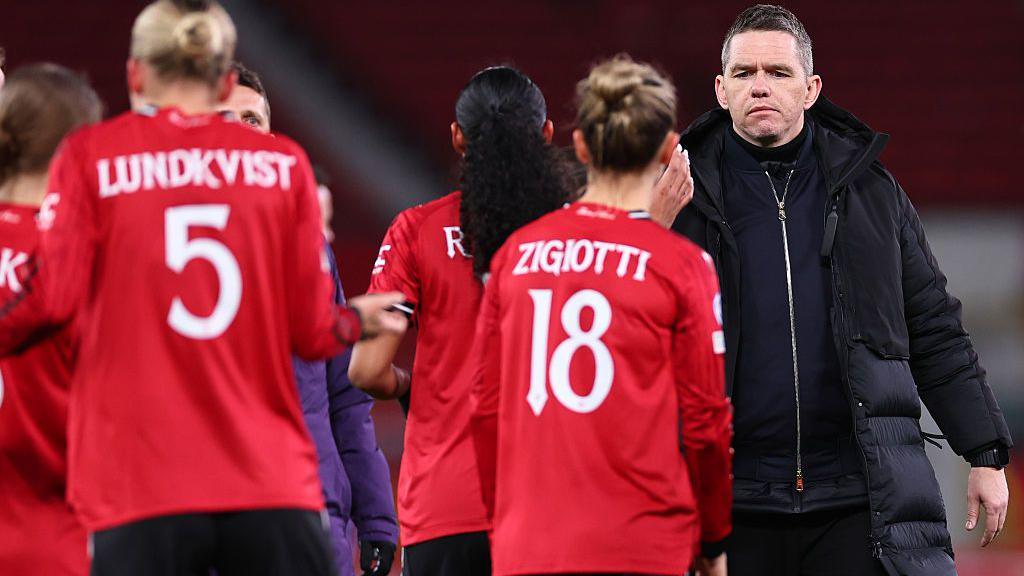 Image source, Getty Images
-
Published
With a month to go before the start of the Women’s Super League season, Manchester United are without a manager and have a thin squad.
The club said on Monday that Marc Skinner had left his position by mutual consent, ending a five-year spell that included a first major trophy.
The timing of his departure increased concerns that United are in danger of being left behind after a quiet summer of recruitment.
Having previously faced criticism regarding their women’s team, are they scaling back resources further, seeking a more sustainable model or moving in a new direction?
-
Man Utd boss Skinner leaves role before WSL season
-
Published8 hours ago
-
-
London City host Man Utd to kick off WSL season
-
Published4 days ago
-
What led to Skinner’s exit?
In April, Skinner faced questions about his future, insisting he had “no doubts” that he remained the best person for the job.
There had been no internal discussions about his position going into the World Sevens tournament in May – and the club were satisfied with results.
The expectation was to challenge for silverware and try to qualify for Europe again. United lost the League Cup final to Chelsea, missed out on a top-three finish by nine points but had reached the quarter-finals of the Champions League.
All in all, given their budget was considerably lower than their top-three rivals (their wage bill was £5.9m in 2024-25, while Chelsea’s was £14.5m), Skinner had done a good job in the face of widespread scrutiny from fans.
But United sources say as the new season approached, discussions took place and it was clear Skinner and the club were not aligned on the direction they were going.
As United moved towards a sustainable model, focused on youth development, Skinner had become increasingly frustrated at a lack of squad investment.
Following their 3-0 defeat by rivals Manchester City in March, Skinner said: “The team are giving absolutely everything they can. It’s clear to me that if we get the right investment in the right areas, then we can meet those expectations.”
He echoed the sentiment following their cup final defeat by Chelsea and again on the final day of the season as they looked ahead to the summer transfer window.
Yet despite a quiet January window, United have not acted with pace this summer, instead signing 22-year-old defender Andrea Medina and goalkeeper Janina Leitzig, who is presumably back-up to the established Phallon Tullis-Joyce.
While United remain cagey in the market, their rivals are spending big with Arsenal bringing in the likes of England international Georgia Stanway and Spain full-back Ona Batlle, while Chelsea paid £850,000 for one of United’s key players, Melvine Malard.
Skinner had struggled to win over supporters, so faced with intense external scrutiny, limited squad depth and clear disagreements over the club’s lack of spending, his position became untenable for both parties.
Why has United’s commitment been questioned?
It is not the first time United’s lack of investment has been in the spotlight.
Former manager Casey Stoney stepped down in 2021 because of growing concerns over a lack of resources and facilities.
High-profile reports followed about United’s inadequate training facilities in 2024, while owner Sir Jim Ratcliffe’s comments about the women’s team were criticised.
They have also lost a number of key first-team members of staff with ex-assistant Martin Ho now enjoying success as Tottenham manager and was joined by goalkeeping coach Ian Willcock in April – while another former assistant, Charlotte Healy, became head coach at WSL 2 club Bristol City last year.
When Skinner took the United job in 2021, he had big boots to fill with Stoney a popular figure among supporters.
His ratings plummeted further with a number of big-name players leaving on free transfers, including England duo Alessia Russo and Mary Earps, as well as Batlle.
Are the club addressing issues?
Manchester United have tried to stop big players leaving for free, opting to sell Malard last month for a considerable profit they hope to reinvest.
They have also made money on the sales of Millie Turner and Lisa Naalsund to Birmingham City – both sold for a six-figure sum.
BBC Sport reported in July that the girls’ academy would train at Carrington – the club’s main training facility – this season.
That is all part of their new strategy, which club sources insist is based on a sustainable future, with an ambition to develop homegrown talent.
United say there has been “significant” investment in the academy as there are concerns that the current spending trajectory in the WSL is not sustainable.
The hope is that this approach will deliver long-term success for United, and they will use the transfer fees they have received so far to improve the club as a whole.
It is understood the search for Skinner’s replacement is already advanced and they hope to appoint a new head coach quickly.
A main requirement of Skinner’s successor will be a track record of developing talent, and with no European football to navigate this season, United hope there will be more opportunities for young players to get game time in the WSL.
But will this approach deliver results the fans want?
Former boss Stoney told BBC Sport in May: “Are they at the level of the other [top] clubs? Possibly not in terms of wages and recruitment.
“If they do want to go higher, they are going to have to invest in the squad and get more depth.
“You’re only ever as good as the team you can put out on the pitch. It’s about the investment you’re prepared to put in.”
Find interviews and extra content from the Women’s Super League and beyond on the Women’s Football Weekly feed