

This post was originally published on this site.
What could happen to prisoner early release scheme now?
 Image source, PA Media
-
Published
Prime Minister Andy Burnham has changed the incoming early release scheme for some prisoners in England and Wales amid huge political and public pressure to rethink the scheme.
His decision to exclude rapists and some other offenders from the plans comes after the widow of PC Andrew Harper described two of his three killers being freed earlier than had been expected as “deplorable”.
Under the new Sentencing Act, set to come into force in September, some 6,000 criminals had been due to be released at varying stages – the aim being to ease overcrowding that has caused chaos across prisons and the courts.
How would the early release scheme have worked?
Earlier this year Parliament voted through the Sentencing Act 2026 to radically reform the rules governing the sentencing and management of prisoners.
This was part of Sir Keir Starmer’s government’s plan to tackle the unprecedented crisis of overcrowded jails it had inherited: quite simply, if the prisons ran out of cells – as was nearly the case in late 2024 – the police and courts would be unable to lock up newly caught criminals.
Police would not be able to charge suspects. Trials would have to be stopped. Judges would not be able to sentence criminals to years in prison.
It would be unprecedented in modern Britain.
One part of the plan means many jailed offenders on fixed terms will leave prison after serving just a third of their term behind bars, rather than at the halfway point which has long been the law.
Leaving prison does not mean they are free: release on licence includes strict conditions and often an electric tag or curfews to monitor whereabouts – although recent figures show thousands of people required to have a tag did not have one.
The plan had been that from 2 September, the first prisoners to benefit from the scheme were those serving up to 19 months. Offenders serving longer fixed-term sentences would become eligible for the scheme month-by-month.
That roll-out has now been delayed. Burnham says the scheme should exclude rapists, serious sexual offenders against children and those guilty of grooming gang related crimes. There will be a “presumption” that all offenders are tagged.
So that means that prison governors and probation officers must put plans on ice – and start rethinking who gets out and when.
How will the scheme be changed?
This is where it gets really complicated. The government wants the new plan operational by October.
Ministers can use their powers to lay down new rules – but Parliament can intervene in such direct orders – and that raises the possibility of a clash with the opposition over who to exclude from early release. Last October, when the plan was going through Parliament, the Tories attempted to amend it to exclude the very groups who will now be kept inside.
So whatever the wording of the new orders triggering the release plan, it may not be plain sailing.
How many offenders would benefit?
Initially up to 6,000 offenders were to benefit from the scheme, but it’s unclear now how many will still be released because ministers have not published the draft of the new rules which specifically lists the offences that will be excluded.
While politicians and the public roughly understand the aim, this lack of clarity has caused a huge problem for prison governors.
They must tell offenders their release dates.
The Prison Governors Association says its members are unclear how many prisoners will now need their sentences to be recalculated again and who will remain in prison.
“We don’t know if it is tens, hundreds or thousands that will be excluded,” it said in a statement.
Knowing the date means governors can plan how they are using cells for other inmates – and it helps inmates prepare better for release through resettlement and rehabilitation – including making sure they have a bed for the first critical nights.
A safe bed means a better shot at going straight and getting a job.
Anything that makes it harder to resettle an offender increases the chance they will break the law again and return to prison – and that in turn means more overcrowding and the chances of rehabilitation diminish.
What happened to PC Andrew Harper?
In 2019 the 28-year-old officer was killed when he was dragged down a road in Berkshire after getting caught in a strap attached to the back of a car that teenage burglary suspects were using to flee the scene.
Henry Long, 18 at the time, was the driver and the jury did not convict him of murder because it was not sure he knew he was dragging the officer along as he drove off.
But he, Albert Bowers and Jessie Cole, both 17 at the time, were all convicted of manslaughter – which means causing an unlawful death, without necessarily intending to do so.
They were all jailed in 2020.
When did the men expect to be freed?
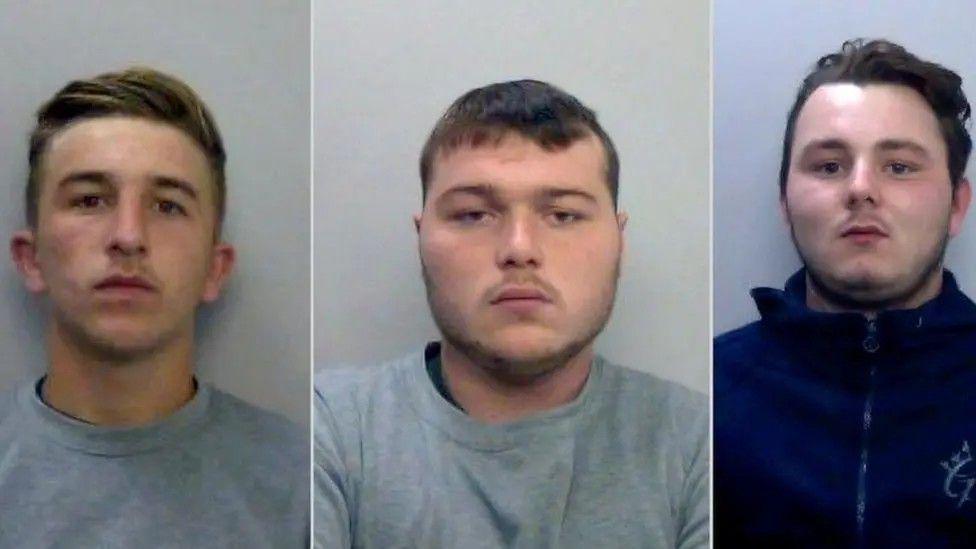 Image source, Thames Valley Police
Long was jailed for 16 years. It would have been 24 had he not admitted manslaughter.
The sentencing judge said he would serve 10 years and eight months of that in a cell before he could be released on licence.
Bowers and Cole were told they would serve two thirds of their 13 years in custody and the rest on licence in the community.
Release on licence is baked into sentencing laws in the UK and comparable countries. It means an offender leaves prison but is not free of their sentence – they are subject to restrictions and conditions on their life which can include electronic tag monitoring of their movements and curfews.
If an offender breaks the conditions, they can be sent back behind bars.
So would PC Harper’s killers benefit and when?
Bowers and Cole were in a category of criminals who were told by their trial judge they would spend two-thirds of their sentence in jail.
But that was changed under the new rules which meant they could leave at the halfway point of their term. That remains the case – they are unaffected by Labour’s U-turn to exclude some groups of prisoners. If the government sticks to the original release timetable for most prisoners, they will become eligible from after next June.
Is Henry Long, the driver, eligible?
No. His more severe sentence is unaffected by any of the new rules under the original or revised plan. He still has at least another four years of prison walls to look at.
Could prisons run out of space again?
Almost certainly. The prison population today is about 86,500 and there are about 2,400 spare places.
That headroom is reducing monthly despite the government pushing ahead with building 14,000 extra cells. By 2030 officials think there will be around 100,000 in prison – but it could be more than that.
Worst-case scenario? The government begins to run out of space in 2029 unless this new plan to manage and monitor more offenders in the community is a success.
Sir Keir’s government sold its reforms as “prison outside of prison”, but there are widespread and genuine concerns across criminal justice that the Probation Service, which has been rocked by a series of disastrous reorganisations in the last 15 years, is still not fully resourced and able to deal with all the risks.
-
-
Published42 minutes ago

-
-
-
Published23 July
-
-
-
Published22 July
-
-
-
Published24 July 2020

-