
This post was originally published on this site.
Why £1m-a-season deal will be hard for Pollock and Hearn to find
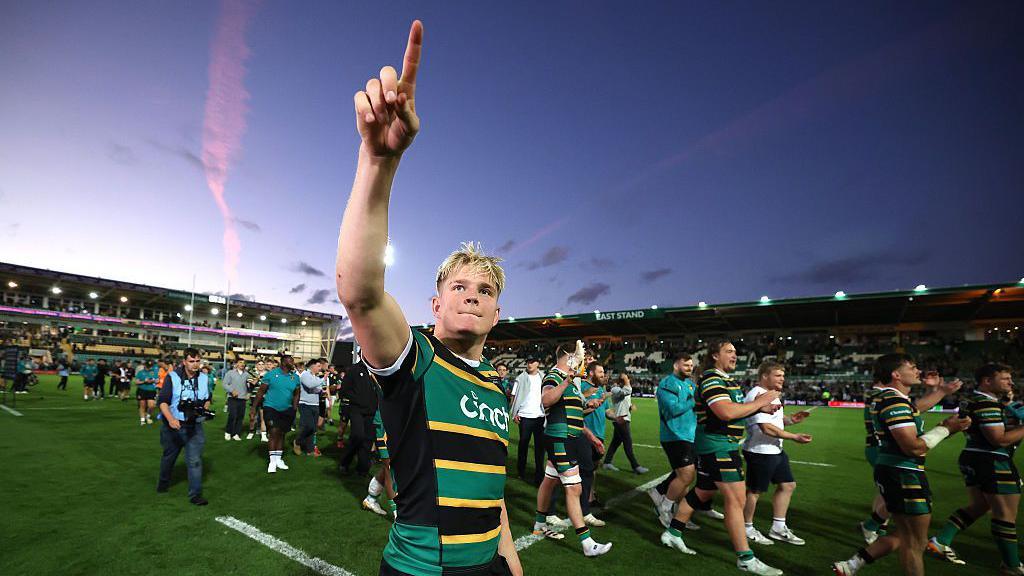 Image source, Getty Images
-
Published
Salary cap regulations might not be high on everyone’s holiday reading list, but agent Eddie Hearn might be interested if he’s keen to get Henry Pollock’s £1m pay-day.
The Prem salary cap is currently £6.4m per club. In basic terms, your whole squad’s salaries have to add up to £6.4m or less.
There’s an outside chance the Northampton back row could get a salary of £1m next season, if a club out there has that amount of space in the cap.
The only team thought to be in this bracket, according to the last published salary cap report in 2024-25, would be Newcastle.
However, we don’t have Newcastle’s latest data since the Red Bull takeover and the signing spree on the likes of Raffi Quirke and Hoskins Sotutu.
Clubs in the 2026-27 season also have to spend at least £5.4m, dubbed the new salary cap floor – this leaves less wriggle room if you wanted to bring in one player on big money.
As he negotiates for a new contract, if the 21-year-old England forward wants to stay at Northampton, it looks like they don’t have the cap space for a £1m deal.
They could make space by significantly reducing the salaries of Pollock’s team-mates who renegotiate this year, although that might not be very popular or sensible business.
So, this is where we enter the world of ‘excluded players’, or marquee players if you’re old school, whose salaries are exempt from the £6.4m cap.
-
Pollock to demand £1m a year at Northampton – Hearn
-
Published1 day ago
-
To play this video you need to enable JavaScript in your browser.
This video can not be played
Before we get too deep, it’s worth knowing that a current Prem player moving to a different Prem club is not the same as a player coming in from outside the league.
Basically, don’t think that Pollock can be compared to Scotland’s Finn Russell at Bath, as there are different rules.
Time to grab a pen and paper. In the Prem salary cap regulations section 3.26 on excluded players, the first problem Pollock has is that to become the excluded player he must have “been a player of that club for at least two full salary cap years prior to the salary cap year in which they are nominated to be an excluded player”.
This means Pollock can’t just become Northampton’s excluded player next season, they have to declare him to be that player in the future. But why, I hear you cry.
It’s to stop clubs poaching players off each other and back-loading player contracts.
We learnt about this during the Covid pandemic, when clubs agreed bigger pay-days with their players in advance of the new lower salary cap regs being introduced, so that their salary didn’t count in the reduced cap.
It also prevents sides from manipulating the cap. For example, you can’t pay player X £5m in year one of an excluded deal, then just £100 in year’s two and three, rinse and repeat with a new big name every year. Not allowed.
The way the cap stops clubs doing this is a process of “averaging”.
The BBC is not responsible for the content of external sites.
Allow Instagram content?
This article contains content provided by Instagram. We ask for your permission before anything is loaded, as they may be using cookies and other technologies. You may want to read Meta’s Instagram cookie policy, external and privacy policy, external before accepting. To view this content choose ‘accept and continue’.
The BBC is not responsible for the content of external sites.
If you want to read regulation 3.28.2, it’s long, wordy and not very sexy.
The summary is that over three years the average pay of the excluded player is key to what ends up in and outside the cap.
If a player earns £100,000, £150,000 then £200,000 across three years, the average is £150,000.
Then as the excluded player, if you then want to pay them £1m, the extra £850,000 would actually be included in the cap as it is above the average.
These rules mean it’s actually quite hard for players to move around the league and command the excluded player spots.
To conclude the excluded player regs, it’s also worth knowing that we’re not allowed to know the identity of any excluded players.
You can guess, assume, even ask them, but technically “a club is not entitled to know the identity of the excluded players of other clubs”.
This means that if Northampton already have a player nominated for the excluded player spot they would probably have to unpick a huge amount of spreadsheet calculations to move it over to Pollock.
To those outside the sport much of this will seem like madness and an unfair market. However, the salary cap is basically designed to stop clubs making poor financial decisions or over-stretch themselves. The demise of Wasps, Worcester and London Irish being the forefront of this.
Prem Rugby told BBC Sport: “The salary cap is designed to prevent clubs from over-spending. It helps control inflationary pressures from club costs and ensures the viability and competitiveness of clubs.
“This year the Prem is forecast to post record revenues of more than £200m for the first time, with that number forecast to grow again year-on-year.”
With six different Prem winners in seven seasons, you can’t argue that the league isn’t competitive.
Clubs like Saracens have long championed salary cap increases and now that the league’s stability has been assured following the removal of promotion and relegation, this is likely the next chapter in the salary cap debate.
Prem Rugby said: “Any change to the wider cap structure would always go through a full club consultation and be up for discussion amongst the men’s professional Rugby Board before any decision is made.
“The removal of promotion and relegation is a separate strategic decision aimed at giving clubs long-term investment certainty, as is evident with the new ownership of Red Bull at Newcastle and Black Knight Rugby at Exeter Chiefs – as well as the new investment from Sir James Dyson at Bath.”
Some players can command big commercial deals outside rugby, and these deals will eclipse their club earnings multiple times over.
The big examples away from Pollock right now are the USA’s Ilona Maher, South Africa’s Siya Kolisi and England’s Ellie Kildunne.
A Pollock £1m pay-day in club rugby is possible, but highly unlikely at Northampton, for now.
-
-
Published6 hours ago
-
-
-
Published1 day ago
-