
This post was originally published on this site.
Russian court bars only anti-war party from standing in parliamentary elections
-
Published
Russia’s only liberal, anti-war party will not be able to take part in next month’s parliamentary elections, a Moscow court has ruled.
Yabloko was the only registered party to oppose Russia’s war on Ukraine.
The case against it was brought forward by Rodina, a pro-Kremlin nationalist party.
Hundreds of people – mostly very young – on Monday had stood outside the Moscow courthouse where the hearing was taking place in support of Yabloko, singing songs and waving flags.
Videos posted on social media showed that when news of the verdict spread among the crowd, many started chanting: “Shame! Shame!”
The lawsuit by the Rodina party accused Yabloko of publicly supporting an extremist organisation by publishing material on its website in support of the “international LGBT movement”, which Russia’s Supreme Court designated as extremist in 2023.
Rodina also said Yabloko was guilty of copyright infringement after a senior party member had quoted the lyrics of a Soviet-era song – “Let there always be sunshine” – in an interview.
At the hearing, Russia’s financial monitoring service also claimed that Yabloko received money through third parties from foreign countries, including Germany and the US.
The Kremlin-controlled Central Electoral Commission had approved Yabloko’s candidate list in late July.
But by then several party members had already been barred from running, including two deputy chairmen and deputy leader Maxim Kruglov, who was sentenced in June to seven years’ imprisonment for social media posts about civilian casualties in Bucha, Mariupol and other Ukrainian cities.
And last week, Yabloko had suffered a cyberattack soon after launching a donations appeal for its election campaign fund.
It campaigned under the slogan “For peace and freedom! For a life without fear!” and advocated for a “ceasefire, diplomacy, and peace” and “for a Russia free from fear and political repression”.
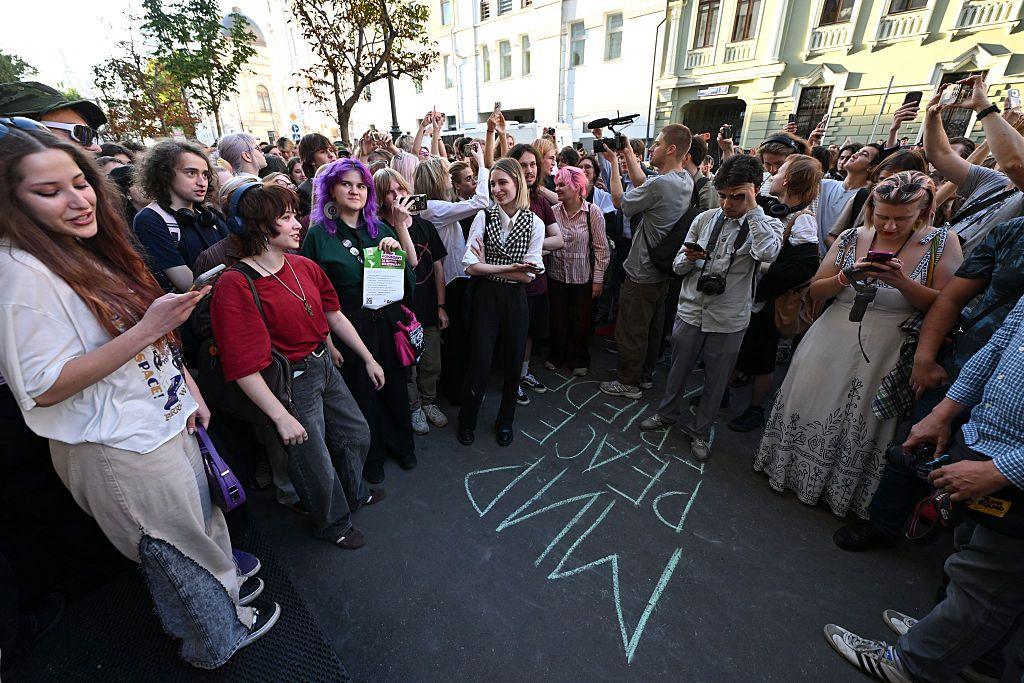 Image source, Getty Images
Hundreds gathered outside the Moscow courthouse, chanting “Russia” and “Yabloko” – the Russian word for “apple” – as the eight-hour hearing dragged on. Many carried apples as a sign of support.
Since the start of Russia’s full-scale invasion of Ukraine in February 2022, any remaining opposition to the Kremlin has been crushed.
Public shows of dissent have been suppressed by wartime censorship laws and can trigger hefty fines or long prison sentences.
Because protests are no longer permitted, the Yabloko hearing offered a rare chance for likeminded Russians opposing the war to gather publicly. “For Yabloko. For freedom” was scribbled in chalk on the pavement outside the courthouse.
Yabloko has not won Duma seats since 2003 but has contested every election since.
Once led by presidential contender Grigory Yavlinsky, it later fractured with allies – expelling the late opposition leader Alexei Navalny in 2007 and criticising him even after he was eventually imprisoned ahead of his death in 2024.
Still, Yabloko remained Russia’s most consistent anti-war voice, opposing Russia’s war on Chechnya, the 2014 annexation of Crimea, and the invasion of Ukraine.
With ruling party United Russia’s ratings down to 33% amid inflation, internet blackouts and drone strikes, Yabloko’s support had been surging.
The Central Electoral Commission could have allowed Yabloko to contest the election and initially appeared to be leaning in that direction, potentially to use the party’s marginal result in 2021 – when it won just 1.34% of the vote – to show how that the anti-war stance in Russia does not hold much sway.
But the government has now appeared to have changed its calculations, as signs of growing dissent over the war in Ukraine emerge.
Without a political force that clearly represents the opposition on the ballot, fewer people may be motivated to go to the polls. A low-turnout election, particularly among those who oppose the ruling party, would likely benefit the Kremlin.
All 10 other parties taking part in the election either support the war in Ukraine or do not openly criticise it.
And although United Russia’s ratings appear to be in a deep dive, the Kremlin still has the resources to deliver the outcome it wants at the election.
Independent election watchdogs have been deprived of much of their ability to monitor and challenge the process.