
This post was originally published on this site.
Jewish school heads spend more time on security than education, review finds
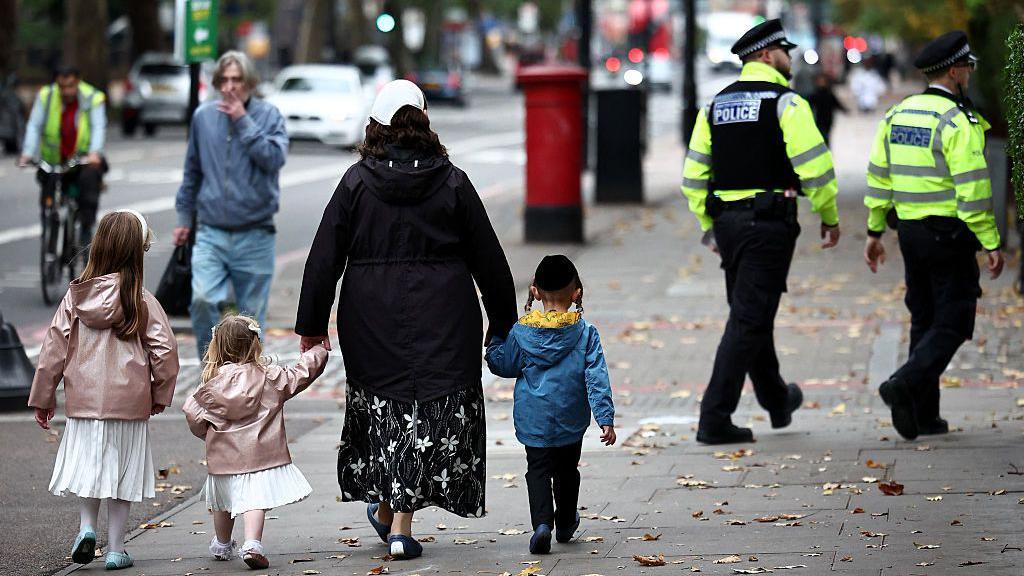 Image source, Getty Images
-
Published
Headteachers of some Jewish schools are spending more of their time dealing with security arrangements than on educational matters, a review into antisemitism in schools and colleges has found.
Sir David Bell, speaking for the first time about his ongoing government-commissioned independent review, told the BBC he had been struck by how many leaders of Jewish faith schools had told him security was their primary concern – and that “sometimes education takes second place to that”.
The report, due in the autumn, examines the experiences of Jewish pupils and staff in faith and secular schools and colleges in England.
Sir David said he found that pupils were “subject to regular harassment and abuse”.
He said Jewish children and young people “are facing a pressure – and indeed one might say even a crisis – that is not the experience of other communities in this country”.
The review is likely to recommend dedicated training for all teachers and improved education about antisemitism for pupils, the BBC has been told.
The BBC has spoken to several headteachers and staff at Jewish schools. All asked not to be named because of concerns over their security and that of their schools.
One headteacher said: “In recent years [security] has become an overwhelming priority and increased a significant amount. There have been weeks where approximately 90% of my time has been spent on security-related matters.
“Security concerns can become one of the many things that headteachers carry with them beyond the school day and, quite literally, can be among the things that keep me awake at night.”
 Image source, University of Sunderland
Another headteacher, who has led a different Jewish school for 13 years, told the BBC: “I’ve never spent so much of my time and so much energy dealing with security issues, talking to governors and parents, and above all making daily decisions about how to ensure children in our school are safe.”
He said it prevented him from “working on educational priorities and on improving our school – instead my focus and time has been spent on security, something that should be a given for every child in this country”.
Sir David Bell, a former Ofsted chief inspector and senior civil servant at the Department for Education, is now vice-chancellor of the University of Sunderland. He has heard evidence from pupils, teachers, governors and parents across both the state and independent sectors as well as community organisations.
The Bell review has also drawn evidence from a bespoke survey of 5,000 children conducted by the universities, colleges, and admissions service, Ucas. It found about 20% had experienced or observed antisemitic behaviour in schools and colleges.
Sir David said: “When you think about antisemitism, you assume that it’s going to be directed towards adults… What’s been quite shocking is the extent to which antisemitism is encountered by children and young people.”
‘Nazi salutes became quite widespread’
Recent figures from the Community Security Trust, an organisation which provides security for the Jewish community, showed a spike in antisemitic incidents at schools.
It found in the first half of 2026, antisemitism in schools reached the highest level ever recorded for the first six months of any year. It jumped by 59%, from 112 reported incidents in the first half of 2025, to 178 recorded over the same period in 2026.
Dr Dave Rich, director of policy at the CST, said the review was timely and hopes “it will lead to practical recommendations that help educational institutions tackle antisemitism effectively.”
Education Secretary Lucy Powell told the BBC the review was a “vital piece of work” and she would “carefully consider the conclusions and recommendations to ensure we do what is necessary to prevent antisemitism in our schools and colleges”.
She said in a statement: “Antisemitism has no place in our society, let alone our education system. Jewish children and staff should never face hatred or prejudice, and every school and college must be equipped to tackle it when it happens.”
One teenager who gave evidence to the Bell review is Jonathan Frisher, from Cheshire. Now a sixth former, Jonathan was the only Jewish student at his school. He first experienced antisemitic bullying when he started secondary school in 2020.
“Having one single lesson about modern-day antisemitism really did help,” he said.
“Attitudes changed immediately and people did apologise to me. I experienced a lot less antisemitism. If it works in my school, there’s no reason that it can’t work in every school across the country.”

Sir David said the majority of the 700 people who had responded directly to his “call for evidence” were Jewish parents and pupils at non-faith schools.
He said the evidence has led him to realise that many schools do not record antisemitic abuse in part because of a lack of understanding about how to recognise it.
When his report is published, he is likely to recommend a standardised approach to reporting and recording antisemitic incidents in schools and colleges.
Jonathan Frisher’s own experiences have led him to campaign for antisemitism education to be made compulsory in schools. A petition he started has gained nearly 40,000 signatures.
He said: “People were telling me that I should be in a gas chamber. Swastikas were drawn in lots of classrooms and Nazi salutes became quite widespread. Obviously for someone whose family suffered in the Holocaust it was incredibly difficult to have to deal with comments like that.”
‘My car is searched with an under-car mirror’
Sir David added that pupils travelling to and from Jewish schools were “subject to regular harassment and abuse”. Pupils aged 12 and 13 in one Jewish faith school in London told him they were regularly abused on the school journey and on public transport. “It’s a very different experience for these children and young people to what the vast majority of children and young people in this country face when they’re going to and from school and college,” he said.
He said many teachers at Jewish faith schools reported that going out on school trips was more hazardous than before.
One teacher at a Jewish primary school told the BBC security had been stepped up since the spate of arson attacks against Jewish sites and the stabbing of two Jewish men in Golders Green earlier this year.
She said: “There’s a security presence patrolling outside the school, inside the school, at all times of day. When I get to school in the morning and enter the car park, my car is searched with an under-car mirror.”
She added that recent incidents had at times contributed to a “heavy” atmosphere.
She said: “There have been reports from parents that antisemitic comments have been made while [pupils] are walking to school. We’ve had children at music events and sporting events who were booed. There was a comment made about big noses at one of the events that we took the children to.
“We do what we can to shield the children from a lot of it, but also, if they approach me with their concerns, I can’t ignore it. And when one of my pupils said to me, ‘Why do people hate Jews so much?’, that was really difficult for me to answer.
“It just goes to show what they’re internalising.”
-
-
Published20 April

-
-
-
Published4 October 2025
-
-
-
Published29 July

-