

This post was originally published on this site.
Trump signs order to limit childhood vaccines and split MMR shots
To play this video you need to enable JavaScript in your browser.
This video can not be played
-
Published
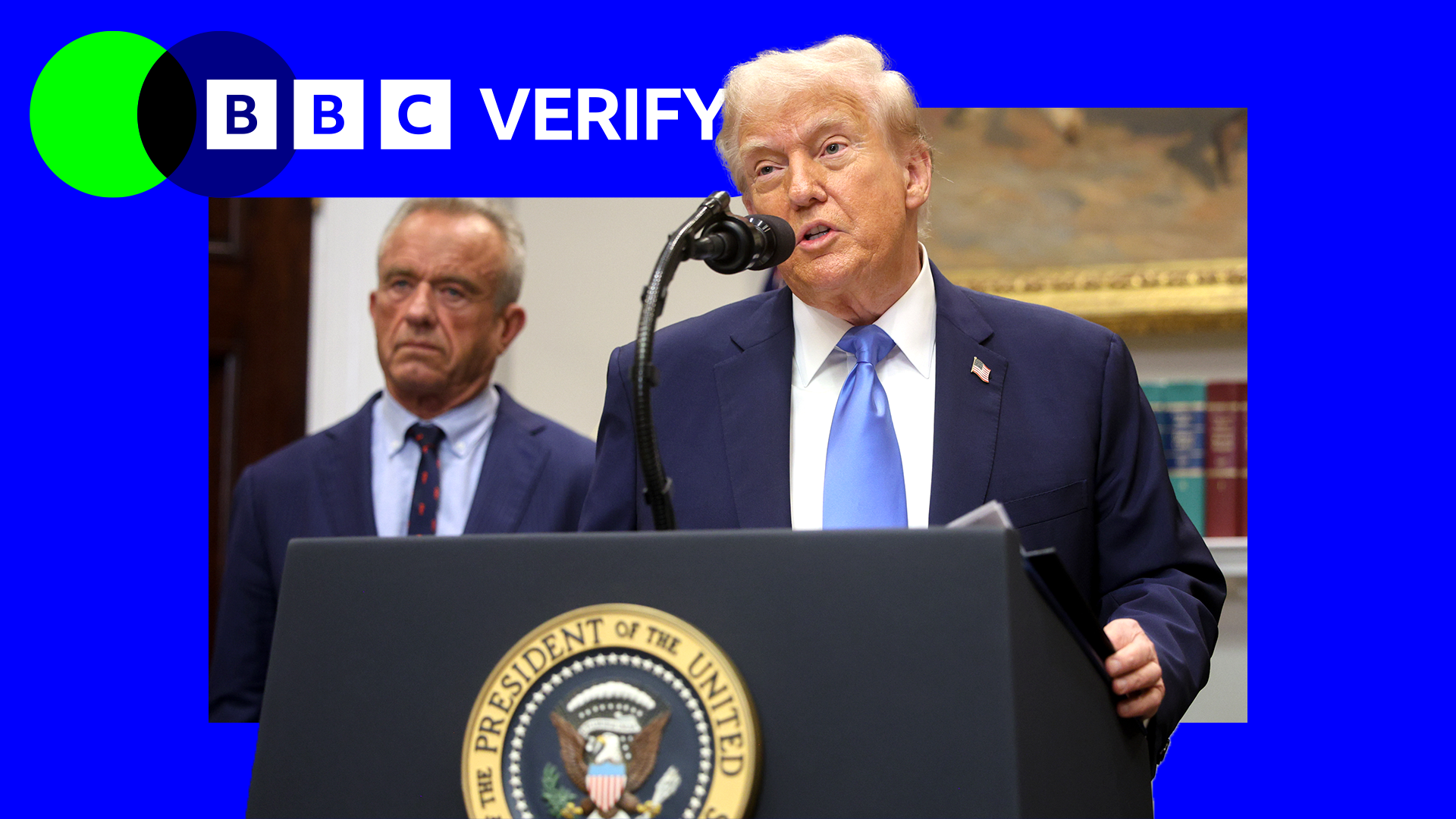
US President Donald Trump has signed an order that calls for fewer childhood vaccines and also recommends splitting the mumps, measles and rubella (MMR) shots.
“Decades ago, children received only a small fraction of the vaccines required today,” Trump said. “In those times, people were much healthier and of course the high rates of autism now observed did not exist.”
The president has long cast doubt on the safety of MMR vaccines, but multiple studies have found no connection between the shots and autism.
The order also recommends that the number of childhood vaccines drop to 11 from the existing 18 recommended by the American Academy of Pediatrics (AAP).
Trump’s order serves as guidance, not a mandate, since shots required for school attendance are set at the state level, rather than by the federal government.
Speaking in the Oval Office on Monday, the president said his administration “is recognising gold standard childhood vaccine recommendations for only 11 core vaccinations against the most serious and dangerous diseases”.
The immunisations recommended for all children under the order are for measles, mumps, rubella, diphtheria, tetanus, pertussis, polio, Haemophilus influenzae type B, pneumococcal disease, human papillomavirus, and varicella or chicken pox.
“We’re reducing them,” Trump said. “It’s not only that you’re doing fewer vaccines, or jabs, as they say, but you’re doing them in a series of visits to the doctor.”
The president suggested the MMR vaccine could be “quite lethal” if given at once. He compared it to pouring a bottle of soda into a child’s body.
When a reporter asked for evidence of the “lethal” claim, Trump said: “What I’ve heard is that there are some people that say it is that way.”
According to the Centers for Disease Control and Prevention (CDC), external, the MMR vaccine carries a very small risk of febrile seizures for young children. Those with health issues, including severe allegeric reactions or weakened immune systems, are advised to consult with healthcare providers before taking the shots.
The agency says “most people who get MMR vaccine do not have any serious problems with it”, and that getting the vaccine “is much safer than getting measles, mumps, or rubella”.
According to the CDC, there is “no published scientific evidence that shows any benefit in separating the combination MMR vaccine into three individual shots”.
Experts say that allowing time between jabs means children are more likely to contract diseases in the interim or that they are more likely to miss appointments if there are multiple shots.
Trump’s Secretary of Health and Human Services (HHS) Robert F Kennedy Jr said the proposed changes were meant to give parents choice, not prohibit access to childhood vaccines.
Since taking office in 2025, Kennedy has sought to change and loosen vaccine regulations. During a tense 20-minute interview on CNN last week, Kennedy insisted he had “never questioned the efficacy of the MMR vaccine”.
Trump administration officials have said the order means children in the US would receive much less than the 72 shots recommended under the previous vaccine schedule, a figure that assumes annual flu and Covid-19 doses.
Dr Andrew Racine, president of the American Academy of Pediatrics, said Trump’s executive order was “dangerous” and not based on “gold-standard science”.
“Delaying or skipping shots is risky, especially as measles continues to spread and children go back to school,” Racine said.
Republican Senator Bill Cassidy, who was the deciding vote in the Senate to confirm Kennedy as health secretary, also admonished Trump’s executive order on Monday, labelling it “wrong”.
“The President does not have the expertise to make these changes,” Cassidy, a physician, wrote on X. “Vaccines are overwhelmingly safe. Vaccines are effective. Vaccines DO NOT cause autism.”
Experts fear that if parents refrain from getting their children vaccinated as a result of the discredited idea that childhood vaccines are linked to autism, it risks the re-emergence of diseases like measles.
Multiple studies have found no link between the MMR vaccine and autism. A recent high-quality study from Denmark in 2019 looked at 657,461 children and concluded that the data did not support the MMR vaccine causing or triggering autism.
On its website, the CDC recommends that two doses of the combined MMR vaccine be given to children, starting with the first dose at 12-15 months and the second between the ages of four and six.
How often and how many vaccines children in the US receive is based on the times when vaccines will work best with their immune systems and when they are most vulnerable to certain diseases, according to the AAP.
There is no medical reason to delay or skip recommended immunisations, the AAP says.
Trump’s order also calls for the development of alternatives to aluminium in vaccines, and to test if those alternatives are safer and more effective.
But the AAP, external says studies have found no significant health risks associated with the tiny amounts of aluminium salts in vaccines.
Small amounts of aluminium salts – which are found naturally in soil, water and foods – have been used in some vaccines for decades in order to boost the body’s immune response.
That means lesser quantities of the vaccine and fewer doses are needed, according to AAP.
-
-
Published23 September 2025
-
-
-
Published23 September 2025
-
-
-
Published7 hours ago

-