
This post was originally published on this site.
Seventy percent of marketers believe the marketing industry has changed more in the past three years than in the past 50. That means that marketing automation platforms need to change, too. Pardot is a longtime fixture of the B2B landscape, but the lack of development has left many businesses looking for alternatives.

Why are businesses leaving? What Pardot alternatives are they choosing, and what do experts say about having a successful migration? This guide answers all these questions and more.
Why Marketers Are Seeking Pardot Alternatives Now
Pardot (rebranded as Marketing Cloud Account Engagement in 2022) is a B2B marketing automation platform owned by Salesforce. According to Pardot expert Tom Ryan, founder of MarCloud, many Pardot users choose to leave because they fear it will be discontinued.
Ryan has been a Pardot consultant since 2016 and feels the eventual discontinuation is obvious. “There’s no development on the platform,” he explains. “There’s a clear migration path.” To Ryan, it feels like “it’s just a case of ‘when’ not ‘if.‘”
Beyond discontinuation fears, Ryan points to revenue attribution and reporting as persistent pain points. Revenue attribution is “[incredibly difficult] if you do not know how to do it. Users need to wrestle with the Pardot-Salesforce sync,” he said. Reporting presents similar challenges, as the platform offers little flexibility. “The reports are not customizable in Pardot and therefore, people cannot get the reports they need. Clear reporting in general is very difficult for people to achieve, without consultant-level knowledge.”
In Ryan’s experience, the most common destination for customers leaving Pardot is HubSpot. “Pardot to HubSpot makes the most sense. There’s a lot of architectural similarities between Pardot and HubSpot via the connector. So there’s a familiarity there, and you get so much more.”
How to Evaluate Pardot Alternatives for B2B Teams
Pardot alternatives should be evaluated on CRM integration. HubSpot and Zoho both offer full CRM capabilities, making them top candidates for businesses leaving Salesforce altogether. Salesforce Marketing Cloud Next runs natively on Salesforce’s own platform, so there’s no separate system to sync at all, eliminating the data silo issue that Pardot has. Marketo maintains a native two-way Salesforce sync for teams that want to keep their CRM there. ActiveCampaign offers the same native Salesforce sync, plus its own lightweight CRM for teams that want to consolidate instead.
B2B teams should also weigh these criteria when reviewing Pardot alternatives.
- ABM and lead scoring: Does the platform support both individual lead scoring and coordinated outreach across a group?
- Sales alignment: Is the data easy for sales to access?
- Integrations: Does the new platform integrate with your existing marketing tech stack: email marketing, analytics, reporting tools, etc.?
- Time-to-value: Can a marketer build and launch without a developer or certified consultant, or does every task require outside help?
Pardot Alternatives at a Glance
Pardot Alternatives
Businesses looking to leave Pardot need to evaluate other tools based on CRM sync, automation capabilities, integrations, and price.
1. HubSpot Marketing Automation
HubSpot Marketing Automation builds multi-step B2B nurture workflows that trigger based on behavior, lifecycle stage, or CRM data. The tool is designed for marketers who want their data under one roof with HubSpot’s Smart CRM, alleviating the pain points of Pardot’s siloed design and clunky features. Teams can replace Salesforce CRM with HubSpot CRM, or use the native two-way sync to keep contacts, companies, deals, and activity history aligned across both platforms.
Key HubSpot Features
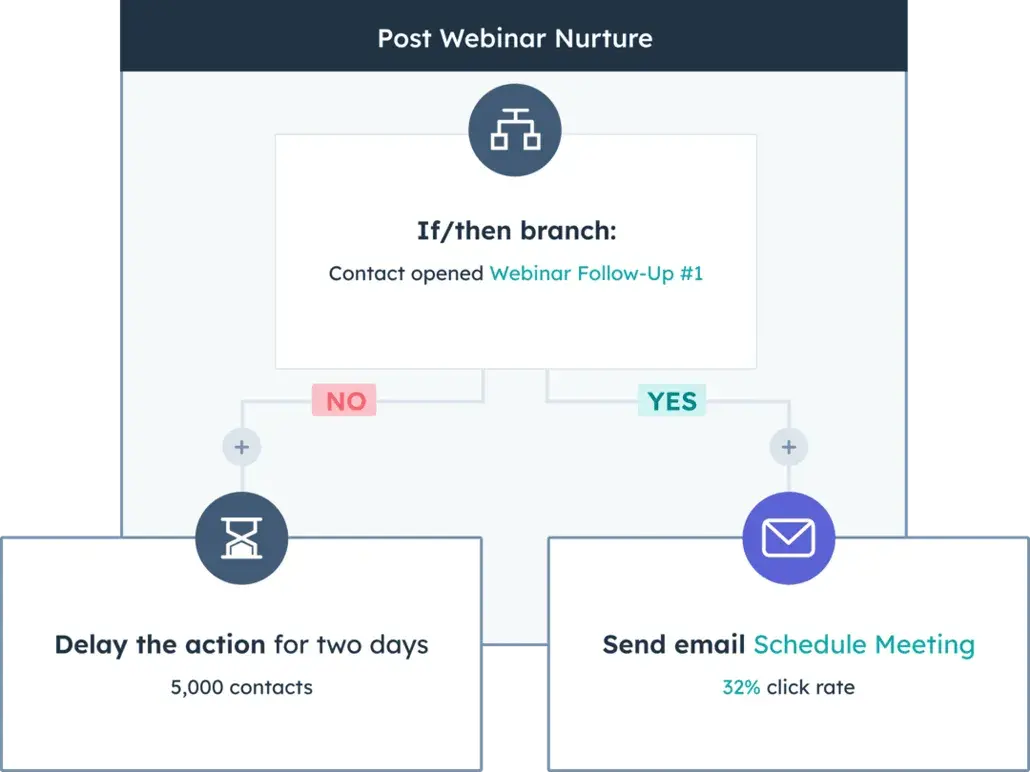
- Marketing automation: Build multi-step nurture workflows that trigger based on a prospect’s behavior, lifecycle stage, or CRM data. This replaces the rigid workflows in Pardot with something marketers can build and adjust themselves.
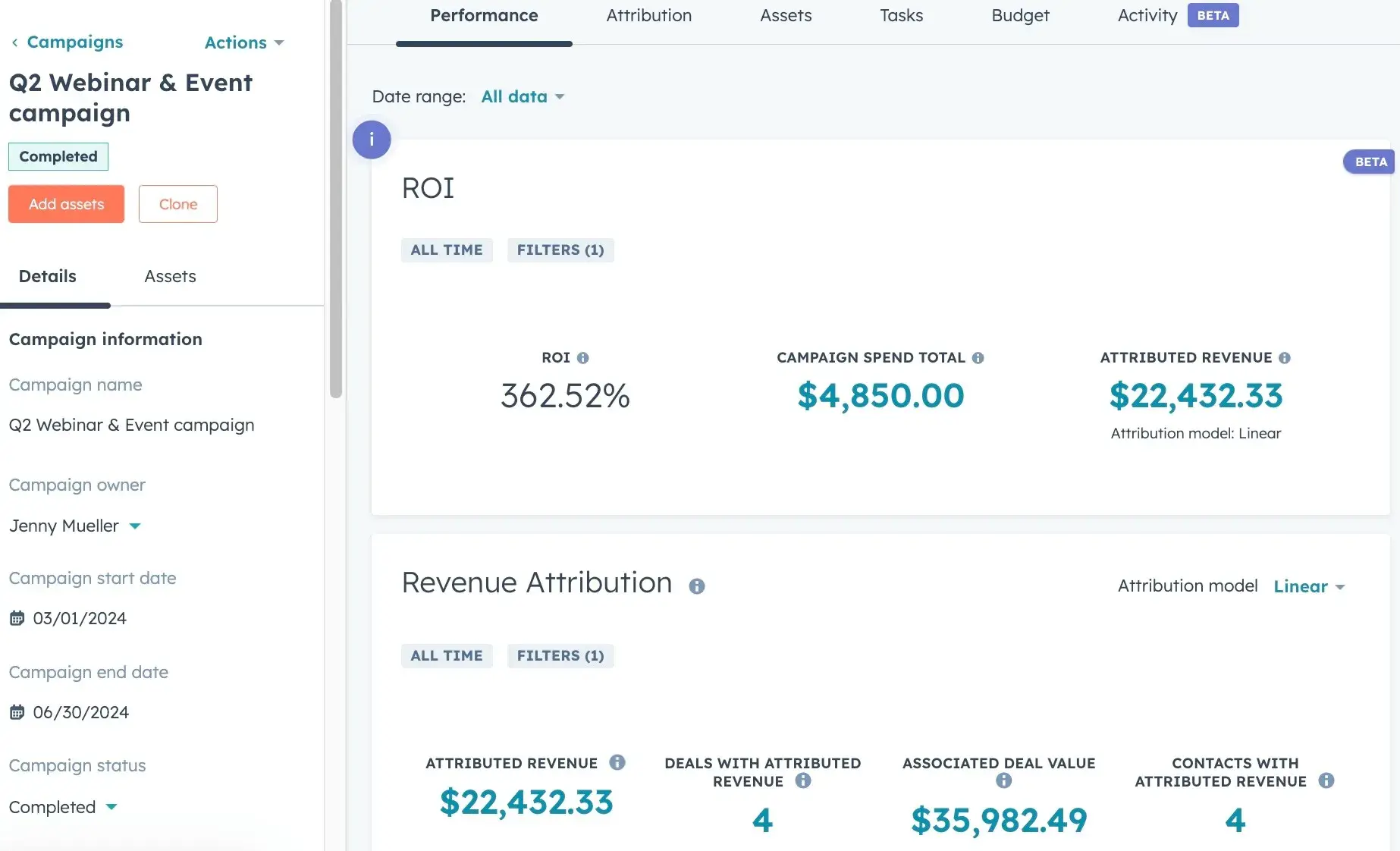
- Marketing campaigns: Connect social, ads, emails, and landing pages into one tracked campaign. This allows B2B teams to measure cross-channel impact without manually piecing data together between sources.
- Lead scoring: Ranks prospects by fit and engagement so sales teams receive only qualified leads.
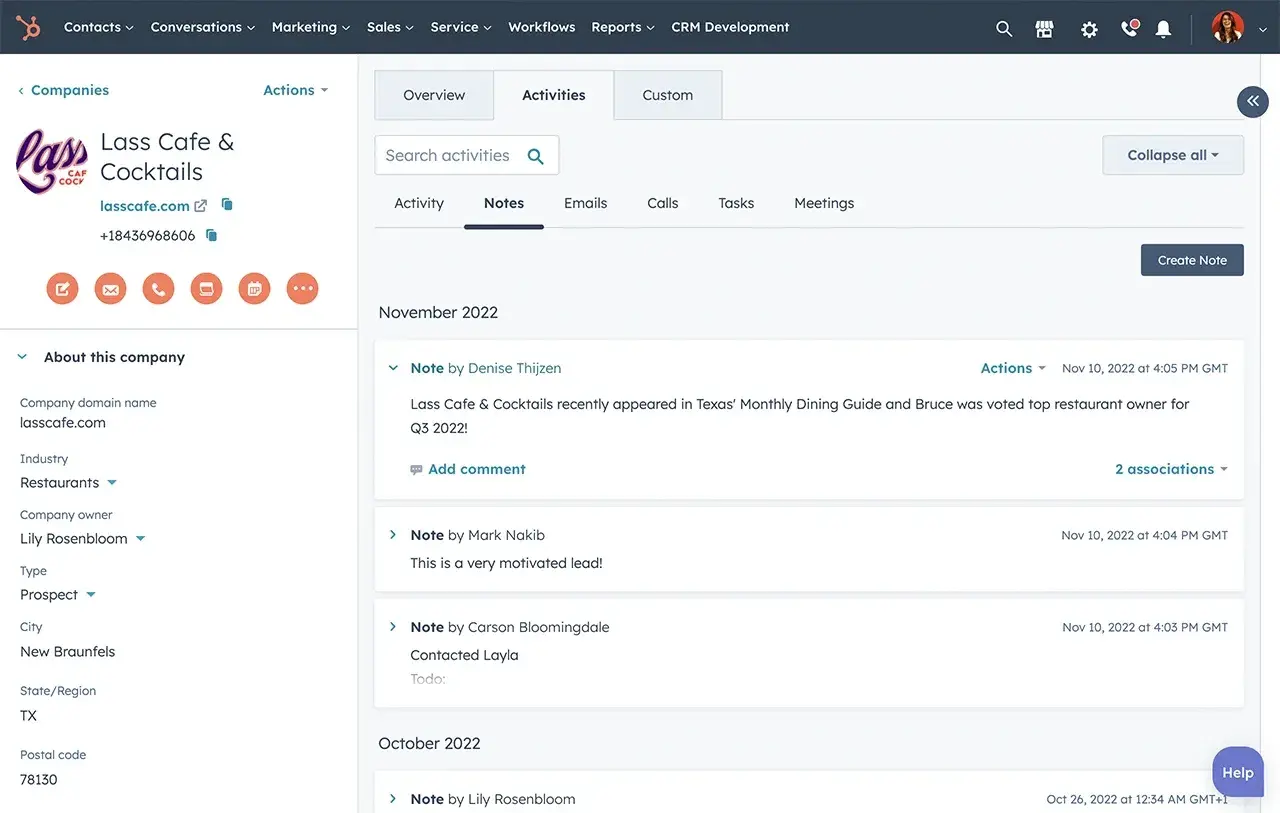
- Contact management: Unifies sales and marketing data on a single contact record so handoffs between teams don’t require syncing across separate platforms.
- Website tracking: Track organic search traffic and site visitor behavior with HubSpot’s built-in analytics, plus a native Google Analytics 4 integration.
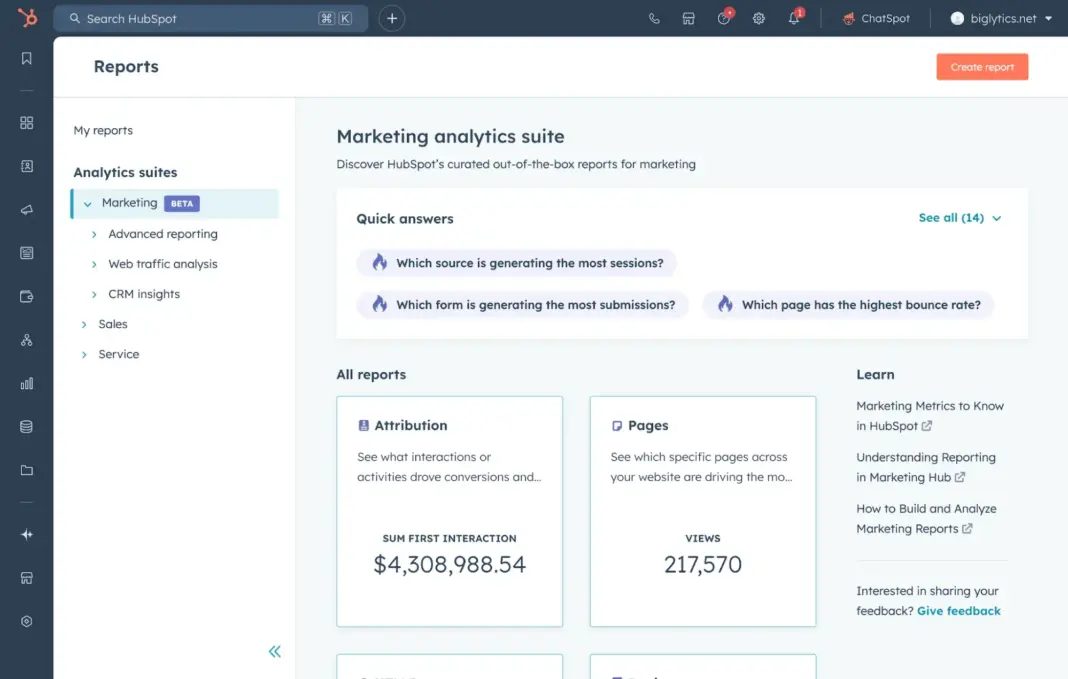
- Advanced marketing reporting: Attribute revenue back to specific channels and campaigns so B2B marketers can validate ROI to leadership.
Reviews: Ease of use is the top strength cited by HubSpot Marketing Hub users, followed by email marketing, automation, and intuitive design. Users cite the learning curve and missing features as the cons.
HubSpot Marketing Hub Pricing: Free plan for up to 2 users. Paid plans starting at $10/month/seat.
What I like: HubSpot is famous for its user-friendly, modern interface and its all-in-one platform that syncs across marketing, sales, and CRM. It’s built for marketers, with all the marketing automation tools needed to test and scale. I love the drag-and-drop email and campaign builders that allow you to iterate and execute without waiting on developers.
2. Salesforce Marketing Cloud Next
Salesforce Marketing Cloud Next is the tool that Salesforce itself pushes Pardot customers towards. Marketing Cloud Next is built natively on Data Cloud, rather than running as a separate, connected system as Pardot does. Marketing Cloud Next isn’t the right fit for every team, particularly for those replacing Pardot, who often want less Salesforce dependency. Marketing Cloud Next is a massive, expensive tool that suits teams that are already deeply ingrained in the Salesforce ecosystem and want to stay there.
Key Marketing Cloud Next Features
- Built on Salesforce’s core platform
- Uses one unified data foundation across customer, campaign, and revenue data
- Includes autonomous AI agents
- Turns static marketing into live, two-way conversations
- Can launch campaigns with less manual setup than traditional marketing platforms
- Personalizes website content in real time as a visitor browses
“Salesforce is directing [customers] to their new platform called Marketing Cloud Next… but essentially what this is doing is prompting a wider tech review,” Ryan shared. Rather than a straight migration, many customers use the moment to evaluate their full stack. “So it isn’t necessarily that people are blindly going towards Marketing Cloud Next. Quite a lot of customers are going. The most common direction is HubSpot.”
This jump from Pardot to HubSpot is so common that Ryan’s business MarCloud went from being a Pardot-specific consultancy to earning Diamond Solutions Partner status with HubSpot. He shared that some customers choose Marketing Cloud Next when they are already using other Salesforce tools, like Data Cloud or Agentforce.
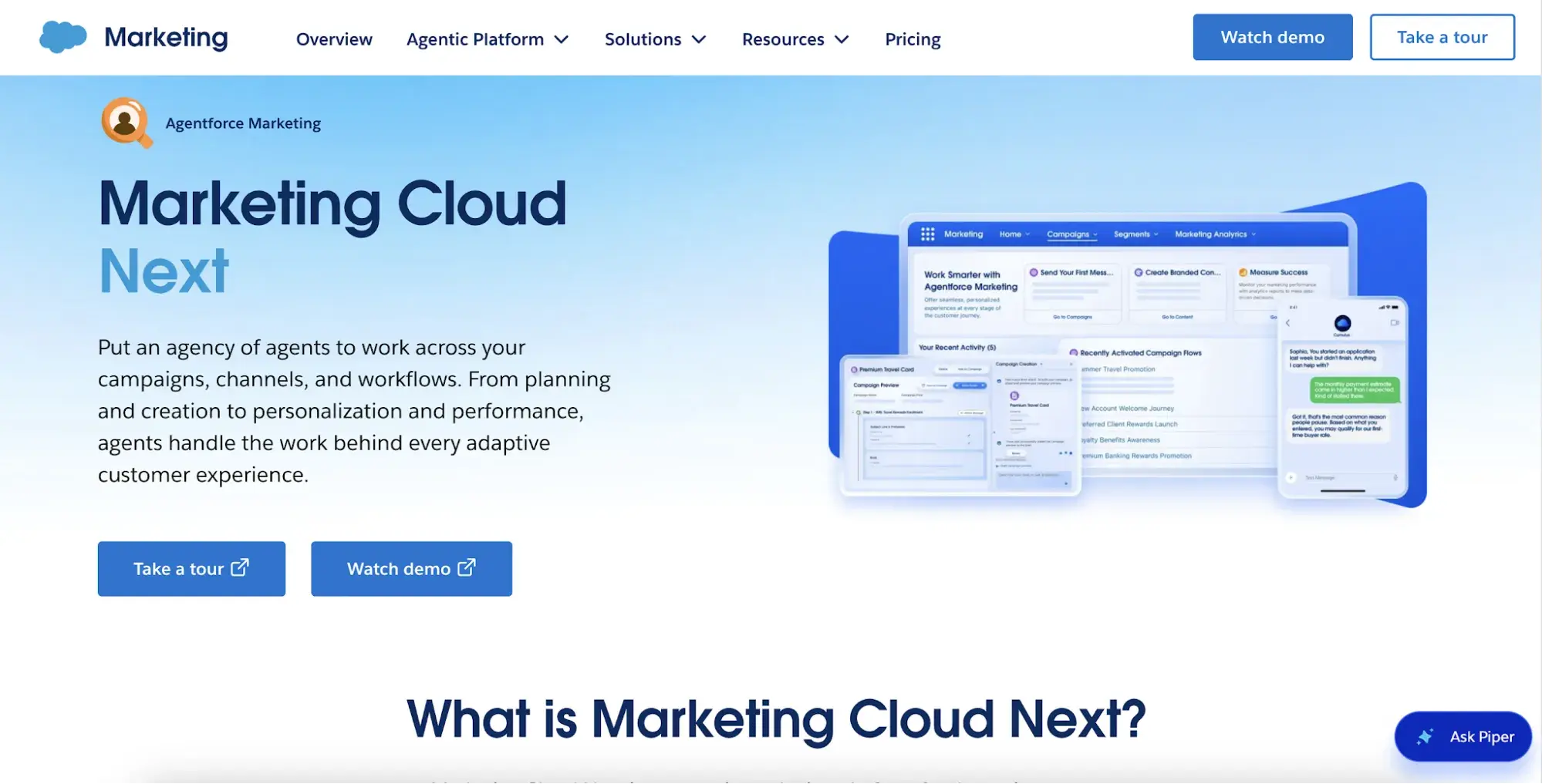
Reviews: When reviewing Agentforce Marketing (which includes Marketing Cloud Next), users disagree on usability. Ease of use is a highlight, while learning curve and complexity are common concerns.
Marketing Cloud Next pricing: The Growth Edition pricing starts at $1,500/organization/month.
Best for: Marketing Cloud Next is best for large companies that don’t want to give up their other Salesforce integrations.
3. Adobe Marketo Engage
Marketo is a robust enterprise marketing automation software that can be a good fit for customers who have outgrown Pardot. The platform brings more complexities and requires a higher budget, and users report that it prioritizes features over ease of use. Complex teams with the time and resources to invest in setup and customization may find that tradeoff worthwhile.
Marketo Key Features
- Native two-way sync with Salesforce for leads, contacts, and campaigns
- Lead scoring and grading
- Multi-step lead nurturing
- AI-assisted campaign building
- Cross-channel campaigns (email, web, mobile, events, paid ads)
- Segment-based email personalization
- Multi-touch revenue attribution reporting
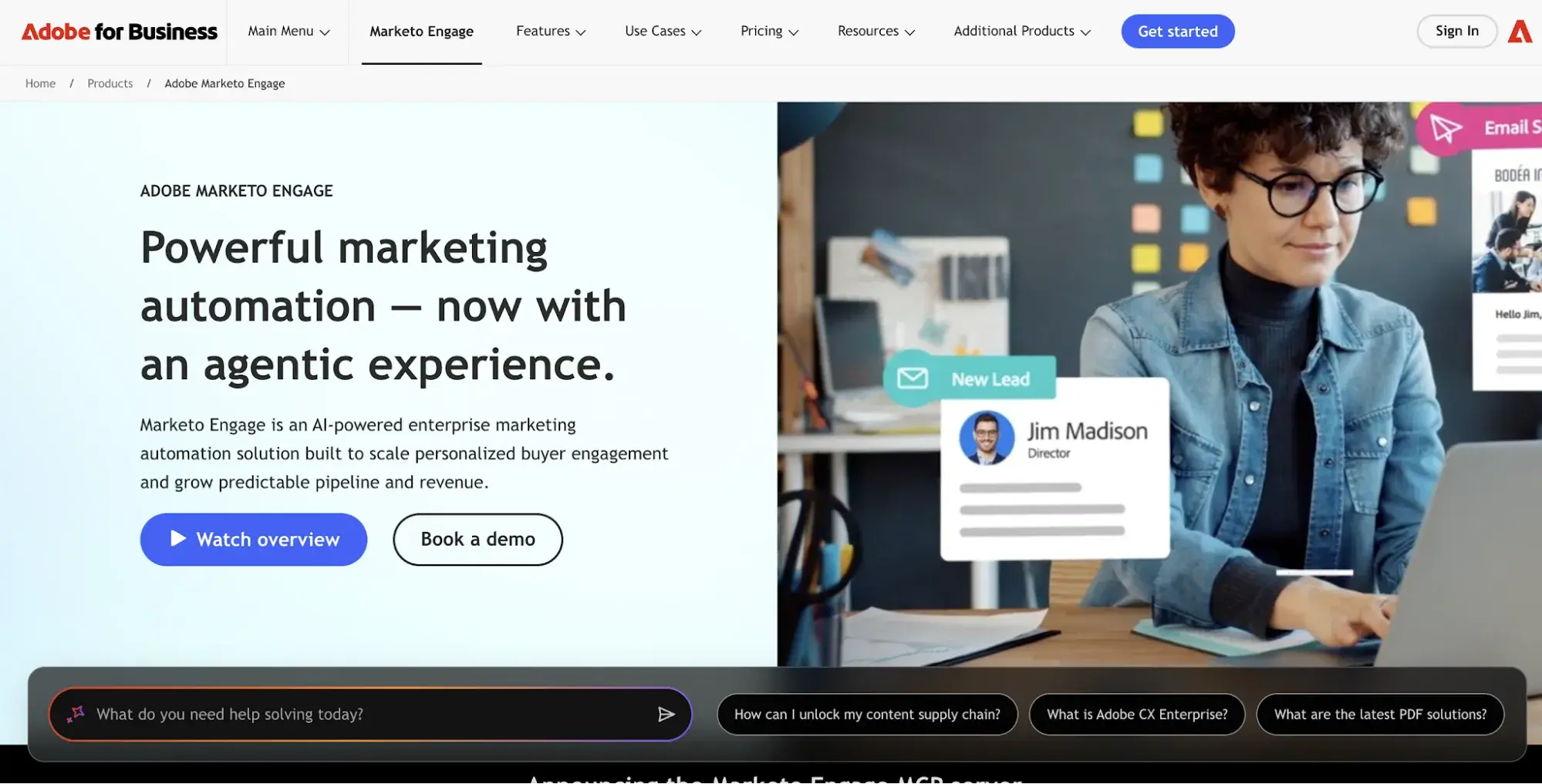
Reviews: Users cite the ease of use and automation are Marketo’s strengths. The drawbacks of the tool are the learning curve, unintuitive design, and complexity.
Marketo pricing: Adobe doesn’t publicly share pricing details for Marketo and requires businesses to book a call to get an estimate.
What I like: Marketo’s strength is its AI “conversational interface” that allows teams to write and test code directly within the platform without requiring developer handoffs.
4. ActiveCampaign
ActiveCampaign is an AI-forward marketing automation platform that includes a lightweight CRM. The platform offers multi-channel automation and a native two-way Salesforce sync, making it an option for smaller teams that want simplicity over Pardot’s complexity. Pricing jumps are steep when moving between tiers (or when the company increases prices for existing customers), which is important for scaling businesses to consider.
Active Campaign Key Features
- Lightweight native CRM and Salesforce sync between contacts, leads, and email engagement data
- Multi-step marketing automation workflows
- Lead and behavior-based segmentation
- Multi-channel messaging: email, SMS, and WhatsApp
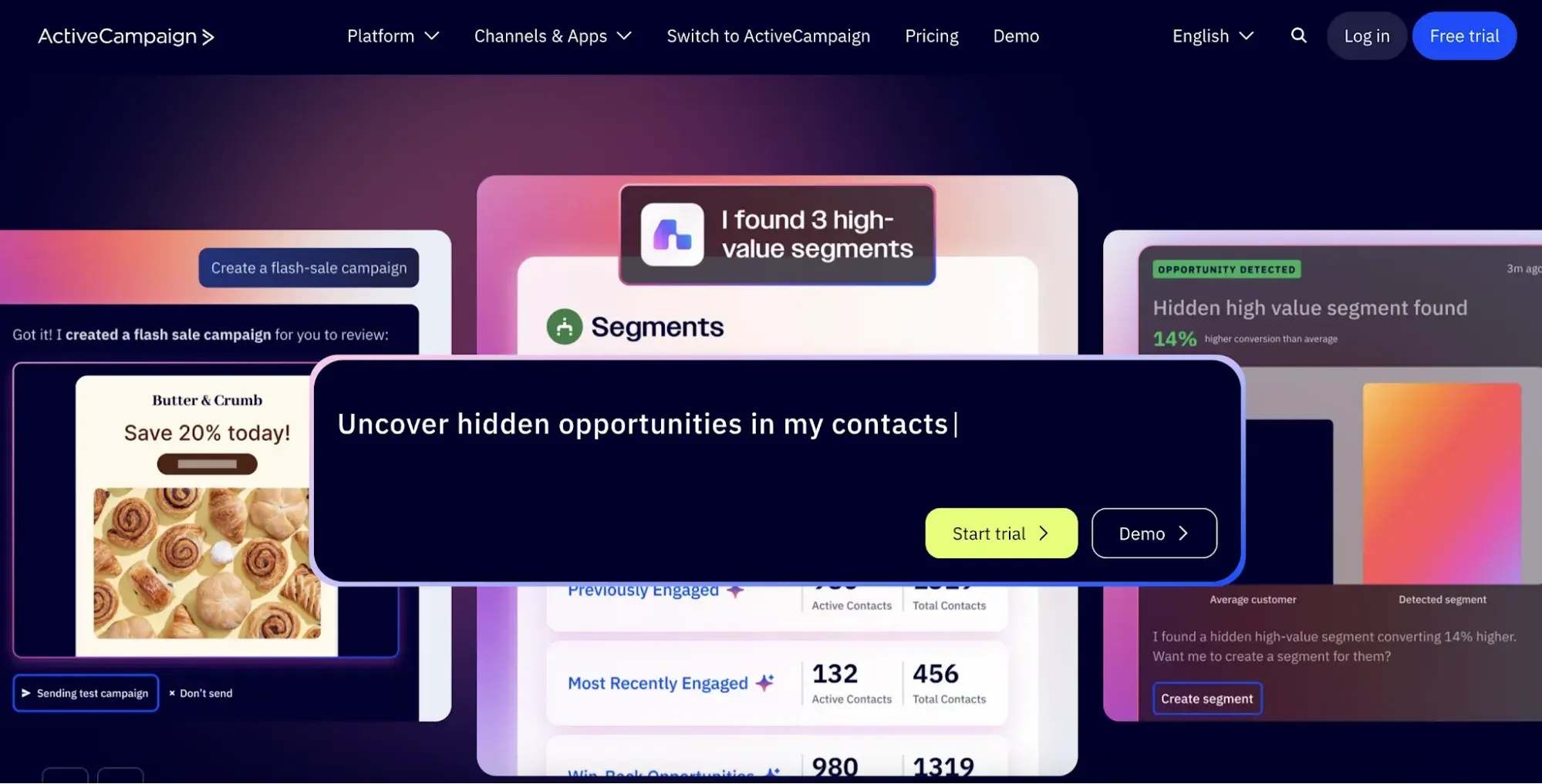
Reviews: Users praise the ease of use and automation. The most common complaints are the learning curve and weak reporting, with limited reporting features cited repeatedly as a specific pain point.
ActiveCampaign pricing: Plans start at $15/month and scale quickly with your contact count.
What I like: The “active intelligence” feature that lets users use spoken language to prompt the AI on any feature, which is a huge shift from Pardot’s code-heavy design.
5. Zoho Marketing Automation
Zoho Marketing Automation syncs natively with Zoho’s own CRM and across marketing channels. The platform uses customer data to score leads, generate campaigns, and personalize outreach. Zoho is a budget-friendly Pardot alternative that’s less robust than other platforms, but it can be a good option for small businesses with straightforward data needs.
Key Zoho Marketing Automation Features
- Connects to Salesforce to bring lead data into campaigns via a third-party connection rather than a native sync.
- Behavior-based lead scoring that tracks website visits, email opens, and content downloads
- Multi-channel campaign automation across email, SMS, WhatsApp, and social
- Behavior-triggered nurture journeys and follow-up sequences
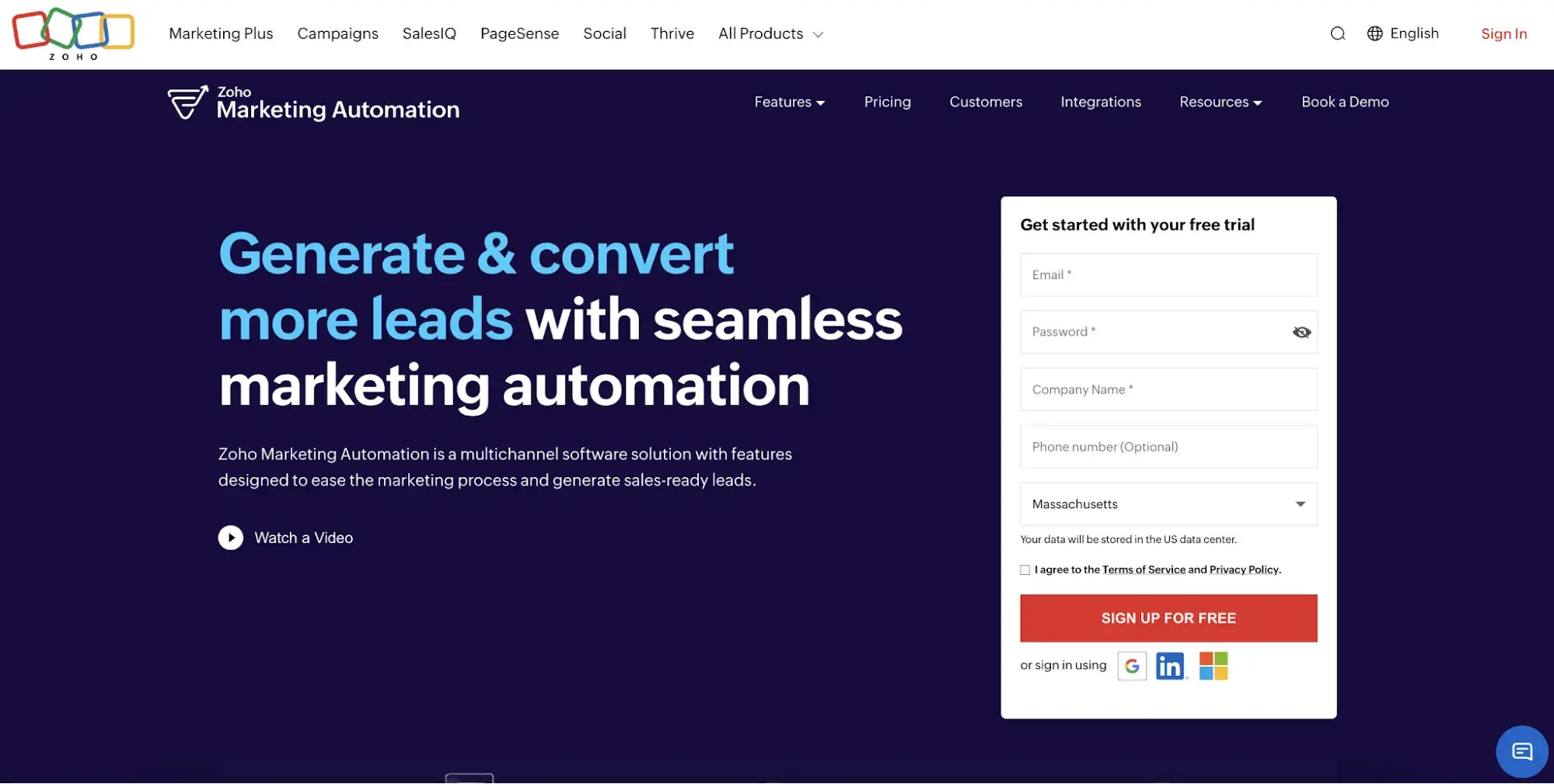
Reviews: Users praise the marketing automation solutions but report issues with customer service and reporting.
Zoho Marketing Automation pricing: Plans start at $19/month for 1,000 contacts.
What I like: Zoho offers a budget-friendly option for companies ready to move away from Salesforce entirely, whereas many customers leaving Pardot choose to retain Salesforce as their CRM.
Which Pardot alternative fits your use case?
Choosing a Pardot alternative requires an assessment of budget, current needs, growth, and features. The following guidance covers which tools are best for which use cases.
- HubSpot Marketing Hub: For marketing teams that want speed, ease, and unity across marketing, sales, and CRM. The drag-and-drop email builder and lead management tools make it a popular choice.
- Salesforce Marketing Cloud Next: Best for teams already deeply ingrained in Salesforce that want agentic marketing automation and advanced personalization at scale.
- Marketo: Best for account-based marketing (ABM) teams that need advanced customization and have significant budget and time to invest in setup.
- ActiveCampaign: Good for businesses that want built-in event workflows and prompt-based automation building, no coding or manual workflow setup required.
- Zoho: Strong choice for budget-sensitive teams with straightforward email marketing needs who are willing to move off Salesforce and consolidate with Zoho’s own CRM.
How to Migrate From Pardot With Minimal Risk
A low-risk Pardot migration requires data mapping, workflow translation, QA, and phased rollout. Underestimating the translation factor of the migration is one of the most common mistakes that Ryan sees.
For example, campaign attribution modeling differs across platforms. “A Salesforce campaign is a completely different object from a HubSpot campaign… so there’s a translation there,” Ryan explained.
Ryan says that users need to think through questions about campaign attribution modeling — where it lives, how it operates across systems, and whether existing Salesforce hierarchies are worth preserving.
“If we’re going to get to campaign attribution modeling, do we do it in HubSpot? Do we do it in Salesforce? Do we do it in both? How do we want to continue operating? Because some companies have a really good campaign hierarchy in Salesforce that they’ve built, and they don’t want to lose that effort,” he shared
Migrations are complex, and Ryan organizes priorities into three buckets:
- What’s needed
- What’s nice to have
- What will you do if you have the time
With the right planning and discovery, Pardot migrations can take as little as one month.
Frequently Asked Questions About Pardot Alternatives
Is Pardot part of Salesforce?
Yes, Pardot is part of Salesforce. It’s also known as Marketing Cloud Account Engagement or just Salesforce Account Engagement. Pardot is the original name, and Salesforce rebranded it to Marketing Cloud Account Engagement in 2022.
How long does a typical Pardot migration take?
While a fast Pardot migration can take one month, Tom Ryan has found that a typical migration takes 2-3 months.
Will we lose our lead scoring and ABM models if we switch?
Yes, both will need to be rebuilt. Lead scoring cannot be ported directly because Pardot uses an out-of-the-box scoring model that doesn’t transfer to other systems. “However, scores and grades can still be retained when migrating to a new platform, for segmentation reasons,” Ryan advised. “Treat it as an opportunity to rebuild the model with the learns gained from Pardot.”
ABM models face the same challenge, as Engagement Studios and automations do not port easily to new systems. “A key consideration here when migrating is to carefully track where prospects are in a given journey, as they should continue where they left off in any new system,” he shared. “Working with a partner makes this process safer and more reliable.”
Can we keep Salesforce for sales but switch off Pardot?
Yes, you can leave Pardot, but still keep Salesforce. Pardot is billed as a distinct line item in Salesforce, so businesses can keep CRM, Sales Cloud, etc., while switching to a separate automation tool.
What’s the best way to budget for the first year on a new platform?
Budget for the platform’s list price at your current size, plus the growth you expect in seats and contacts, since jumping tiers is often where costs escalate fastest. Also factor in onboarding and implementation fees, which some platforms charge as a mandatory cost in year one.
Making the Switch from Pardot
A business’s marketing is only as good as its tools. When your automation tools have fallen behind the times, it’s time to invest in a platform that’s current. These Pardot alternatives are diverse enough to meet different teams’ needs and powerful enough to handle advanced customization at scale.
Ready to start now? HubSpot Marketing Hub supports marketing automation and reporting for businesses of all sizes. Speak to a sales rep or sign up and try it for free today.