
This post was originally published on this site.
Youthful Pocognoli the brave choice for Scotland job
To play this video you need to enable JavaScript in your browser.
This video can not be played
-
Published
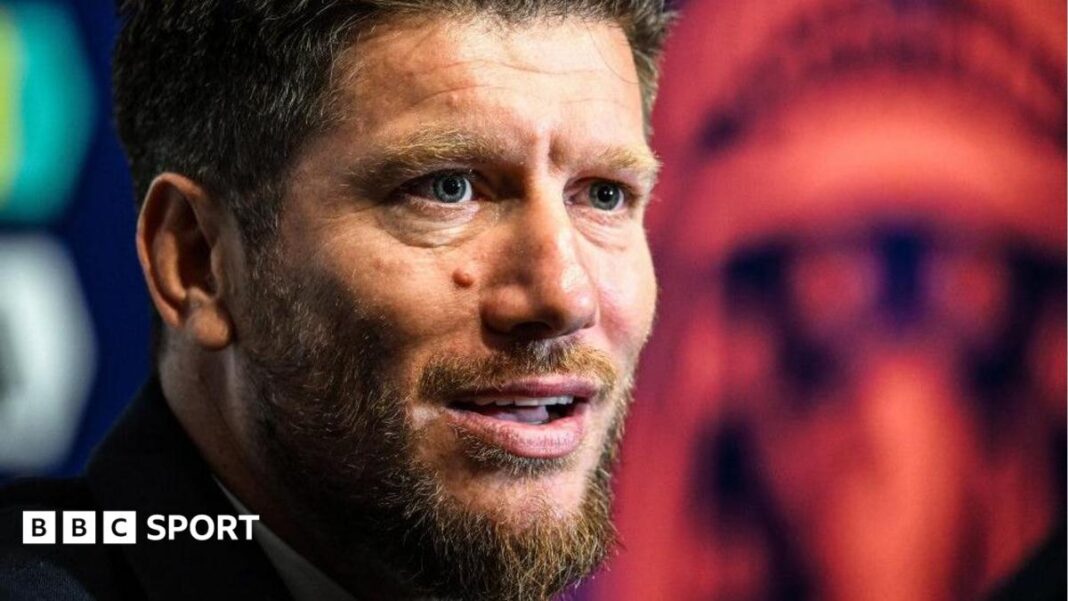
He stood on the gantry at Hampden – Sebastien Pocognoli, 39 years young, but with the gnarled face of a former full-back with 300 games and more under his belt, 16 years younger than Steve Clarke was when he took the job at the age of 55.
Younger than most, to be fair. Younger, for sure, than any manager who appeared at the last World Cup, younger even than Julian Nagelsmann, the then Germany manager, by a week.
The World Cup had 25 managers who were in their 50s, 11 in their 60s and five in their 70s. Pocognoli is in short pants by comparison.
Look around the world and it’s hard to find an international coach who is his junior. Singapore, yes. Most other places, no. If the Tartan Army wanted different, then they’ve got it, with bells on.
Different in the way he wants his team to play – front-foot, high press, high intensity, “mastery in possession” – as opposed to Clarke’s style, which leaned into risk aversion too often for the liking of the fans.
All we know of Pocognoli comes from a mere 107 senior games as manager of Union Saint-Gilloise and Monaco. He’s a rookie and a gamble – but an intriguing one. There’s an air of mystery and buzz about this one. A high-wire act from the Scottish FA. Who’d have thought it?
Is he Sebastien or Seb or Sebba, as some call him? “Also Poco,” said the new Scotland head coach, with half a smile. Imagine Clarke saying: “Call me Stevo or Clarkey, if you wish.” The differences between the two men stretch as long as the Hampden pitch, the one similarity his employers are banking on is that he becomes the serial qualifier Clarke became.
-
Pocognoli ‘feels connection’ with ‘passionate’ Scotland
-
Published6 hours ago
-
-
What awaits new Scotland head coach Pocognoli?
-
Published22 hours ago
-
-
Scottish FA withdraws support for Fifa president Infantino
-
Published6 hours ago
-
His youth is a huge talking point, as is the fact he’ll be pitting his wits against some very experienced operators in the months and years ahead. He has signed an initial two-year deal. The former Everton player, and Pocognoli’s previous coaching side-back, Kevin Mirallas is likely to join him in Scotland.
“I like to do things in a different way,” said Pocognoli. “I don’t believe there is one way to be the best in life. Not only about football, but generally in life. Did the Scotland challenge [reflect] my identity and personality? I think that, yes, and that’s why I was curious to go through the meetings.
“I’m maybe one of the youngest managers for the job but I was also one of the youngest managers in Belgium.
“Everybody was surprised. And at the end, it was a happy end. And then I continued the journey in Monaco and today I’m here.”
Belgium was Union Saint-Gilloise, who use the same data analytics company as Hearts, and the remarkable story of their first league title win in 90 years. That was 2024-25 and Pocognoli was in charge. He was 37 when he got the job and delivered massively at the first time of asking.
USG had been a process, though. For context, they didn’t go from nobodies to champions in Pocognoli’s one season at the helm. They’d been knocking on the door for three seasons, under different managers, before he arrived; second, third and second in the three campaigns prior to his elevation from coaching at underage level. In 2023 and 2024 under different managers they missed out on the title by a point. Pocognoli was the historic one who got them over the line.
How did it happen? “Well, it starts with people who believe in you, give you the opportunity to shine,” he explained. USG are a curious case. They have had four different managers in recent seasons and all of them left the club quickly, poached away to supposedly bigger things, only to fail.
Felice Mazzu left USG for Anderlecht, Karel Geraerts went to Schalke and then Reims. Alexander Blessin went to St Pauli. Pocognoli, himself, left for Monaco. All of them were a disappointment. It begs the question and adds to the suspense about these managers being products of a system at USG. Can they operate successfully outside of that system?
To play this video you need to enable JavaScript in your browser.
This video can not be played
Clarke was the veteran coach who worked with Ruud Gullit at Newcastle, Jose Mourinho at Chelsea, Gianfranco Zola at West Ham, Kenny Dalglish at Liverpool and the wise old head who managed West Brom for a year and Kilmarnock for two.
Pocognoli is the up-and-comer who managed USG to a league title and a cup in his first season in management, the culmination of which was a manager of the year award and a tag of one of the hottest young things in the game. He was lured to Monaco but failed, by their standards, and was sacked after 38 matches. One extreme to the other. A season of glory and a season of angst. He’s piled all managerial emotion into two campaigns.
How does he describe himself? “Oh, it’s not easy to talk about myself,” he said. “I’m a passionate person. What I love the most is football. I try to work in a certain ethical way in terms of communication, loyalty, integrity. I’m quite dynamic also, and try to reflect this personality on the pitch.”
He paid tribute to Clarke at every turn and vowed to build on it. “I just want to bring the next step, just to bring some dynamic moments on the pitch,” he explained. “Front-foot defending, front-foot attacking and just play with a big heart. Run more than the opponent, create chances, give some good vibes and energy in the stadium.”
And the things he won’t tolerate? “When you represent your country, you just expect that your players give the head and the heart for the country and for the shirt,” he said. “So, that’s the basement. Everybody who will be selected on the pitch has to play with big integrity. The mentality and the desire to represent the country is the most important.”
He has preferred systems but he’ll wait and see on that front. He has started his due diligence on every Scotland player and has spoken to some, but you get the impression that his knowledge of these guys didn’t begin when he got the call from Hampden asking about his availability. He comes across as a guy who eats the game for breakfast, lunch and dinner.
“I just want to play attractive football,” he replied when asked about what system he intends to use in the fast approaching Nations League.
He talks about his lack of games as a manager. “No, it’s not a lot, but each game is a moment to learn,” was his rationale. “And it is [the case] for all the jobs in the world. It’s the same for you or for all the people who are starting a job. I’m very analytical. I’m very objective about what I can improve daily. I’m very reflective about progressing every day.
“Scotland can be a good fit for me but I also want to bring the next generation on the pitch and to develop them. It’s very important. What Steve achieved was fantastic because he put Scotland back on the map. But I have to continue this.
“There’s different successes. You have the numerical success – winning games. It’s the most important. So, I will try to bring this winning mentality and to play each game to win the way that I would like to do it. You can also be successful with a nice entertaining style of play on the pitch that the supporters can enjoy and smile about after the game.
“And there’s the future, the developing of the young players is also success. So that’s also very important. If you think about Scotland from outside, you’d straight away think about passion, about players who just fight together, who run more than the opponent. And that has to be the base. With the quality that we have – and we have a lot – we want to bring some offensive movements. I like to be aggressive.”
He has six games between late September and mid-November and a trip to Slovenia to start with. By then we’ll know what’s the most suitable moniker – the overly-familiar Sebba or Poco – or something more stern.
His employers are all in on him. Salute their bravery and their ambition – it is, after all, what everybody wanted.
Watch ‘I’ve never heard of him!’ | Meet new Scotland boss Sebastien Pocognoli on the BBC Scottish Football YouTube channel HERE, external
To play this video you need to enable JavaScript in your browser.
This video can not be played