

This post was originally published on this site.
To the well and back – how Malaga returned to La Liga
-
Published
For Spanish football enthusiasts, the returns of Deportivo La Coruna, Racing Santander and Malaga to La Liga are a welcome sight.
All three have featured strongly in Spain’s top flight in the past 30 years, before various factors meant they dropped out of professional football.
Of the trio, Malaga seemed the least likely to recover.
Ten years after stunning Europe’s elite in the Champions League, the Andalusians had no owner, no money, and seemingly no future.
Yet thanks to a hungry group of youngsters, an unconventional teacher and a fanbase that refused to let their club die, ‘los boquerones’ are back.
This is how they did it.
On 9 April 2013, Malaga were minutes away from reaching the Champions League semi-finals.
The competition debutants led 2-1 at Borussia Dortmund, but were dumped out in heartbreaking fashion after two stoppage-time goals from Jurgen Klopp’s fearsome side.
Regardless, Malaga looked set to achieve what countless others had tried and failed to – consistently challenge Spanish football’s ‘big three’ of Barcelona, Real Madrid and Atletico Madrid.
In 2010, Qatari Sheikh Abdullah bin Nasser Al Thani bought what was traditionally a second-tier club and began transforming them into a European contender.
Manuel Pellegrini was installed as manager and provided with quality players including Santi Cazorla, Jeremy Toulalan, Ruud van Nistelrooy and promising youngster Isco.
But Pellegrini joined Manchester City and Isco signed for Real Madrid in summer 2013 – and hopes of a golden era at Estadio La Rosaleda morphed into a decade of decline.
The following season Malaga were banned from the Europa League for breaching Uefa’s financial fair play (FFP) rules regarding overdue payments.
Mounting debts necessitated player sales, and relegation from La Liga followed in 2018. Two years later a regional court ordered Al-Thani’s removal because of alleged misappropriation of funds.
European and international arrest warrants have been issued against the Sheikh and his three sons, with prosecutors seeking prison sentences totalling 14 and a half years for alleged misappropriation, unfair administration and abusive corporate decisions.
Court-appointed administrator Jose Maria Munoz has overseen operations since 2020.
Fire sales and years of relying on free agents and loan signings helped steady Malaga’s financial position, but in 2023 a threadbare squad slipped into the regionalised third division.
“I was at the last game in the second division against Ibiza. Both teams were already relegated and it was like a funeral,” said podcaster and Malaga season-ticket holder Matt Harrison.
Escaping ‘the well’ and Kung Fu Panda
Spain’s third tier is known as ‘el pozo’ – the well – because it is notoriously difficult to climb out of. Fearing the worst, a group of local businessmen discussed plans to form a phoenix club in the event Malaga faded into obscurity.
Fortunately, a hungry squad of youth-team players and local lads secured promotion at the first attempt.
After finishing third in the south division of the third tier, Malaga faced a two-legged play-off final against Gimnastic Tarragona.
With the Catalans on top in the dying moments of extra time in the second leg, Antonio Cordero bundled the ball home to send the travelling fans wild and Malaga back to the second tier.
“The city exploded with promotion back to the second division,” said Harrison. That season in el pozo seemed to reignite the city’s love for its football team.
“Disgracefully, in Malaga there have always been lots of Real Madrid and Barcelona fans,” said Malaga supporter and journalist Jose Luis Sabatel.
“But when Malaga flew lower, an enormous quantity of ‘Malaguenos’ [residents] became ‘Malaguistas’ [supporters].”
Sergio Pellicer – in his second spell as manager – followed promotion with a 16th-place finish in the second division, but began the next season with just four wins in 14 games.
He was replaced by reserve-team boss Juan Francisco Funes, who had never played or coached in professional football.
A few weeks earlier the former teacher had considered returning to the classroom with his side bottom of their fourth division group.
 Image source, Getty Images
After beginning the Funes era with one win and two draws, the gamble began to pay off as Malaga won their next six games and surged to third in the table.
Not only did the results improve, but what had been a restrained side started playing some entertaining, attacking football.
“That style of football combined with local players made a perfect cocktail that energised the fans,” says Harrison.
Those players included academy graduates like striker Chupe – scorer of 25 goals – winger David Larrubia, and defender Diego Murillo, as well as others who grew up in the stands at La Rosaleda.
Knowing many of his younger players from the academy certainly helped Funes turn things around.
“He already knew their strengths, weaknesses and personalities from the outset. There was virtually no adaptation period, so they hit the ground running,” says Radio Marca journalist Juanje Fernandez.
Funes drew on his teaching experience, using historical quotes and films to motivate and convey ideas to a young group.
He is likely not the only coach to draw inspiration from The Good, the Bad and the Ugly, but he might be the first to use Kung Fu Panda to aid a promotion push.
“The players bought into Funes’ ideas from day one,” adds Fernandez.
“Footballers tend to perform at their best when they genuinely believe in what they’re being asked to do, rather than simply following instructions.”
Funes speaks about his players like they are his children, once affectionately describing them in an interview as ‘los bichos’. The colloquial term used to describe talented people soon became the team’s nickname.
‘Funesbuque’ is another name that stuck – ‘the good ship Funes’.
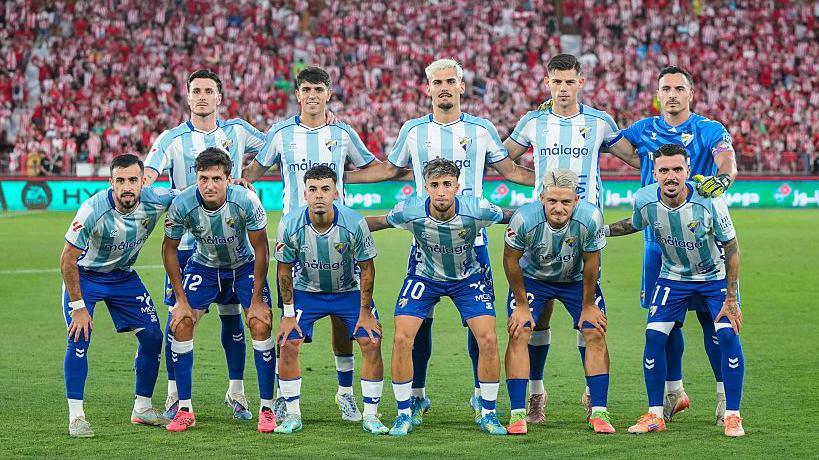 Image source, Getty Images
After finishing fourth, the 2025-26 season boiled down to a play-off final against Almeria.
Malaga had one of the smallest budgets in the division and had spent just £325,000 on permanent transfers since 2020. Almeria spent more than £10m that season alone.
After a goalless home draw in the first leg, hundreds of fans lined motorway bridges heading out of the city to wave the team on their way to Almeria.
It was a sight symptomatic of the strong bond forged between the team and its fanbase in recent years. It became a common occurrence for fans to welcome the team bus to the stadium with flags and pyrotechnics.
A song adopted by the club’s Fondo Sur ultras, borrowed from the ultras scene in Morocco, became the soundtrack of the season. ‘Es la Vida Loca’ – the crazy life.
Malaga’s average attendance last season was the 11th-highest in the country, but only a few hundred tickets were available for the game in Almeria.
Yet when Chupe steered Malaga in front before Larrubia curled in a stunning second, the whole fanbase did too – kit supplier Hummel incorporated the names of all 26,550 season-ticket holders into a special one-off strip.
The 2-1 victory sparked mass celebrations in Malaga. After partying all weekend, an estimated 185,000 fans lined the streets to give the team a triumphant welcome.
“It was a once-in-a-generation moment. Many young fans had never seen Malaga play in La Liga,” says Fernandez.
“An entire generation had grown up after the club’s Champions League years knowing little more than financial turmoil, sporting disappointment and uncertainty surrounding the club they loved.”
After a second night of partying, several players took to social media to challenge fans to meet them at 07:00 on Monday at a roundabout in a western suburb. Hundreds answered the call.
“That connection between the squad and the fans was one of the defining features of the campaign,” adds Fernandez.
“It helped create a sense that everyone, from the dressing room to the streets of the city, was pulling in the same direction.”
Given their financial constraints, Malaga’s preparations for the top flight have been low-key.
Several important players have renewed their contracts, while sporting director Loren Juarros has made some astute loan signings.
Promotion winner Carlos Dotor returned on loan from Celta Vigo, while £256,000 was spent on loaning winger Juan Cruz from Leganes.
Malaga fans know their club are favourites for relegation.
They open the season with daunting trips to Atletico Madrid (Wednesday, 20:00 BST kick-off) and Real Madrid, but after what they have been through that should not faze them.
“Malaga’s story is beautifully convoluted, with plenty of plot twists and the most enchanting ending,” says Sabatel.
“From now on, we can only enjoy.”