

This post was originally published on this site.
‘Relentless’ GCSE resit cycle ‘simply not working’, school and college leaders say
 Image source, Getty Images
-
Published
The “relentless” cycle of pupils in England failing and then resitting their GCSEs in maths and English is “simply not working”, a leading education union has said.
The Association of School and College Leaders (ASCL) said a “significant proportion” of students fall short of passing those subjects, and that most who retake those exams “face the miserable experience of falling short once again”.
Thursday’s results data showed nearly one in four maths and English GCSEs in England were taken by students aged 17 and older, mostly young people resitting exams they had previously failed.
The government said it wanted to stop the “endless treadmill of unnecessary resits”.
It said it would introduce a new “stepping stone” qualification from 2028 at Level 1 – one level below GCSEs – for students who do not achieve a pass in GCSE maths or English.
Currently, many courses and jobs remain dependent on students securing GCSE passes in those subjects.
But those that miss the grade can find themselves in a continuing loop of resits as they try and try again to pass.
Pepe Di’Iasio, general secretary of ASCL, said the fail-resit cycle was like “force feeding” students a “relentless diet of GCSE English and maths”.
“This limits their education and career options and is very likely to be a factor in the large number of young people who end up not in employment, education or training,” he said.
Pass rates for students aged 17 and older in English and maths are much lower than 16-year-old students taking the exams for the first time, bringing down overall GCSE grades for all ages across England, Wales and Northern Ireland as a result.
While resitting is not a requirement, according to the Department for Education (DfE), colleges will generally enter students into exams when they think they are ready.
For Marianne, from Cambridgeshire, results day has been a “mixed bag” as both of her sons, Tobias and Jake, collected GCSE results.
While Jake achieved a grade 8 in maths, his older brother, Tobias, did not get the pass he wanted after sitting the exam for a fifth time.
 Image source, Handout
“He was very upset,” Marianne said.
“He turns up for his lessons, he puts great effort in, there’s just something about maths he doesn’t get. What do we do now?”
Last week Tobias, collected A-level results in which he achieved a B in history and two Cs in politics and criminology – but his ambitions to apply to university to become a history teacher are on ice without that pass in maths.
“It’s horrendous making him keep doing it. I don’t think it’s fair, the pressure on them to keep resitting it,” mum Marriane said.
The new stepping stone qualification would offer an alternative route for students like Tobias to keep moving forward.
Although the details are scant, the DfE said a student could be directed to it once they had sat maths and English GCSE but did not achieve a pass.
It said it would “give students the essential knowledge and skills” before they resit their GCSEs, and then “only be entered into exams when they are ready”.
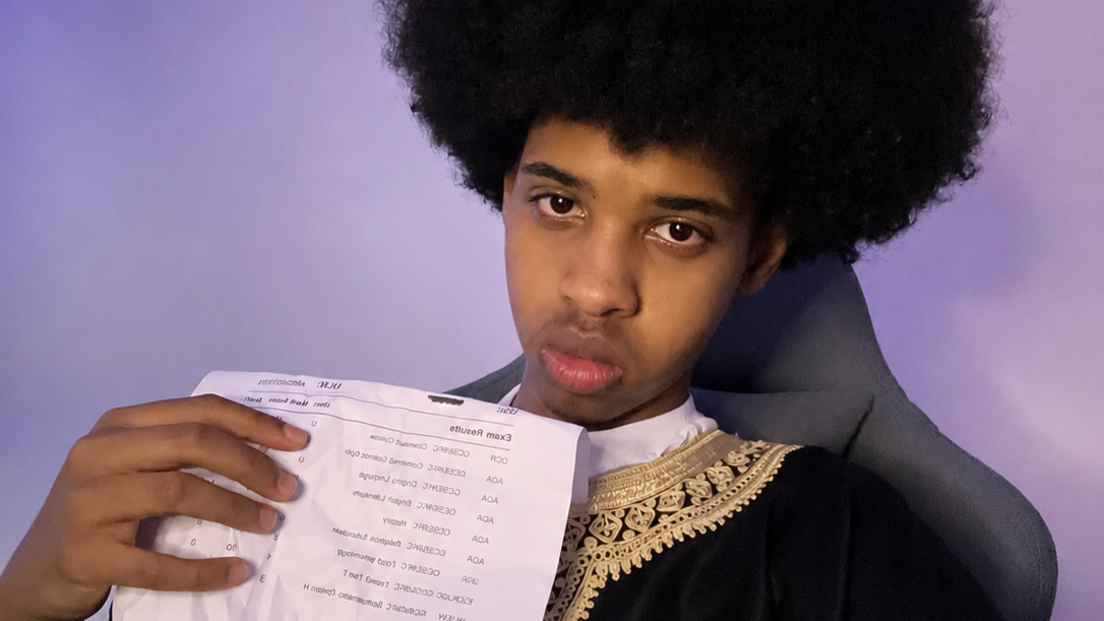
It is hoped it would provide a solution for students like Abdi, 17, from east London, who failed to pass his exams in maths and English for the third time.
“I have to get my retakes right next time, or they won’t let me complete my course at college,” he said.
“My school has provided extra classes to help prepare for the exams, but you have to be self-disciplined because juggling resits and college is not easy.”
Catherine Sezen, from the Association of Colleges, said the stepping stone qualification sounded positive, but that it should become an option for students long before they fail their GCSEs.
“We have to look at what happens probably from reception right the way through, because young people who don’t achieve very well in their SATs at 11 are really unlikely to achieve a grade 4 at 16.”
She said this year’s resit figures were “disappointing and slightly demoralising for everybody” but not a “huge surprise”.
“I think we’re still also seeing the legacy of the pandemic,” she said.
“These young people would have been in Years 6, 7 and 8, and so possibly haven’t necessarily got the basic foundations in these subjects which are really fundamental.”
-
Unexpected GCSE results? This interactive guide runs through your options
-
Published14 hours ago
-
-
Five key takeaways from GCSE results day 2026
-
Published5 hours ago
-
But the resit cycle is not always an inevitable one.
Amandeep, 17, did not pass her maths or English language GCSEs this time last year.
But on results day on Thursday, the student at Sandwell College, in the West Midlands, found out she had passed with a grade 5.
“I teared up, I thought my patience had paid off,” she said.
“It happened for a reason, it was meant for me this year.”
Amandeep’s results mean she is now able to move on to study a T-level in health and social care.
While the majority of resit students are aged 17 to 19, some are also mature students.
Wynne Hindle, 52, a grandmother from Sudbury, in Suffolk, celebrated having passed her GCSE maths on Thursday after taking it for a fifth time and achieving a grade 4.
“I was very happy and shocked to pass,” she said.
“I just wanted to achieve something and I’m a resilient person.”
Hindle, who previously worked as a nanny and nursery nurse, now hopes to work in a school and said it was all “part of a journey”.
She said her message to others who might be stuck in the resit cycle is: “Keep at it”.