
There are 4.73 billion email users in 2026 – that’s over half of the world’s population.
According to Porch Group Media, the average email user receives 100-120 emails a day, including personal and promotional mail.
Standing out in this saturated market is a mountainous feat, but it’s worth it. That’s why we’re going to show you how to build an engaged email newsletter.
Know what you want from your email newsletter
Before you start anything, establish a set of measurable (SMART) goals. Targets like these are valuable as they gives you a clear idea of how your emails are performing. For example, you might want a certain number of subscribers clicking on a link, sharing content on social media, purchasing a product or registering for an event.
Some goals are less measurable, but still valid, such as developing a relationship with customers. That’s easier to gauge by monitoring email open rates and dwell time.
Optimise layout to maximise value
Whatever your intended action from subscribers is, put it at the top of the email so that it’s more obvious. So, if you want them to register for an upcoming event, put a link where most of them will see it.
With that in mind, your email layout is a top priority. It should be easy for readers to understand and navigate. Features such as anchor links to the key sections of the email can be really helpful here.
All of your branding – colour scheme, font, wording – should reflect your brand, too. Even on someone passively clicks on the email, they should still know that it’s from you. Remember that some will be reading on their smartphone, so make sure the text is large enough for them to read, formatted in shorter paragraphs.
Your email marketing provider should have pre-set templates already, with varying levels of customisation.
Content value
This is where we get to the meat of the newsletter. Create an outline to get a sense of layout, keeping your goals front and centre as you do so. Think about a summary at the top to give readers a sense of what’s coming up and a tease to encourage them to read on. Links to your website are essential – making them tracked links will tell you which website visitors came from email clicks.
Clear headings so that readers can go to the sections they’re interested in if they don’t want to wade through the entire newsletter.
As for shaping your content, try theming your newsletters or keeping them as a regular round-up of company news.
The subject line is the most tantalising part of your newsletter. Keep it relatively short and avoid spam words such as ‘guaranteed’, ‘urgent’, ‘act now’ or ‘risk-free. Listing a problem in headline and solution in the text is a tried and true way to go. You can A/B test. It involves sending newsletters with two different subject lines to different samples of your audience to see which one gets the better response.
Images break a wall of text, or they may be powerful enough to stand on their own. With so many demands on people’s time and attention, an arresting image can be so effective, depending on the product or service you offer.
You don’t necessarily have to create content from scratch, either. It’s an opportunity to repurpose other content for a newsletter to give it a second (or indeed a third or fourth) life. For example, a news article on an event you hosted could be rejigged to promote the following year’s event.
Put your analytics to work
Depending on your analytics, you can segment your audience based on demographics and send tailored emails to them. You could offer a discount for a subscriber’s birthday, say.
When, where and how
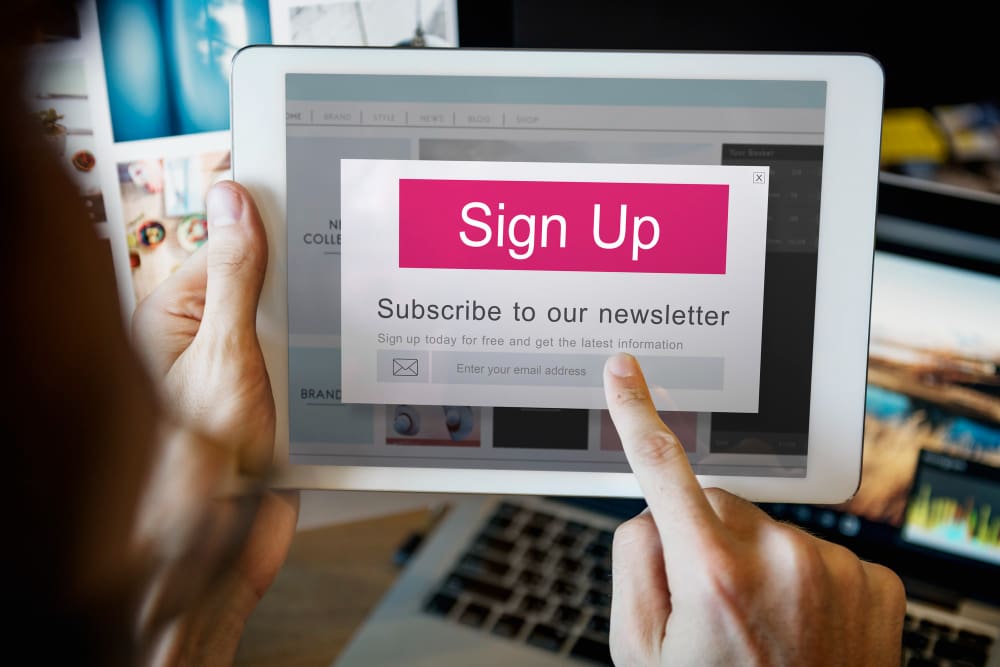
Your email subscription form will enable people to find you. Have a landing page so that potential subscribers can have the information they need before they sign up. As with anything else around your newsletter, make it readable on mobile.
When you send your newsletter is key. The timing of your send is dependent on how long it takes to read, i.e. a longer email would be better for a lunchtime or evening send. There’s an extra layer of decision-making if you’ve got customers in different time zones. Will they be more engaged over their morning coffee or after the working day?
Be strategic about the number of emails you’re sending out as well. Too many and your subscribers will get annoyed; too few and they may forget about you.
Make sure you see the email preview on various devices. Test your email in Outlook, Gmail and other email providers as well as on desktop, tablet and mobile.
Remember GDPR
The GDPR rules around email marketing are pretty simple. You can’t send a person email, unless:
- They have consented to email from you
- They’re an existing customer who bought a similar product or service from you in the past, and you gave them a clear way to opt out when you first collected their details and in every message you’ve sent
You can’t hide your identity and you’ve got to provide a genuine contact address to allow users to unsubscribe. The most common method of clear consent is a box that you must tick to subscribe. You could also click on an icon or send an email to consent. The important piece is that they must be opting in rather than out. Boxes where you untick to opt out aren’t covered by UK GDPR. The Information Commissioner’s Office (ICO) explicitly says:
‘You cannot show consent if you only provide information about marketing as part of a privacy policy that is hard to find, difficult to understand, or rarely read’
Be careful with obtaining permission when working with third party providers – it’s up to you to make sure that the permission is specific and includes your business. Generic consent covering third parties won’t cut it.
It helps to keep clear records of what individuals have consented to and when they granted consent. When an authority asks you for proof of consent, you’ll have it to hand.
These rules don’t apply to B2B marketing as they don’t affect corporate subscribers.
Top tips from your fellow entrepreneurs
Three business owners spoke to Small Business about how they grow their email list.
Mangla Sachdev, founder of Expat Business in a Bag
“I’ve grown my email list largely through networking and conversations. When I meet people, I don’t tell them to ‘join my email list’. I’ll mention something I shared in a recent email that’s relevant to the conversation, or tell them what I’m writing about next. It gives them a reason to actually want to hear from me.
“I also regularly share the subject line of my upcoming email on Instagram Stories and occasionally in Facebook groups where it’s relevant. It creates curiosity before the email has even landed. I have built an engaged list who regularly reply to me and forward it on to others.”
Jenna Farmer, PR expert and founder of jennafarmerpr.co.uk
“I’ve built an email list of 4000 people from scratch for my PR business. I’ve done this through creating engaging freebies (in my case, a guide to getting top-tier media coverage and a list of publications to pitch) which I aim to share every single week. I use ManyChat, which automates sending the link to these freebies every time someone requests them in response to a Facebook post. I also collaborate with other small businesses in ‘freebie swaps’, where I mention their email list freebie to my email followers and they do the same for me!”
Martin Forshaw, owner and managing director of Diamond Edge
Forshaw says that he biggest lesson he’s learned is that an engaged email list is built by being useful – and emailing too much is the fastest way to lose people.
Diamond Edge sells professional dog grooming equipment, so customers often need advice before and after they buy. “We invite people to subscribe at checkout and through useful content on the website, but we’re clear about what they’ll receive. That might be help choosing compatible blades, advice on looking after clippers and scissors, information about new products or the occasional genuinely worthwhile offer,” he said.
Some of the best email ideas come directly from customer conversations. “If several people ask the same question, it is probably something many more customers would find useful. Turning those questions into short, practical emails makes the communication feel relevant and gets great engagement.”
Segmentation is actually really important too. Someone who has bought professional clippers has different needs from somebody interested in grooming scissors, so sending the same message to everyone is rarely the best approach. Even basic segmentation based on interests or previous purchases can make a noticeable difference in open rates and getting them back to the site, he added.
“I also wouldn’t judge success purely by the number of subscribers (which is what most people do who I speak to). A smaller list that opens emails, clicks through, replies and buys is far more valuable than a huge database that just ignores you. We try to write as a real small business speaking to its customers. The personal tone, combined with genuinely useful information, is what keeps people engaged over time – or so we hope!”