
This post was originally published on this site.
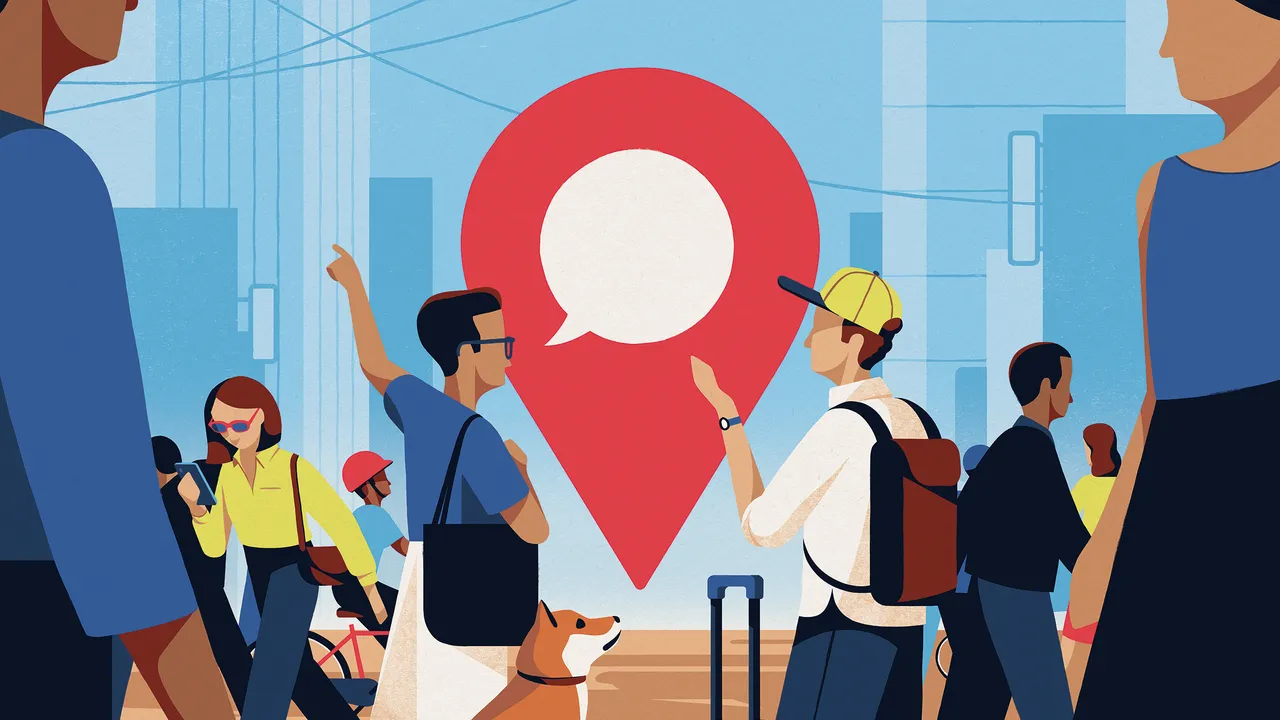
I am not like other men. I like to ask for directions.
Some might call me an unabashed neanderthal, but I adhere to a city’s rhythm, not the algorithm. I let my legs and eyes and nose lead me. In a new place, I have historically enjoyed any excuse to embrace my interrogative prerogative and engage with locals by asking for guidance—to a hip café, to an off-the-beaten-path bar, to the nearest restroom. As a try-lingual chap, a wannabe polyglot in it for the plot, I can attest to the fact that my interpersonal gregariousness has facilitated several memorable side-street side quests—during a college Russian program in St. Petersburg (flirtation and fluency), a day trip to Tangier (an unexpected guided tour), and a ride on Xi’an’s metro (a hand-crocheted rose for my daughter). Last year, a young couple ferried my family, suitcases and all, through Tokyo’s Cat Street to help us arrive on time for our reservation at a hard-to-locate pig café. When I offered a tip, they recoiled and waved their hands with such urgency that I looked down to see if I was wielding a knife. Human kindness—that was the exchange, I remembered.
My standard approach to travel seems at odds with Google’s Ask Maps, its sexy new conversational AI feature, powered by Gemini, that can chart out clean travel itineraries based on crowd-sourced rankings and efficient routes with waypoints that adhere to your specified preferences—or even predict them. That travelers are increasingly turning to AI chatbots like Open.AI’s ChatGPT, Anthropic’s Claude, and Perplexity AI to build out itineraries and get them to the best local greasy spoon, ice-cream parlor, and coffee shop, is old news. Ask Maps, however is the first integration of its kind, allowing travelers to ask such specific queries as “My phone is dying—where can I charge it without having to wait in a long line for coffee?” or “Is there a public tennis court with lights on that I can play at tonight?” without ever leaving the Google Maps app.
The convenience is undeniable, but what do we lose when we do away with those random travel moments of yore? Are we sacrificing the joys of spontaneity and discoverability by relying on AI?
Vicente Abarca Del Rio, managing partner of Muletek, a global eSIM store, laments what’s missed with an over-reliance on technology. “Why do we travel?” he says. “Simply to follow the little line traced by our map, oblivious to the life unfolding around us?”
Traveling with an element of anything-could-happen uncertainty puts us in a liminal state. With this unfamiliarity, we’re less sure of our footing. Of course, there’s something infantilizing, even embarrassing about being lost. We’re helpless, at the whims of strangers. But it’s also an invigorating contrast to the pre-charted course that’s become de rigueur. A chance to grow and learn and immerse ourselves to the experience.
According to Andrey Meshcheryakov, head of practice at Recombinators, a management consulting firm that specializes in business innovation, Ask Maps “effectively de-risks the travel experience by eliminating the friction of human error and language barriers.”
“While this utopian technological leap maximizes utility, it threatens the serendipity engine that traditional travel provided,” he adds. Tech, against the age-old adage, is prioritizing the destination over the journey.
“Those small moments of asking for directions used to carry vulnerability,” says Seden Dogan, an assistant professor at the University of South Florida School of Hospitality and Tourism Management in Tampa whose research focuses on the emergence of AI technologies in travel. “The interactions give travel a certain texture that you don’t plan for, and things become smoother and more predictable with AI.”