

This post was originally published on this site.
We helped create UK emergency alert system – but question how government is using it
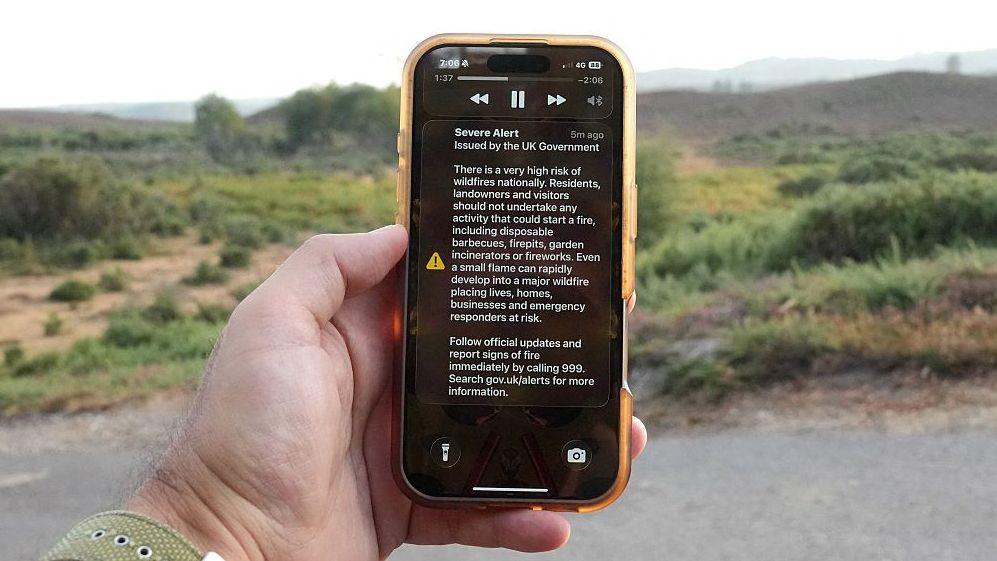 Image source, AFP via Getty Images
-
Published
As the Conservative minister who launched the UK’s emergency alert system, Oliver Dowden was more than familiar with the loud bleeping sound coming from his phone earlier this month.
What took him by a surprise was the message on the screen.
Like millions of people across England and Wales, the “severe alert” on 14 August warned him of a “very high risk of wildfires nationally” and against doing anything that could start a fire, including lighting disposable barbecues.
It was the biggest use of the system to date – but Dowden has now weighed in to question whether it was strictly necessary.
Dowden and two officials who helped create the government’s emergency alert system are calling for Labour ministers to be up front with the public on what it could be used for in future.
“I was surprised at the decision to issue this nationwide alert and it raises some serious questions,” Dowden, who served as deputy prime minister under Rishi Sunak, tells BBC News.
“The government needs to clarify the criteria for its use and why this alert met those criteria.”
‘People will ignore it’
When he fronted the launch of the alert system in April 2023, he says it was intended for as narrow a geographic area as possible where the threat to life is imminent.
The government’s own webpage, external for emergency alerts says they are only sent for “life-threatening emergencies”, listing wildfires, severe flooding and extreme storms.
Two national tests of the system took place in 2023 and 2025, while 10 local alerts have been sent since its launch, all related to weather or flooding bar one in Plymouth for a World War Two bomb removal.
The day before the alert was sent earlier this month, 19 homes burned down in the west Midlands town of Stourbridge after a wildfire. The day of the alert, ministers say they were asked directly by fire chiefs to send one as crews dealt with 43 wildfires and 11 major incidents across the country.
 Image source, AFP via Getty Images
The government’s Cobra emergency committee met to discuss how to respond. After sign off from Prime Minister Andy Burnham’s de facto deputy Louise Haigh, the alert was sent at 19:00 on 14 August.
It triggered a backlash on social media with some vowing to opt out of further alerts in their phone settings, domestic abuse charities and survivors saying victims with hidden phones were put at risk, and confusion about alerts sent multiple times.
Dowden’s worry is that the wildfire alert was more like a public information campaign than an imminent threat to life across all of England and Wales.
“People need to know that when they receive an alert, it is a genuine imminent emergency,” the Conservative MP says. “If that confidence is lost, people will simply ignore it.”
A Cabinet Office report during trials in 2014 warned of this “cry wolf” effect, while pointing out there was strong support among the public for the alerts.
“Alerts should not be issued just because the government wants to be seen to be doing something,” Dowden adds.
The National Fire Chiefs Council said the alert heightened people’s awareness and public behaviour, while government insiders point out wildfire alerts are commonplace in many European countries.
“By following the guidance that was issued, people were able to take the necessary steps to keep themselves safe and front line services recorded a significant decrease in incidents in the following days,” a government spokesperson said.
But Frazer Rhodes, who worked in government across a decade to help build the technology and devise high thresholds for the alerts, feels a review is now necessary to avoid future ones backfiring.
He was in a bar in Halifax, West Yorkshire, with his wife when the sound of pinging phones began echoing around.
“Everybody around was just going, ‘what’s this?’ What’s this?'” he tells us. “Then my wife shouted, ‘he did that’.”
His wife’s joke aside, he said his “immediate thought” was whether it met the threshold for sending one. He explains: “At its heart are three criteria: urgency, severity and certainty. So, in simple terms, how bad, how soon, and how sure?”
Rhodes thinks the wildfire alert arguably met the bar for urgency and severity, but perhaps not for certainty of a threat to life.
“It should be very rare to get an alert,” he points out.
He thinks ministers should accept there has been a divided response and launch a review to ask themselves: “How do we do this differently?”
Rhodes, a service delivery specialist, adds: “The national protocol should be a public document… I think that document is almost like a contract with us to say ‘this is when we’re going to use it, these are the perameters, this is who can use it’.”
The emergency alerts we may get in future
Back in 2021 when designing the alerts, he says these were the scenarios considered valid for future alerts:
-
Pandemics
-
Severe weather and environmental alerts such as flood risk
-
Counter-terrorism
-
Bomb dispersal evacution
-
Major hazards such as the Buncefield oil depot fire in 2005
-
Wildfires
-
Coal tip landslides
When building the UK alert system, which cost up to £25.3m in its first three years, officials looked to Australia, external and New Zealand, external where emergency alerts have no “opt out” option for the public, unlike in the UK. They also considered minor types of public safety alerts which are sent in the US for issues such as missing children.
The alert targets individual cell towers with a radiowave-like signal, allowing all mobile phones in the area to pick it up without needing to know people’s mobile numbers. This cell broadcast technology is used instead of SMS texts or an app.
It comes as the Cabinet Office plans to launch a separate campaign in the autumn about how people can make themselves and their homes more prepared for extreme weather and cyber-attacks.
Another one of those involved in creating the alert system, Nick Corney, thinks the government “missed a trick” with the wildfire alert by sending it nationally rather than targeted at specific postcodes with the highest risk.
Corney, who worked in the Cabinet Office between 2018 and 2021 and says he was in weekly and then daily meetings about designing alerts, wants a “thorough review”.
He says this would look at making future alert wording more specific, such as explaining the threat to life with a link to a webpage. “An extra level of consideration needs to be put in place” for national alert versus a local one, he adds.
“You’ve really got to take yourself out of the Cobra room,” he says.
“There’s a level of scaring the public that needs to be taken into consideration.”
-
Wildfire phone alert was ‘entirely appropriate’, government says
-
Published17 August
-
-
Emergency phone alert put domestic abuse victims at risk, campaigners say
-
Published16 August
-

Sign up for our Politics Essential newsletter to keep up with the inner workings of Westminster and beyond.