
This post was originally published on this site.
It’s taken me a long time to process Olympic experience – Raygun
-
Published
Just hours before representing Australia at the Paris 2024 opening ceremony, Rachael Gunn had a panic attack in the middle of the Olympic village.
Thrust into an environment full of experienced athletes, it dawned on Gunn, whose professional background is as a university lecturer, what she had got herself into.
Known as Raygun when competing, she was about to take part in the breakdancing event – or breaking – which was making its Olympic debut.
“I felt like an imposter,” said the 38-year-old breaker, during a new Netflix documentary about her experience at the Games.
She describes how she reacted when she saw someone she recognised from the Olympic team.
“I just could not stop crying… I had a panic attack. ‘What am I doing? What have I done? Should I be doing this?'” she said.
Just a few hours later, she was sailing down the River Seine alongside the rest of the Australian cohort, waving to onlookers.
Less than a fortnight after that, her Olympic journey was over. Gunn failed to win any of her three round-robin battles at the Games, but walked away pleased with how she had acquitted herself.
“Finishing my last round, the world champion Nicka [Dominika Banevic] gave me props for my moves, the MC celebrated my stuff and the vibe was just generally good,” Gunn told BBC Sport.
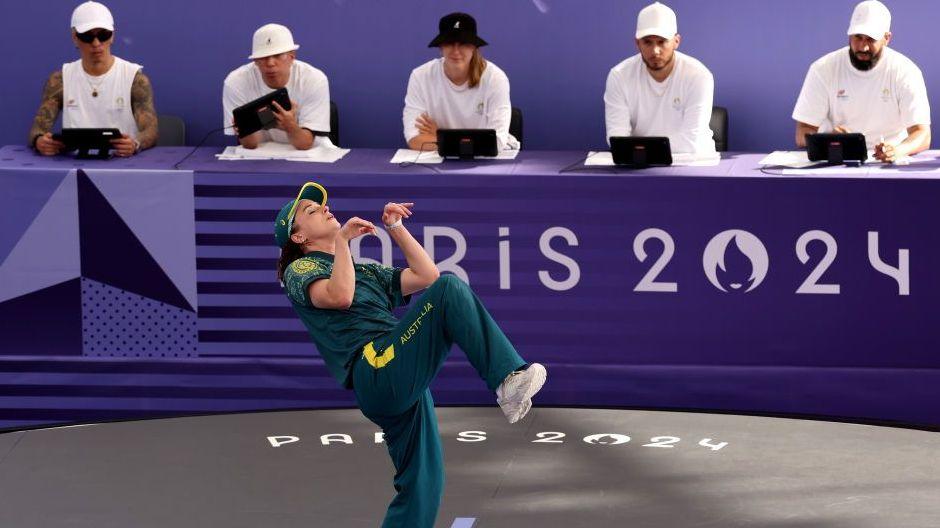
What she hadn’t anticipated was that one of her performances, in which she debuted some unconventional moves including a sprinkler and a kangaroo hop, had gone viral.
There were memes. There was a sketch on The Tonight Show Starring Jimmy Fallon. Adele referenced the performance in one of her concerts. Chris Hemsworth defended Gunn in an interview with Jimmy Kimmel. At one point in August 2024, Australian Prime Minister Anthony Albanese even felt moved to speak out, praising Gunn for having “a crack”.
“It was pretty wild the way I became a topic of conversation in spaces I never thought I would be,” said Gunn.
Alongside the teasing, there were more sinister forces brewing, including conspiracy theories about nepotism – for instance that Gunn’s husband and trainer, Samuel Free, had been on the selection committee when she qualified to represent her country at the Games, when he hadn’t been.
“It was really tough when mine and Sammy’s credibility, ethics and motivations were being called into question,” Gunn said.
“You could just spend 30 seconds researching and find plenty of sources to debunk these conspiracies, but that’s not how people use the internet anymore.”
That new-found scrutiny took a toll on Gunn’s mental health.
“I felt like my whole life was just kind of crumbling before me.. .and I was just trying to get through the day,” she says in the documentary.
In the process of making a film about that time, however, she feels that she’s been able to regain some agency.
“It’s taken a long time for me to process what happened,” Gunn told BBC Sport.
“It’s really exciting for me to finally have a voice again.”
A new Olympic sport and a creative gamble
After it was announced that breaking would be included at Paris 2024, Gunn qualified to represent her country via the Oceania Breaking Championships in Sydney in 2023.
“I’ve never participated in anything of such high stakes before. It was all international judges, but I was relieved and excited when I qualified. And then the next whirlwind happened,” she said.
Quickly, she realised that she would have to start living like an athlete.
Gunn gained a scholarship at the New South Wales Institute of Sport in February 2024, which allowed her to begin a strength and conditioning programme.
“That was great, but also overwhelming because I was training with people who had been doing that stuff since they were kids,” she said.
In the midst of her training, the documentary reveals that Gunn’s mother suffered three brain aneurisms. Gunn herself began a course of anti-depressants to help with feelings of anxiety.
The film portrays how it began to dawn on her what she had taken on when she entered competitions in the run up to the Games.
“That’s when it first starting occurring to me that I was going to be going up against world champs and people who had been winning competitions on big stages for years and years, but I was still going to go out there and do my best,” she says in the documentary.
In that context, Gunn decided to play to her own strengths with a creative gamble, developing a routine that paid cheeky homage to her Australian roots.
“I was aware that I was never going to beat my competitors on athleticism,” she explained.
“For me, my strength is creativity. With that being one of the [judging] criteria, our thinking was, ‘why don’t we put all our eggs in that basket and really try and wow them? Maybe we can make a moment.’
“We never, ever expected the impact it might have.”
The documentary reveals that head of the Australian Breaking Association, Lowe Napalan, only assisted Gunn’s training “a handful” of times in the build-up to the Games, owing to the amount of administrative work taking up his time.
That meant that he only saw Gunn’s controversial routine for the first time just before she performed at the Olympics.
“I was there side-stage,” Napalan says in the film.
“I had to not have a face of shock.”
‘I wouldn’t let what happened take dancing away from me’
It was reported in November 2024 that the furore around her Olympic performance had led Gunn to quit breaking.
She corrects that notion.
“I don’t know where that came from,” Gunn said.
“I wouldn’t let what happened take dancing away from me. I love breaking, I’ll always break, I’ll always be a part of the community.”
Her hope is that the release of the upcoming film can help shift the conversation.
“It feels nice to lay it all out there and now be able to look to the future. I’m actually excited about what’s to come, which is the first time for a while,” she said.
Details of organisations offering help and support with mental health are available at bbc.co.uk/actionline
To play this video you need to enable JavaScript in your browser.
This video can not be played
To play this video you need to enable JavaScript in your browser.
This video can not be played