
This post was originally published on this site.
How the brain of a fly may help explain human behaviour
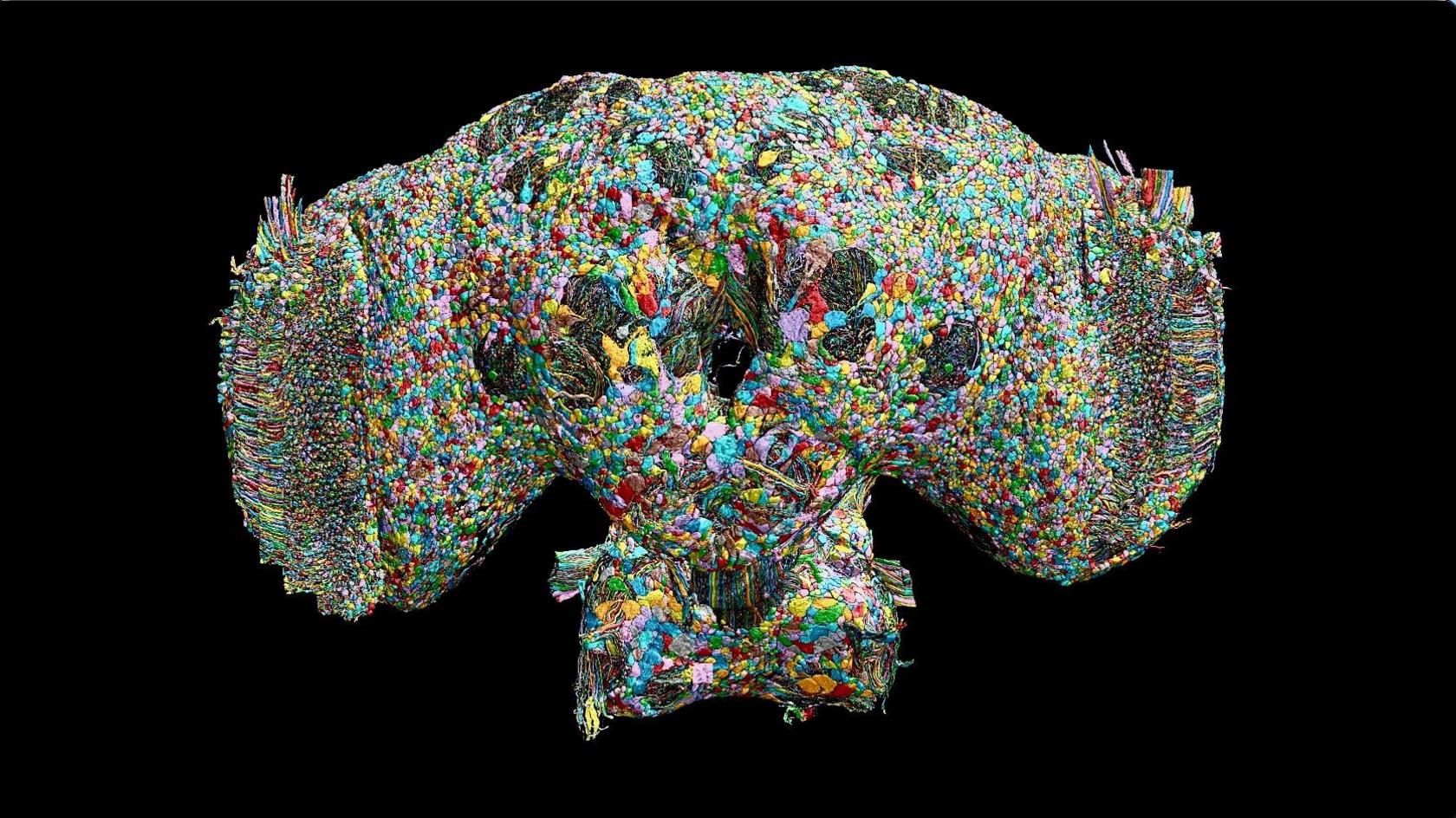 Image source, MRC
-
Published
Scientists have managed to compare the fine detail of the brains of male and female flies for the first time, identifying differences they say explain male aggression, courtship and their singing of love songs.
The scientists in Cambridge mapped all 124 million connections of nerve cells in a male fly’s brain, having done the same for a female fly two years ago.
The team are clear that the research won’t explain differences between men and women because our behaviour is far more complex.
But the research could help scientists better understand human behaviour and conditions in which genetic differences affect brain wiring, such as autism and schizophrenia.
Prof Gregory Jefferis, of the Medical Research Council’s Laboratory of Molecular Biology and University of Cambridge, who co-led the research, told BBC News that the breakthrough was “a really important new avenue in neuroscience”, likening it to the invention of a powerful new telescope in increasing our understanding of the Universe.
“We have this amazing stuff in our heads that lets us do incredible things such as playing a sonata or solving a scientific problem. And this development could help our understanding of how those systems work”.
The fly’s brain is as beautiful as it is incredible. It is the size of a pin head – yet in many ways – more efficient than a supercomputer and able to outsmart the smartest AI.
Jefferis’ team and collaborators painstakingly analysed every nerve cell, every wire and every connection in a male fruit fly. They put them together into a 3D map of the brain and nerve cord and compared them to the earlier, female mapping.
They found that around 95% of the cells are shared between the male and female fly brains. But the remaining 5% are enough to drive quite distinct behaviours, according to Dr Isabella Beckett, who is joint first author of the scientific research paper published today in the Journal Cell.
“We were expecting to find differences, and we found them, and we’re excited by what we got,” she said.
The small differences they discovered can lead to big changes in behaviour.
In courtship, for example, the male tracks the female as she moves. The researchers have identified the brain circuits associated with that trait and found key differences in the wiring. The males have extra bits that should enhance his visual tracking.
There is an even bigger difference in the circuits associated with aggression. Males fight more often and so there is much more wiring associated with that behaviour than in females.
And then, there is the love song circuit.
Males woo females by producing a sound. They have wiring unique only to them to producee the sound. According to Dr Philipp Schlegel, co-author of the study, the circuit has to be just right, otherwise the consequneces for the poor male could be dire.
“The courtship also includes singing to the female,” he told me. “The sound is produced by vibrating the wings to produce a very specific song.
“If the female likes it, she will allow him to approach, and if she doesn’t, and she’s not receptive at a time, she’ll basically reject him, which could be a kick to the face”.
These three differences between male and female wiring in flies are driven by two key genes. Researchers have known about the genes for years, and how they’re linked to each of these behaviours. What they’ve never been able to see is the bit in the middle. Now, for the first time, they can see the actual wiring those genes produce.
The primary aim of the research was not to discover the differences between male and female flies, and certainly not to find neurological explanations for certain alleged behavioural differences between men and women.
Comparing two brains that have some slight wiring differences associated with known big behavioural differences enables scientists to clearly see the principles that underlie the changes to brain wiring for all behaviour, according to Beckett.
“You just have one independent variable, the sex, and then you can see what’s different. This is a scientist’s dream”.
These differences take scientists a big step forward in understanding one of the biggest questions in biology – how genes influence behaviour.
Scientists have known for decades that they do, but have had little idea of exactly how they exert their influence. The answer, according to Dr Jefferis, is in how the genes shape the brain’s wiring and how that wiring influences behaviour.
“The fly brain comparison gives us a really good handle on this,” he told BBC News.
“There are patterns of behaviour in humans that seem to have a strong genetic, basis. So, for example, there are many gene varients now related to schizophrenia and autism spectrum disorders that we don’t really understand”.
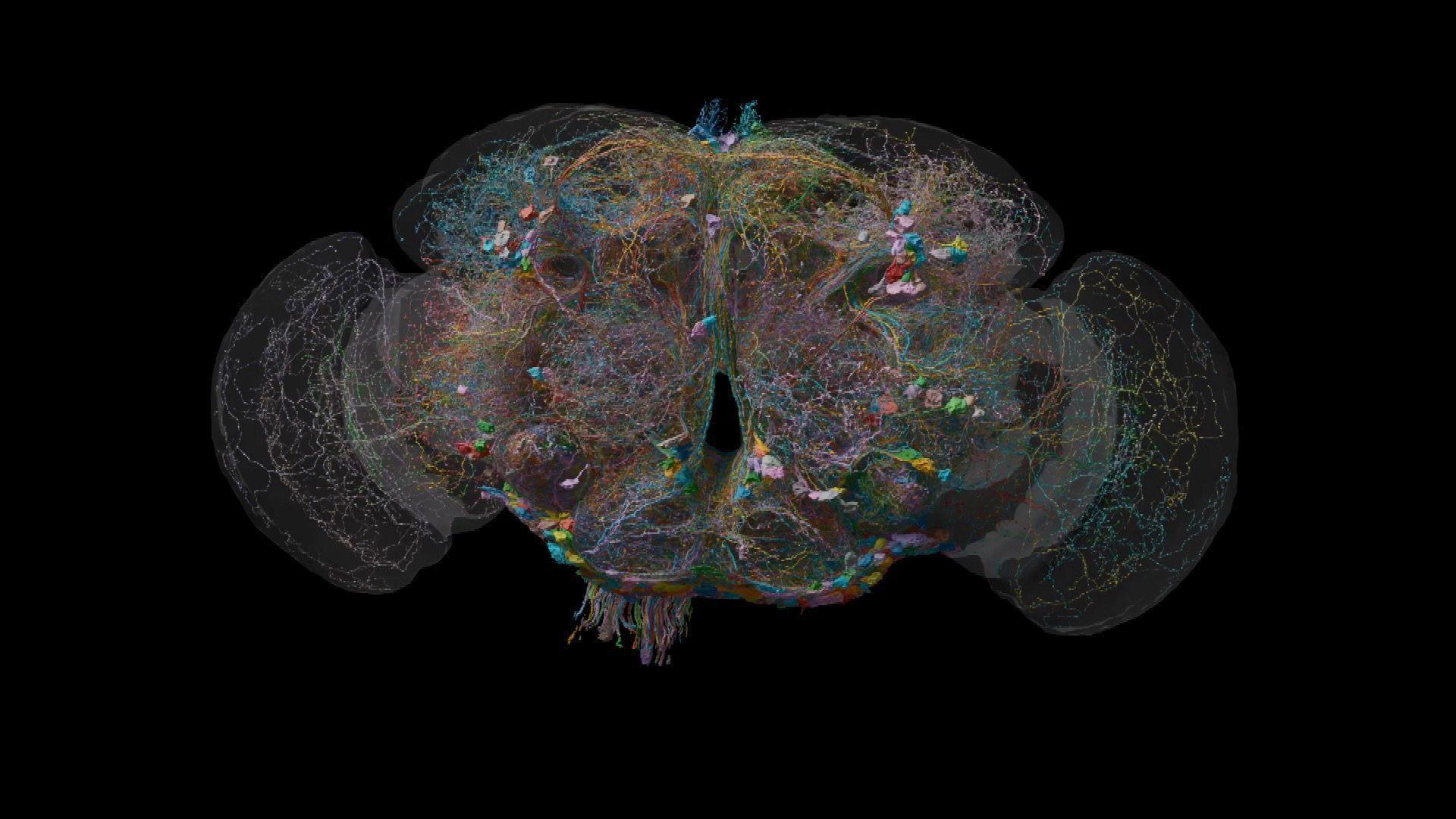 Image source, MRC
There are also possible applications in improving AI and boosting computer systems, he adds.
“To have AI that’s efficient as, as our brains, is probably going to take more biological inspiration. And the inspiration that’s likely to be important is actually real biological wiring diagrams.
“There are people who’ve been putting the fly brain in the middle of artificial networks and trying to see if it’s useful to help, learn and control artificial systems”.
Other scientific collaborators were from the HHMI Janelia Research Campus led by Prof Gerry Rubin, Drosophila Connectomics Group at the University of Cambridge, Google Research and the Champalimaud Foundation