
This post was originally published on this site.
Plans for major overhaul of councils halted
-
Published
Plans for a major shake-up of local government are on hold, after the government launched a review in light of new legal advice.
Proposals to merge smaller councils to form larger authorities in Essex, Hampshire, Norfolk and Suffolk have been withdrawn.
Meanwhile, plans for 14 other areas will also be reviewed and paused.
Reorganisation in Surrey, where councillors for two new unitary authorities were elected in May, will not be affected by the review.
The government confirmed local elections in May 2027 would go ahead on existing council boundaries.
Confirming the review in Parliament, Local Government Secretary Angela Rayner told MPs that “in light of legal advice, I want to satisfy myself firstly that the right process is in place, that it is robust, and of course complies with the law”.
She added: “And secondly, I want to fully test whether our proposals for local government reorganisation meet the priorities of a new administration and a new prime minister and any additional considerations.”
Rayner acknowledged the announcement was “disappointing” but insisted the government was “determined more than ever to devolve power closer to the people we represent” – a key priority of new PM Andy Burnham.
The plans originated under Sir Keir Starmer’s government, when Rayner was also local government secretary, before she was replaced by Steve Reed.
The government was already facing legal challenges over proposals to reorganise councils in Essex, Hampshire, Norfolk and Suffolk.
In June, Reform-led councils in Essex, Norfolk and Suffolk launched judicial reviews against the plans, while the Conservative-led administration in Hampshire did the same.
Reform UK leader Nigel Farage said: “Reform UK not only argued that this government’s plans for local government reorganisation were an unmitigated disaster, but we once again put our money where our mouth is.”
He added: “Thanks to our judicial reviews in affected Reform-led councils, the government has backed down on their plans yet again.”
Conservative shadow local government minister David Simmonds said it was a “humiliation” for the government.
He said: “Ministers are only backing off because they have been found out in the face of relentless Conservative opposition to their gerrymandering.”
Liberal Democrat local government spokeswoman Zöe Franklin said: “This is an embarrassing and chaotic climbdown, which has resulted in already cash-strapped councils wasting huge sums on plans the government told them were legally watertight.”
Sean Matthews, from the County Councils Network, welcomed the move, adding: “Many of our members will be relieved that the decisions they viewed as damaging to local services and financially unsustainable have been withdrawn or are being reviewed.”
A spokesperson for the Local Government Association, which represents councils, said that while local authorities hold different views on the reorganisation plans “there is no excuse for the government’s mishandling of this process”.
The spokesperson added that Rayner’s announcement “will have caused significant uncertainty, after councils have invested scarce public money and countless hours” in the reorganisation programme.
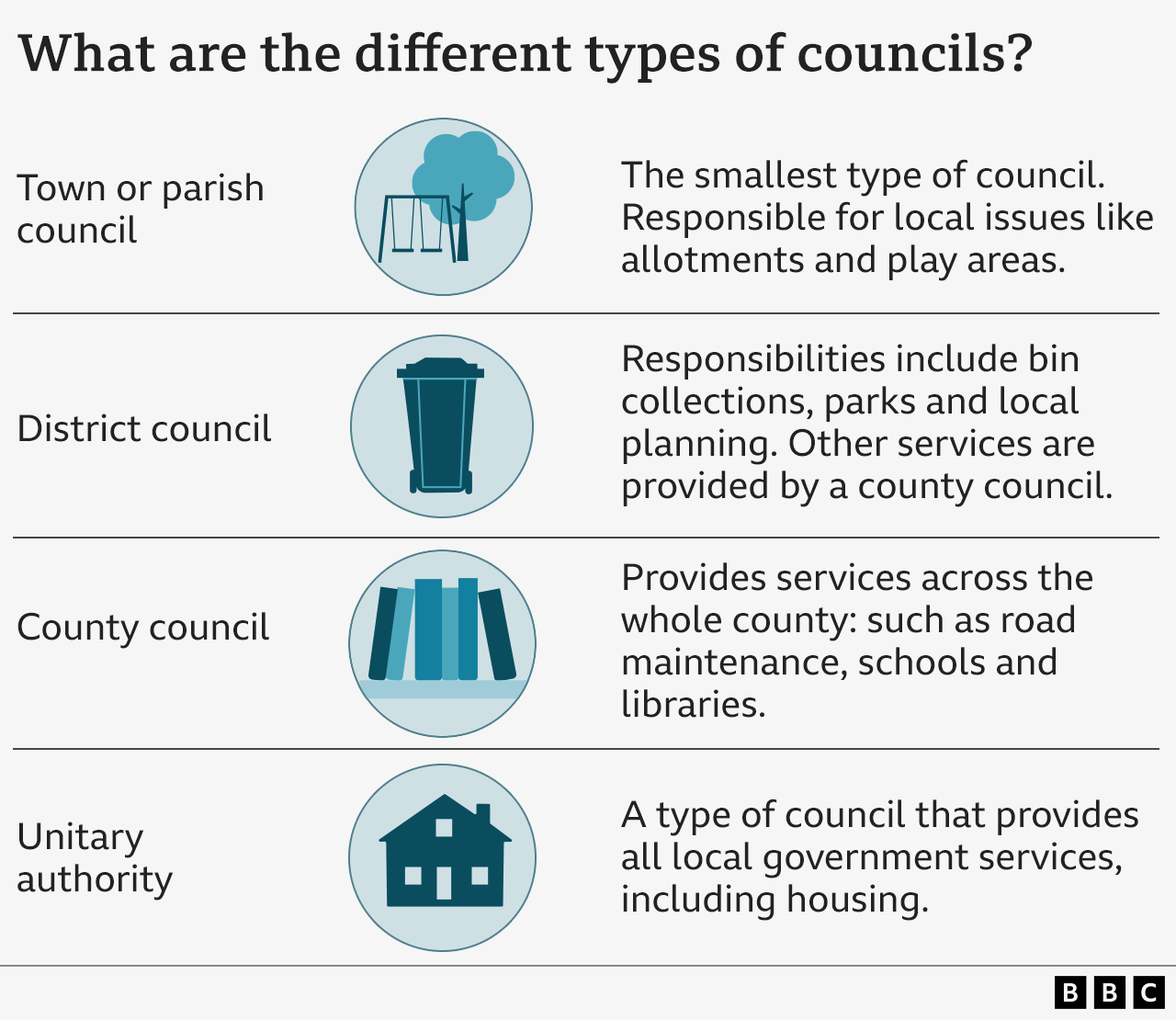
Local government in England is currently covered by a complicated patchwork of arrangements.
In some places, responsibility for local services is shared between county councils, which manage areas including social care and education; and district councils, which cover smaller areas and are responsible for services such as bin collections.
Some areas, particularly larger towns and some cities, have “unitary” authorities responsible for both – while the regions surrounding big cities are increasingly covered by regional mayors and multi-council “combined” authorities, with greater powers in areas such as transport policy, planning and housing.
In late 2024, as local government secretary, Rayner announced plans to move towards unitary councils across all of England, with council boundaries redrawn and smaller district councils abolished.
The government argued the proposals would make the system simpler and produce savings by making the delivery of services more efficient, while also handing new powers from Westminster to regions across the country.
However, critics said the plans would not save money, while diverting resources from front-line services and leaving councils more remote from their communities.
Under Sir Keir, the government had been pushing ahead with the proposals.
In July – just days before Burnham became prime minister – Rayner’s successor as secretary of state, Reed, had announced plans for new councils in 14 areas.
The 14 areas where local government reorganisation is being paused while a review is carried out are:
-
Derby and Derbyshire
-
Devon, Plymouth and Torbay
-
East Sussex and Brighton
-
Gloucestershire
-
Hertfordshire
-
Kent and Medway
-
Lancashire, Blackburn with Darwen and Blackpool
-
Leicester, Leicestershire and Rutland
-
Lincolnshire, North Lincolnshire and North East Lincolnshire
-
Nottingham and Nottinghamshire
-
Oxfordshire and West Berkshire
-
Staffordshire and Stoke-on-Trent
-
Warwickshire
-
Worcestershire
The government said decisions had not yet been taken on Cambridgeshire and Peterborough, and West Sussex, with these areas being considered alongside the wider review.

Sign up for our Politics Essential newsletter to keep up with the inner workings of Westminster and beyond.