
This post was originally published on this site.
Can Kane buck history and win Ballon d’Or?
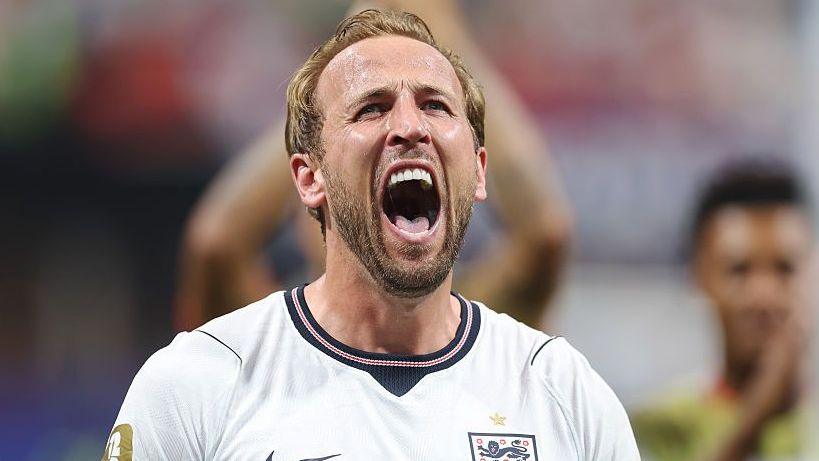 Image source, Getty Images
-
Published
With the Ballon d’Or shortlist to be announced on Tuesday, Harry Kane heads the field as the bookmakers’ favourite after a prolific season for club and country. History, however, suggests football’s biggest individual prize is rarely decided on goals alone.
Since the Ballon d’Or was first awarded in 1956, performances in the game’s biggest competitions have consistently shaped the outcome.
World Cup years, in particular, have followed a remarkably clear pattern and recent editions have shown just how difficult it is to win the award without lifting a major global or continental tournament.
Once the nominees are announced, an international jury of specialised journalists will cast their votes, with one representative per country from the men’s top 100 having their say.
So, can Kane, who has never finished higher than 10th in the battle to be the world’s best player, become one of the rare exceptions?
-
This could be year I win Ballon d’Or, says Mbappe
-
Published5 hours ago
-
-
73 goals from dropping deep – we ask Kane to break down how he did it
-
Published3 days ago
-
The World Cup effect
Created by France Football journalist Gabriel Hanot, the Ballon d’Or was first presented in 1956, with England’s Sir Stanley Matthews the inaugural winner. Originally voted for by journalists, the award was restricted to European players until eligibility was expanded to all nationalities in 1995.
Raymond Kopa became the first Ballon d’Or winner in a World Cup year after helping France reach the 1958 semi-finals. To mark the award’s 60th anniversary in 2016, France Football revisited every pre-1995 edition, external. Its retrospective review concluded Pele would have claimed the award after inspiring Brazil to their first World Cup triumph at the age of 17.
Four years later, Josef Masopust officially won the Ballon d’Or after captaining Czechoslovakia to the World Cup final. Again, France Football judged Brazil’s Garrincha to have been the standout performer after leading his country to successive World Cup titles.
It reached the same verdict for Pele in 1970 after he inspired Brazil to a third World Cup crown. By then, a clear pattern had emerged. Bobby Charlton (1966), Paolo Rossi (1982), Lothar Matthaus (1990), Zinedine Zidane (1998), Ronaldo (2002) and Fabio Cannavaro (2006) all won the Ballon d’Or after lifting the World Cup.
Even among the official exceptions, players still tended to enjoy deep runs at the tournament. Johan Cruyff collected the Ballon d’Or after leading the Netherlands to the 1974 World Cup final, while Luka Modric repeated the feat with Croatia in 2018.
World Cup success has never been an absolute requirement. Kevin Keegan won the 1978 Ballon d’Or despite England failing to qualify for the World Cup, although France Football later concluded Argentina striker Mario Kempes would have been the deserving winner after finishing as the tournament’s top scorer and helping the hosts lift the trophy. The publication reached the same verdict for World Cup winners Diego Maradona in 1986 and Romario in 1994.
France Football’s review ultimately reinforced the World Cup’s influence on the Ballon d’Or. In essence, had the prize always been open to players from all countries, each South American World Cup-winning side between 1958 and 1994 would have supplied the winner.
To play this video you need to enable JavaScript in your browser.
This video can not be played
The biggest prizes matter
The World Cup is not the only competition to shape Ballon d’Or voting.
Recent history suggests success in one of football’s biggest tournaments has become almost a prerequisite. Only four of the previous 19 Ballon d’Or winners failed to lift either the Champions League, World Cup, European Championship or Copa America during the year of their triumph.
Those exceptions underline just how extraordinary Lionel Messi and Cristiano Ronaldo had to be. Messi won despite Argentina’s quarter-final exit at the 2010 World Cup, and again in 2012 and 2019 without lifting a major international or continental trophy.
Ronaldo also prevailed in 2013 after Portugal failed to progress beyond the World Cup play-offs, thanks largely to another remarkable individual season with Real Madrid.
Conversely, Wesley Sneijder’s treble with Inter Milan and run to the 2010 World Cup final, Franck Ribery’s role in Bayern Munich’s 2013 treble and Mohamed Salah’s record-breaking 2017-18 season all proved insufficient when voters favoured different narratives.
Rightly or wrongly, modern Ballon d’Or voting has consistently rewarded football’s biggest occasions. That presents Kane with another obstacle.
Unlike Ronaldo in 2014 or Luka Modric in 2018, he cannot point to Champions League glory as Bayern Munich’s European campaign ended in the semi-finals against eventual winners Paris St-Germain.
Nor is he alone, with Erling Haaland, Kylian Mbappe, Michael Olise, Declan Rice and Jude Bellingham all potential rivals and attempting to buck one of the award’s strongest recent trends.
Why Kane’s case is different
History points towards major honours being important to winning the Ballon d’Or but Kane’s 2025-26 season suggests this may not be a typical race.
The England captain scored 73 goals for club and country – 61 for Bayern Munich and 12 for England – in a season in which Bayern won the Bundesliga and DFB-Pokal and England finished third at the World Cup.
Among players representing clubs from Europe’s top five leagues, only Messi has scored more goals for club and country in a single season, the Argentine striking 82 times for Barcelona and Argentina in 2011-12.
Kane’s tally places him ahead of Bayern great Gerd Muller (72 in 1972-73), Cristiano Ronaldo (66 in both 2011-12 and 2014-15), Ronaldo (66 in 1996-97), Haaland (64 in 2022-23) and Luis Suarez (64 in 2015-16).
To play this video you need to enable JavaScript in your browser.
This video can not be played
Kane or Spain?
Voters might face a familiar dilemma.
Rodri appears Kane’s strongest rival. The former Ballon d’Or winner was arguably Spain’s standout performer throughout the tournament, collecting the Golden Ball after helping his country secure a second World Cup title.
Lamine Yamal also added a World Cup winner’s medal to a season in which he helped Barcelona reclaim La Liga, although it was teenage team-mate Pau Cubarsi who claimed the Fifa Young Player Award after a series of outstanding performances.
Mbappe and Messi are also expected to feature prominently. Mbappe finished as the World Cup’s top scorer with 10 goals, while also claiming the Champions League Golden Boot and La Liga’s top scorer trophy, despite France falling short of the final and Real Madrid ending the season without a major honour. Messi, meanwhile, captained Argentina to a second successive World Cup final and at the age of 39 scored eight goals during the tournament.
Should Kane prevail, he would become only the fifth Englishman to win the Ballon d’Or after Matthews, Charlton, Keegan and Michael Owen. He would also become the first player representing a Bundesliga club to lift the trophy since Matthias Sammer in 1996.
History suggests the odds remain stacked against him but few players have entered a Ballon d’Or election with stronger individual credentials.
Voters must now decide if one of the most prolific goalscoring seasons of the modern era outweighs football’s biggest prizes, and if Kane can join one of the most exclusive groups in Ballon d’Or history.
-
-
Published8 June
-