
This post was originally published on this site.
Non-league to Champions League: The Porto boss out to stun Man City
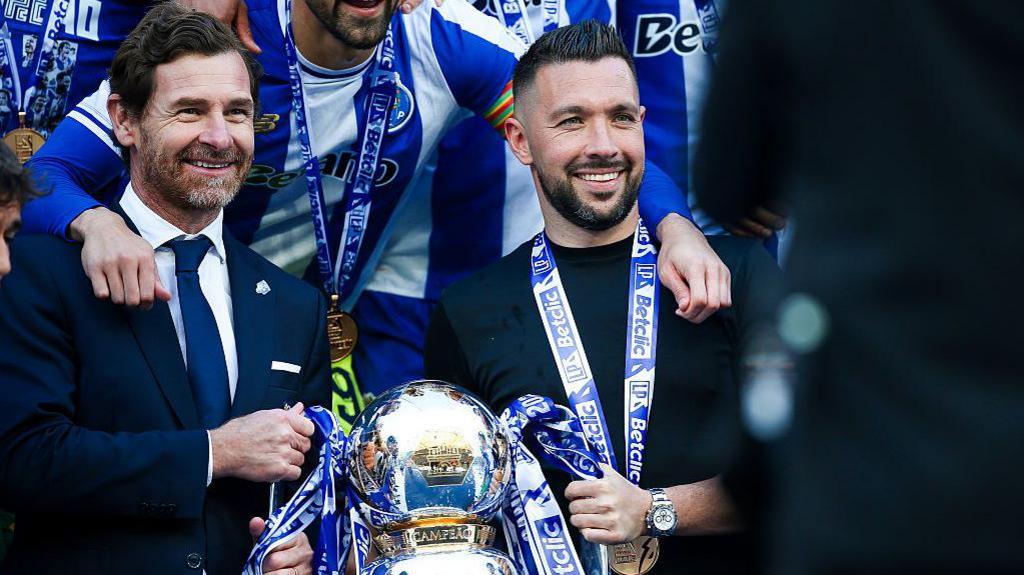 Image source, Getty Images
-
Published
Francesco Farioli is one of the fastest-rising stars in coaching.
The 37-year-old led Porto to the Portuguese title last season and is now preparing to take charge of his first Champions League match as a manager against Manchester City at the Estadio do Dragao on Tuesday.
Leading a team out in Europe’s premier club competition might still feel a long time coming for Farioli, who was linked with the vacancies at Chelsea, Liverpool and Rangers last season.
However, Farioli, who began his managerial journey in Turkey in 2021 with Fatih Karagumruk and then Alanyaspor, opted to renew his contract instead and is certain he made the right choice.
“I don’t feel I could be in a better place,” he told BBC Sport.
“I said at our post-season dinner they have created a problem for me, as I will have to bring the president and directors with me.”
Chief among the relationships keeping him at Porto has been the one with club president Andre Villas-Boas, the former Tottenham and Chelsea manager.
Another key figure in his story is current Tottenham boss Roberto de Zerbi, who appointed Farioli – then a former non-league goalkeeper in Italy and blogger on the Wyscout coaching platform – on to his backroom staff at Benevento in 2017 and then took him to Sassuolo.
Initially a goalkeeping coach, he moved into management in Turkey before successful spells at Nice in France and Dutch club Ajax.
His time at Ajax did, though, end in disappointment, with the club missing out on the Eredivisie title on the final day. That came after a turbulent January transfer window, during which he felt they had failed to strengthen sufficiently.
The season before his arrival, Ajax had briefly been involved in a relegation battle.
“I am used to entering uncomfortable situations where there is a lack of direction and things are not in place,” Farioli said.
“I was looking for a club with a similar spirit, not for revenge, but one that wanted to put things right.”
He said Porto had felt the “same pain” after finishing third before his arrival and shared “the same ambition to do something special”.
On meeting Villas-Boas in the Italian city of Como before accepting the job, Farioli was reassured to find the club’s vision aligned with his own.
Porto won the Portuguese Super Cup last month and will have designs on causing an upset against Enzo Maresca’s City. As former European champions who lifted the trophy under Jose Mourinho in 2004, they possess considerable Champions League pedigree.
How Farioli has developed a distinct identity
It is not just Farioli’s rise through the game that has attracted attention. Across spells at Nice, Ajax and now Porto, his teams have developed a distinctive identity built on possession, structure and aggressive pressing.
Porto have started this season with five wins out of five, conceding only one goal in the league.
This is the result of impressive tactical understanding alongside a focus on the human part of coaching individuals.
A fitting example of Farioli tying these two parts of management together was seen in the form of an anonymous questionnaire he gave his players about his tactics, allowing the squad to make suggestions.
Farioli produced teams with the best domestic defensive records while in charge of Nice, Ajax and Porto but this does not come from being a ‘defensive coach’.
“One year earlier in Ajax, I was accused of being too offensive,” he said. “Now in Porto, I was accused of being too defensive. It’s probably not one way or another but it is just about balancing the team.”
When asked what contributed to his sides being so strong defensively, he referred to this balance between attack and defence.
“A part that is quite underestimated is the part on the ball,” he explained. “You cannot really separate moments. These are phases of the same cycle.
“This defensive record comes a lot also from the way that we attack, the type of structure that we want when attacking and how we prepare ourselves in the moment that we lose the ball. Everything is linked.”
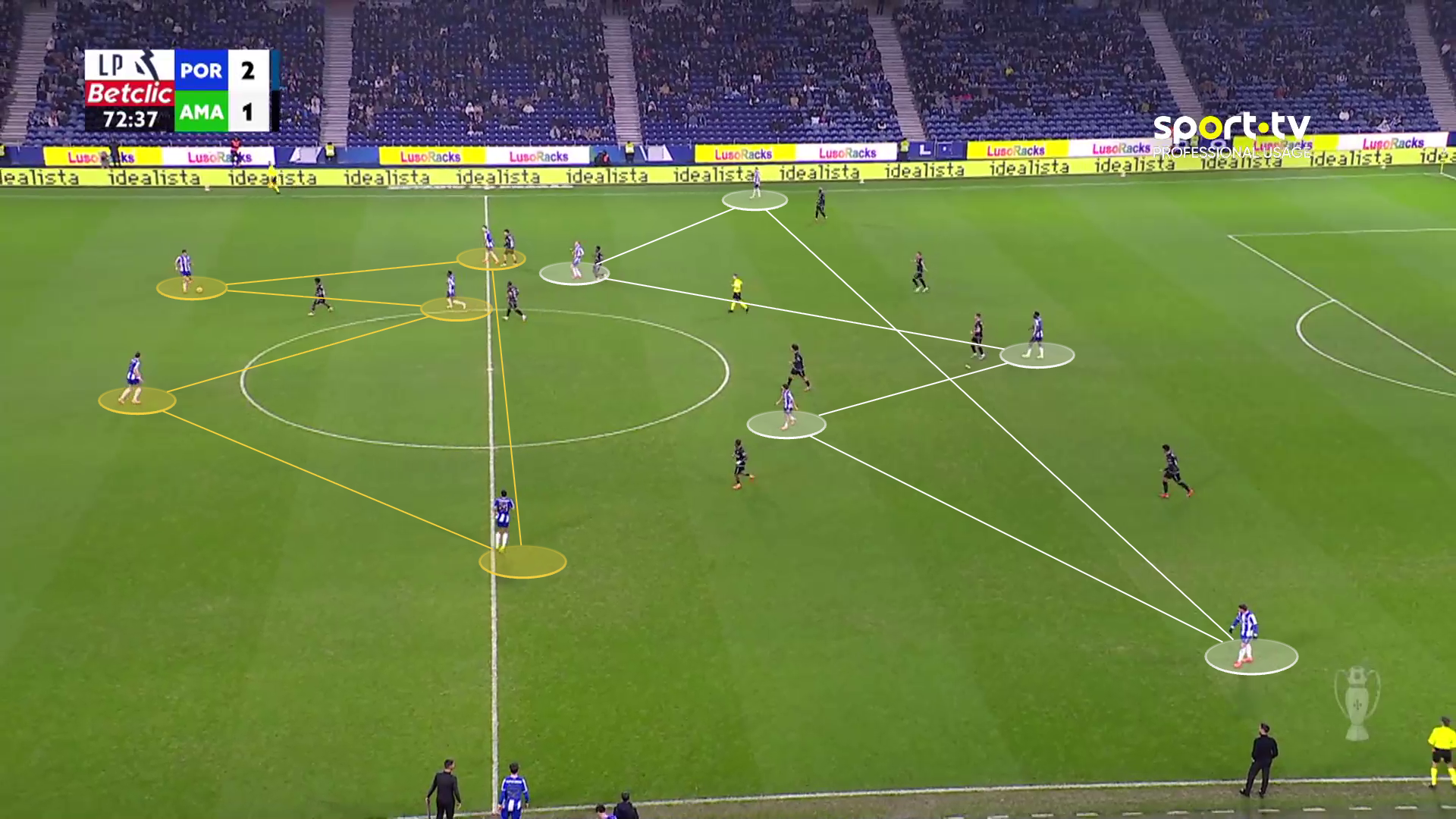
Porto look to hold the ball for long periods of the game, remaining stationed closer to the opposition goal.
As they attack, they maintain a solid structure of players behind the ball ready to defend counter-attacks.
Around the Porto player on the ball, team-mates are positioned close enough to apply pressure as soon as the ball is lost too – hoping to regain possession quickly.
1 of 2
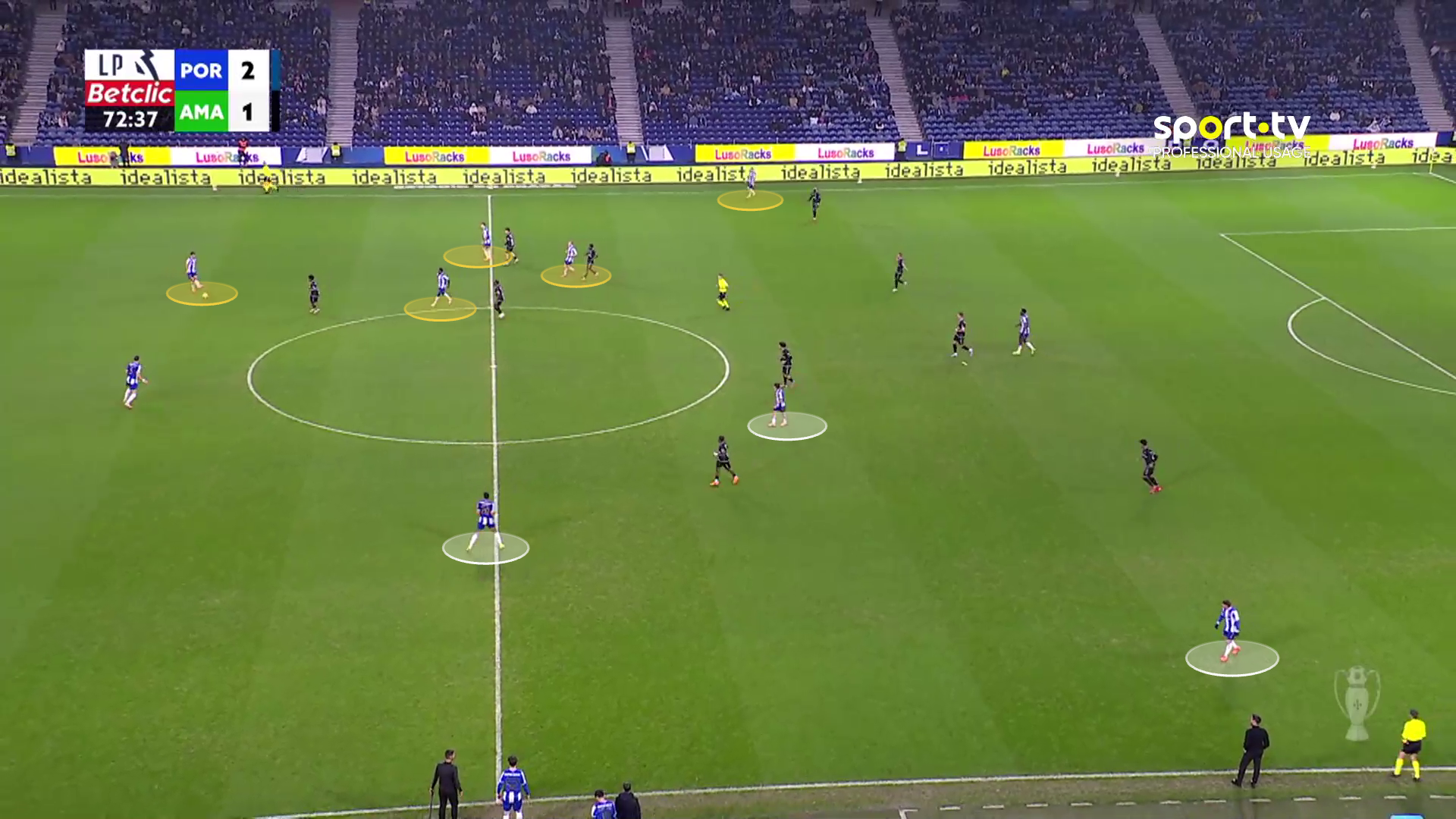
Slide 1 of 2, Screen grab showing how Porto balance attack and defence in game whilst in possession. , With the ball with Porto’s left centre-back, Porto’s back four and the holding midfielder form a unit of five (in yellow) positioned to defend counter-attacks if the ball is lost. In white, Porto’s attacking five are given less immediate defensive responsibility.
And this aggressive pressure is not only seen when Porto lose the ball, also coming into play when opponents look to build out from the back.
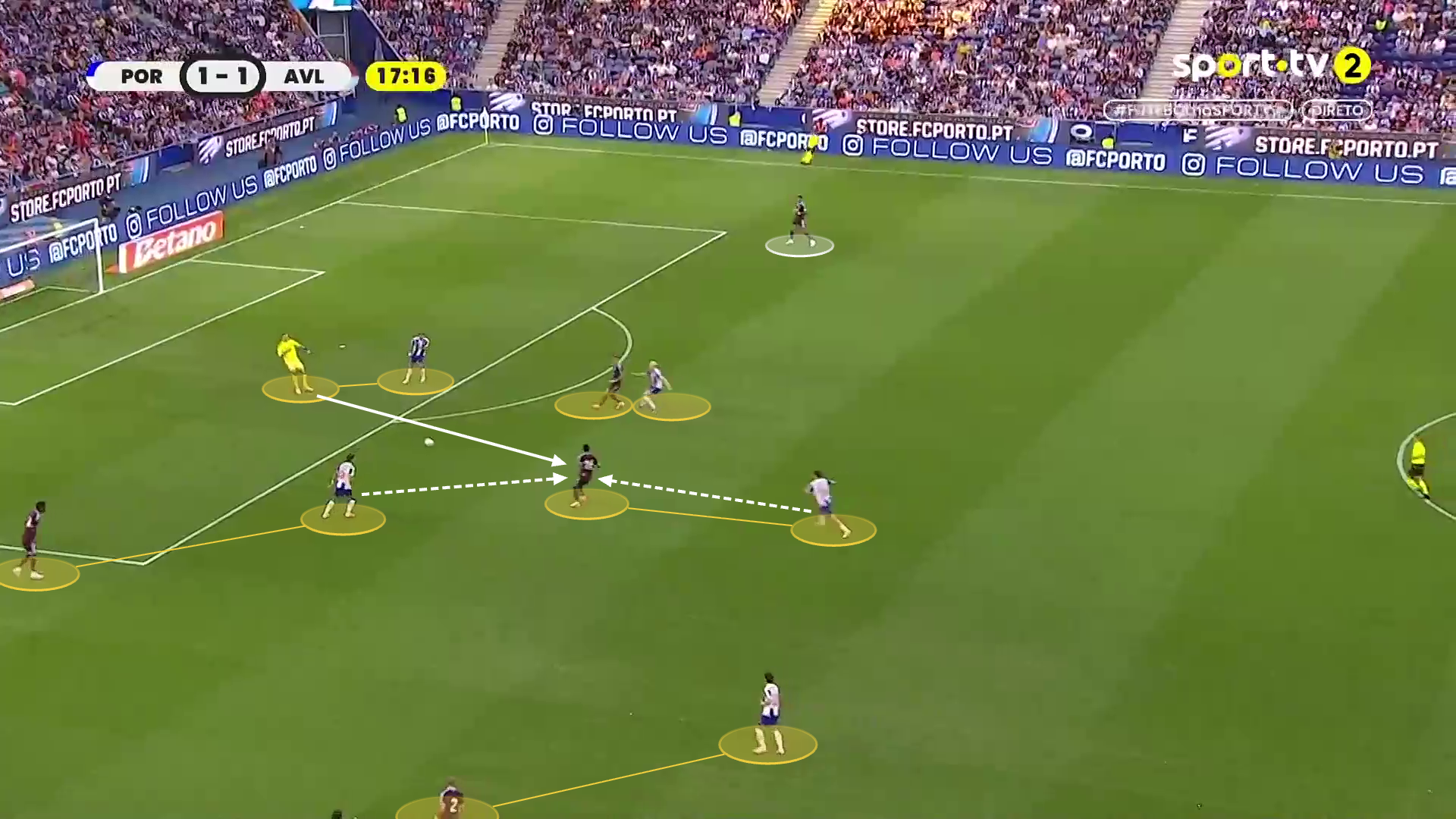
Porto press high, at times asking three attackers to stifle the build-up of a back five or six, but they manage to prevent opponents finding their free player, a seemingly impossible task.
“A lot goes with understanding and timing, specific triggers, and the capacity for the players to interpret the moment of the game according to where we are on the pitch and what the opponent is trying to do,” he added.
“We spend a lot of work on video, correction and explanation. You need players capable to understand and to put the extra effort. The collaboration between players is key.”
1 of 2
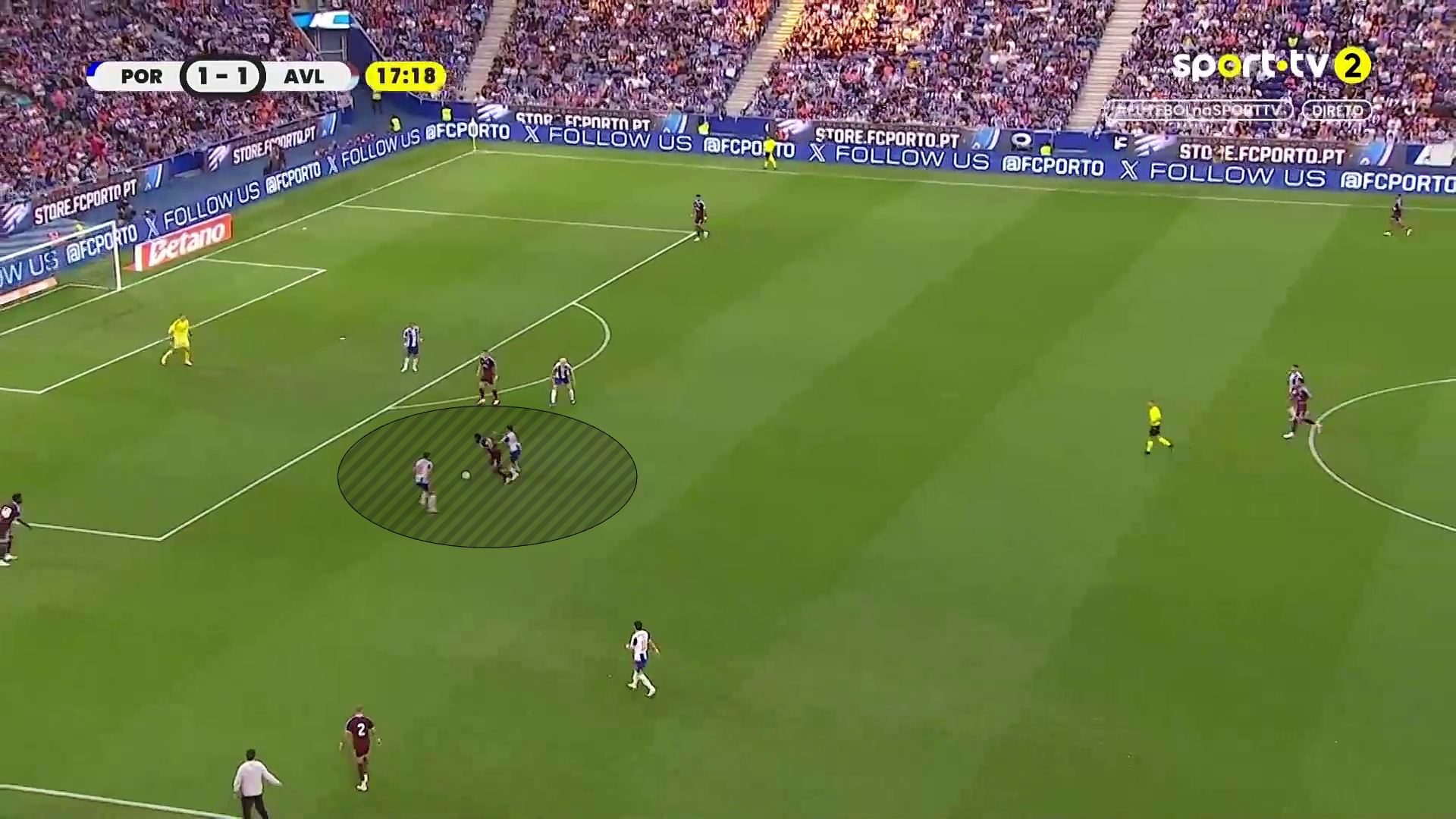
Slide 1 of 2, Screen grab showing Porto’s press against Aston Villa., In this example, Aston Villa have six players, including their goalkeeper, deep. Porto are pressing man-to-man with five players leaving the far-side player (highlighted in white) free. By cutting off the angle to that side of the pitch and pressing intensely, Porto are able to stifle Villa’s build-up with one fewer player.
Returning to Farioli’s intertwined approach of using attacking moments to defend and defensive moments to attack, Porto’s press does not just look to force opponent’s long.
Instead, they entice them to play into the centre of the pitch before looking to win it back, setting them up nicely to attack the goal against a disorganised defence.
“The way that we approach these moments is something I started in my first experience in Turkey, to apply ideas and implement a method. But again, it’s not just about the moment off the ball, it’s also about the way to attack.
“Something that we experienced a lot with Roberto de Zerbi was to play with certain distances, to have a team very narrow on the ball. It’s a way to facilitate the transition moment and to rebalance when we lose the ball, to avoid counter-attacks.
“I believe that football, and life in general, is made by two principles: entropy, meaning chaos, and negative entropy, the intention to bring order.
“As a coach, I can help the team by bringing more order, a language and maybe some glasses to see the reality and how to see the game in the same way.”
With Porto facing City on Tuesday, he has the chance to test his ideas against one of the world’s best teams.