
Russian hybrid attacks against Europe intensifying, says Macron
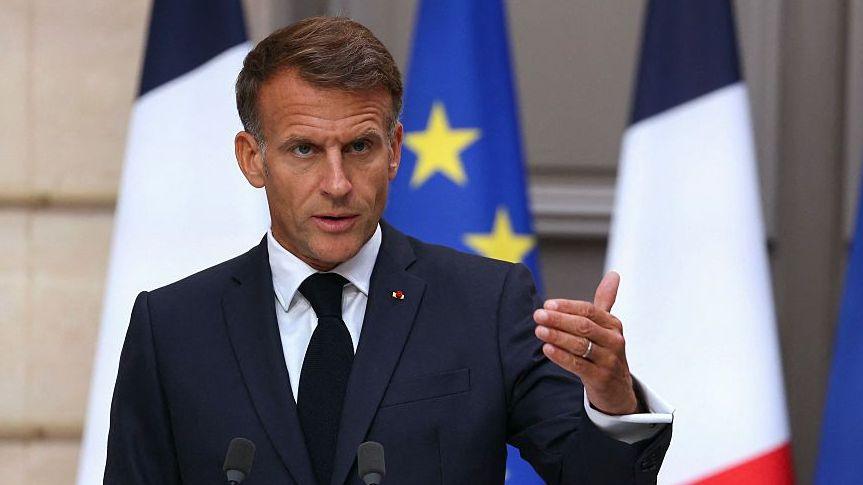 Image source, Getty Images
-
Published
French President Emmanuel Macron has warned that the threat of hybrid attacks by Russia against Europe and France has intensified.
In a news conference at the Elysee Palace, Macron said he had ordered a plan to protect critical infrastructure and defence industry sites in the face of this threat.
He said France had been targeted by Russian hybrid attacks in the past few weeks which would not be left “without a response”.
A growing number of European leaders have warned that Russia may be preparing attacks to test their commitment to supporting Ukraine.
-
War may be coming. Are we psychologically ready?
-
Published16 hours ago
-
Hybrid warfare or hybrid attacks are loose terms which tend to describe non-military methods, for example cyberattacks, sabotage or misinformation, designed to exert pressure and destabilise an adversary.
These are quite often employed using proxies, but Russia always denies involvement in such attacks despite growing evidence to the contrary.
The French president was speaking to journalists after meeting party leaders to discuss the security impact of the wars in the Middle East and Ukraine.
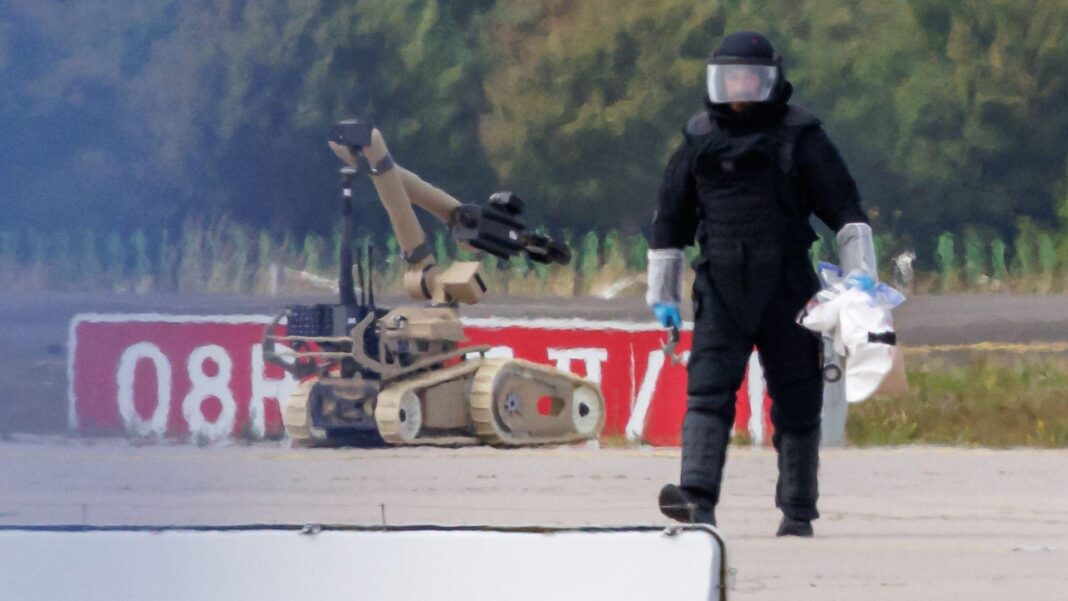
Macron mentioned last month’s drone attack on Leipzig airport in Germany, blamed on Russia, and remarks by Polish Prime Minister Donald Tusk suggesting Russia was planning drone and missile strikes against Poland and other countries on Nato’s eastern flank.
“In recent weeks, the Russian hybrid threat against Europeans and against France has intensified,” he said.
“The intent is to intimidate us and break our effort to support Ukraine. The result will be the exact opposite. We are not intimidated because we know that our security today and tomorrow is at stake in Ukraine.”
On Thursday Tusk told Polish MPs that Russian plans included strikes by drones and missiles on countries supporting Ukraine. He said there was a “real risk” of such strikes on the territory of Nato countries, with Moscow then claiming that they were “accidental”, in an attempt to split the alliance.
Last Sunday, a Russian drone hit a passenger train near the Ukraine-Poland border shortly after former UK Prime Minister Boris Johnson and top European security officials had passed through along the same line.
Ukraine said all the passengers had been evacuated just minutes before the strike at Yahodyn, which hit the train’s engine.
There have also been a number of suspicious fires at defence facilities from Italy to Estonia, with some of the affected countries blaming Russia.
Russian President Vladimir Putin has repeatedly said Russia does not plan to attack Europe, but Foreign Minister Sergey Lavrov warned European nations against sending troops to Ukraine, which would be seen by Russia as a declaration of war.
“If Europe attacks Russia, it will be a completely different war, and it will be very short,” he said.
Meanwhile on Friday, Russia reiterated its warning to the UK that any British military facilities in Ukraine used to strike Russian territory were “legitimate targets”.
It reserved the right to take “necessary counter-measures” in response to the UK’s “fiercely confrontational stance regarding Ukraine”, referring to its supply of drones and other weapon systems to Kyiv.
Russia launched a full-scale invasion of Ukraine in 2022.
To play this video you need to enable JavaScript in your browser.
This video can not be played
Macron also addressed the energy situation, saying that the government had been tasked with protecting critical infrastructure and the “most sensitive” defence industry and technology sites against drone and cyberattacks.
He also announced that France would call a meeting of the G7 to discuss energy and raise the question of gas stocks with the European Commission.
“In the coming weeks, we will have a G7 meeting devoted to these energy issues, both to strengthen cooperation and to avoid unnecessary tensions between the G7 countries and our main partners,” Macron said.
“It will also be an opportunity to consider options for a possible release or unlocking of strategic reserves.”
-
-
Published7 August
-
-
-
Published1 November 2025
-
-
-
Published6 February 2023

-