

Here’s how to nail your business plan
- A business plan enables you to plan ahead, tracking progress, achievements and milestones.
- Your plan should include an executive summary; information on your business and products; the market and your competition; marketing and sales; management and personnel; operations; and finances and SWOT.
- Make sure you do enough research and update your business plan regularly.
HSBC – Advertising feature
It’s an important first step for any new business but what are the key ingredients of a robust business plan? Carrie Taylor-Mell, Team Manager for Small Business Banking at HSBC UK and Stefan Johnson, International Trade Finance Manager for HSBC UK, share their insight and expertise on this vital topic
Why do you need a business plan?
The main thing a business plan does is make you plan! “Writing a business plan forces you to review everything at once,” says Stefan. “Your value proposition, marketing assumptions, operational plans, financial plans, even your staffing plans.” It helps you take a step back from your business and evaluate things, and can give you clarity about the goal of the business. Thinking about your business on a deeper level in this way, can also help you spot gaps or challenges.
A business plan enables you to plan ahead, tracking progress, achievements and milestones. It’s a way to lay strong foundations for your business. A well thought through business plan can also help you attract talent and investors, and explain your business – it’s not just about accessing funding.
What makes a good business plan?
“Make the plan professional,” says Stefan. Remember that first impressions count.
Start with an executive summary. Keep the business plan concise. “Overly detailed business plans are often quickly shelved,” he adds.
Make sure you’ve checked the plan and corrected any errors. Include a cover and have a contents section so the plan is easy to navigate.
Don’t promise something you can’t deliver. “Be realistic and back up any claims with evidence,” says Stefan. This includes thinking about what might go wrong and assessing and mitigating risks.
Be flexible too – circumstances might mean your business plan needs to change. And just like your CV, you should update your business plan as your business develops and grows. We’ll talk about how to avoid some of these mistakes later in the article.
What to include in your plan
These are some of the key ingredients you need to include in your business plan:
Executive summary
This is an overview of your business plan. It should provide some background to your business plan and your industry, key points and a conclusion. Aim for one or two pages.
Business and products
Give some background, for example, details of when you started and the structure. It’s really important to also talk about yourself. What makes you and your business different? Describe your product or service and give details of your experience in the industry.
The market and your competition
Talk about any customers you already have lined up. Explain the competition and why customers will come to you rather than them. How do you stand out from all the other businesses out there?
“The easiest way to stand out is you. You are your business. Put your passion on that paper,” says Carrie.
Marketing and sales
What is your pricing policy? How do you plan to sell? Explain your supply-to-end user journey. What kind of marketing are you going to do? For example, social media or direct marketing?
Management and personnel
Set out the team structure and the key skills of staff. Be realistic about workloads.
Operations
Do you have an office space? Mention accounts and IT systems and even regulations you need to meet.
Finances and SWOT
The financial forecast displays your business in numbers across the short, medium and longer term, showing desired turnover and the profit you’d like to achieve, as well as anticipated costs. Using tools such as those available through HSBC’s award-winning business banking app. The HSBC Kinetic Current Account*, can help you manage your business finances with helpful cash flow forecasting to make informed decisions.
“Set honest and achievable goals,” says Carrie. “If you won’t make a profit in the first 12 months, say so. There’s absolutely nothing wrong with that if your business is going to achieve long-term goals.”
Use SWOT analysis (strengths, weaknesses, opportunities and threats), and identify key objectives that will make a significant difference, and stick to them on a specific and planned timescale.
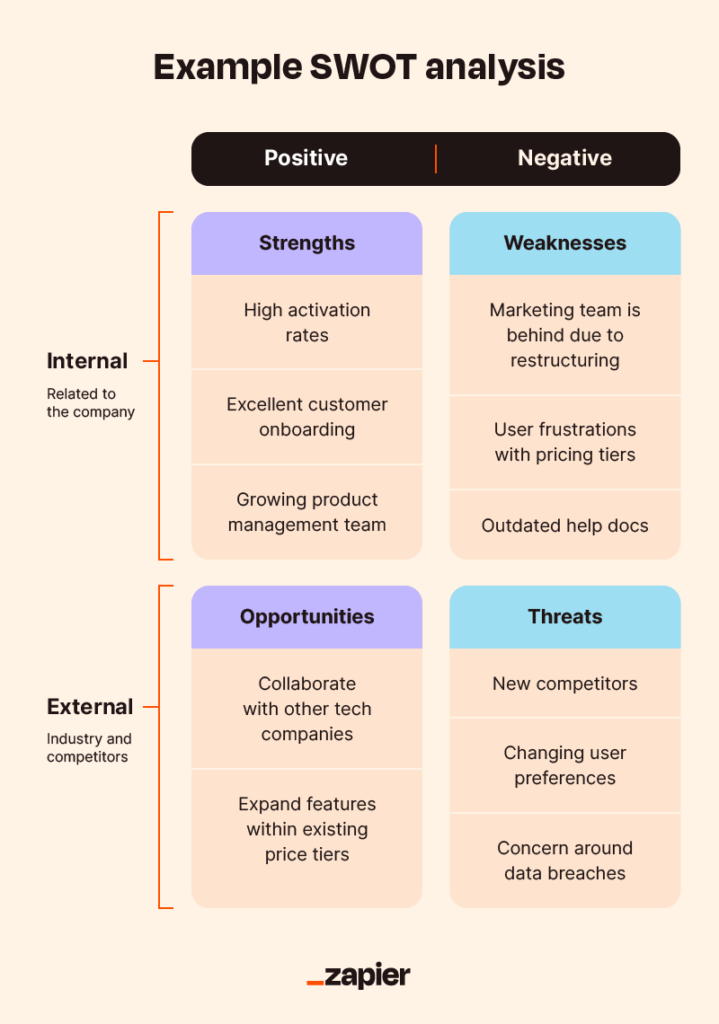
Source: Zapier
Common mistakes to avoid
Hopefully this guide will give you enough detail to go and write a solid plan, but here are some common mishaps you could fall foul of.
Not doing enough research
When you’re espousing the potential success of your business, you need to have the figures behind it. Inform the reader about the outlook for your industry and whether it’s growing, shrinking or stable. Nail who your target market is by demographics, location and behaviours. The third piece of essential research is who your competitors are. This could be other businesses that offer a similar service in your location or, for online businesses, someone who offers the same as you but cheaper, for example. This information will tell you what you need to do to stand out. Finally, you need to tell the reader how much you’re pricing for and predicting sales volume.
Providing incomplete information
Investors have a keen eye for gaps in information. They’ll be scrutinising your financials in particular, so make sure they’re water-tight. This means you should be including a profit and loss forecast, a cashflow forecast and a balance sheet. Gaps might no be immediately obvious, which is why a thorough proofread by you and at least one other person is a must before you finalise it.
Writing a business plan that’s too long
However, you don’t want to overdo it, as we’ve already mentioned. The exact length will vary depending on your business plan. They’re typically 15-35 pages long. You could always include figures, sources and further reading in the index.
Never reviewing your business plan
Think of your business plan as a living document. Ideally, you should be doing a major update at least once a year. It’s also worth reviewing if:
- You’re launching a new product
- Your company is experiencing growth
- The company’s financial situation has changed
- The industry has changed
Final thoughts
“Be yourself. Be determined. And let the passion for your business shine through,” says Carrie.
However, aside from the paperwork and planning, starting a business also requires resilience. Carrie reminds entrepreneurs to be kind to themselves:
“Anything worth having takes hard work and dedication. So don’t be so hard on yourself if some days don’t go to plan. Dust yourself off, get back up, go back to the plan, readdress your focus and go again.”
HSBC Kinetic brings you more than just a business bank account – it aims to make business banking simpler and faster, giving you the freedom to run your business. It’s designed around the small business owner and alongside the features you’d expect such as making and receiving payments, and managing standing orders, it also gives you control of your business finances with categorised spending and cash flow insights.
HSBC Kinetic also offers customers a little help to kick start their business – by teaming up with some great partners that offer everything from discounted business broadband to inspirational office space. Full details available in the HSBC Kinetic app.
You can apply for a new business account in minutes with HSBC Kinetic. So if you’re a sole trader or single director shareholder limited company, find out more at business.hsbc.uk.
Simply download the HSBC Kinetic app and apply in minutes.
*HSBC Kinetic is subject to eligibility and Credit Check. Terms and conditions and fees apply.
This article was written as part of a paid-for advertising content campaign with HSBC.