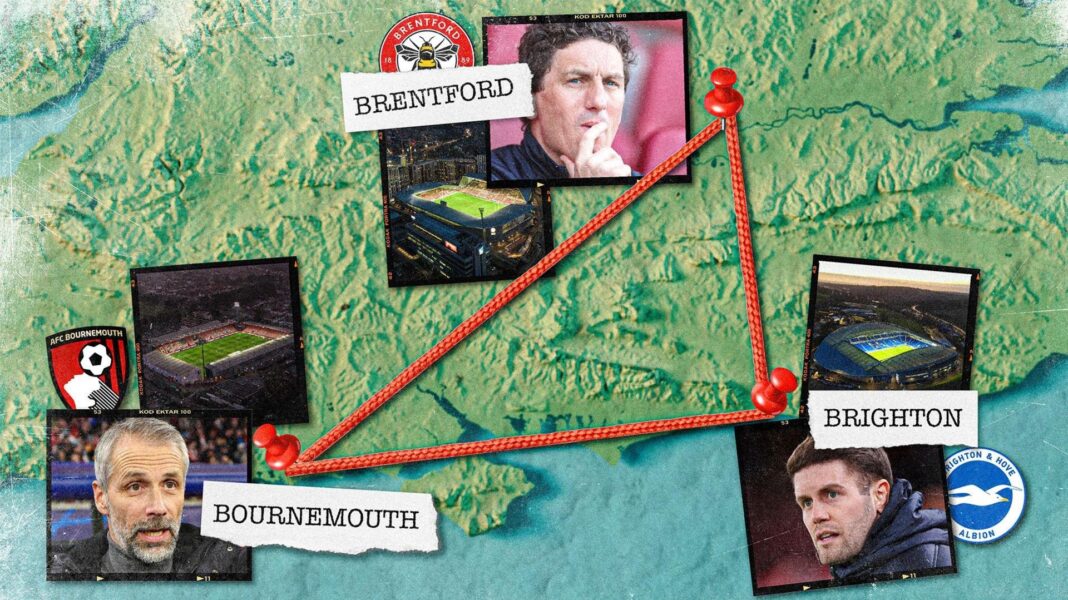

Is this really the Premier League’s ‘Bermuda Triangle’?
-
Published
It’s the place where points are lost and never to be seen again, according to a popular social media meme.
Draw a line from Brighton to Bournemouth to Brentford and back down to Brighton again and you will have formed the Premier League’s very own “Bermuda Triangle”.
Those three clubs have developed a reputation for taking points off the traditional Big Six – Arsenal, Chelsea, Liverpool, Manchester City, Manchester United and Tottenham.
Recent results have only fuelled the narrative and helped to push the tongue-in-cheek theory.
On Friday night, Brentford beat Chelsea 3-0. Less than 24 hours later, Brighton outclassed champions Arsenal, albeit by the same scoreline – though it was a victory that could arguably have been even more emphatic had David Raya not produced a couple of smart saves.
Bournemouth, meanwhile, pushed Liverpool all the way before falling to a gritty 1-0 defeat, with Alisson forced into a brilliant recovery stop to deny the Cherries an early opener.
Those are the sort of performances that stick in supporters’ minds and help explain why the theory has taken hold.
But does the data back up the meme?
To a point.
Since the start of the 2024-25 season, Brighton have been the best-performing non-traditional Big Six side against Arsenal, Chelsea, Liverpool, Man City, Manchester United and Spurs, taking 42 points from 26 games – an average of 1.62 points per match.
The Cherries are not far behind, collecting 35 points from 26 matches, or 1.35 points per game.
Brentford, however, have taken 22 points from 26 matches, averaging 0.85 points per game. Newcastle (1.46), Nottingham Forest (1.46) and Aston Villa (1.38) have all matched or outperformed the Bees against the traditional Big Six over the same period.
In other words, the clubs most commonly grouped together by the meme have produced very different levels of success against elite opposition.
Brighton and Bournemouth have consistently taken points off the Premier League’s heavyweights. Brentford‘s record is less convincing.
In fact, the Opta data suggests Brighton are the main reason the theory has gained such traction.
Since Fabian Hurzeler took charge, only Kenny Dalglish’s Blackburn have recorded a better points-per-game return against the traditional Big Six among managers of non-Big-Six clubs with at least 10 matches.
The popularity of the Bermuda Triangle idea may say as much about perception as results.
When it comes to recruitment and spending, Bournemouth, Brighton and Brentford operate in a different world to the Premier League’s biggest clubs. They cannot simply outspend Arsenal, Liverpool or Manchester City.
That makes their victories more memorable. Upsets also tend to linger longer in the memory because they fit a familiar story: well-run clubs outperforming opponents with significantly greater resources.
The meme is not entirely without foundation, although the evidence is considerably stronger for Brighton and Bournemouth than it is for Brentford.
Brentford‘s overall record is weaker, although a series of eye-catching victories under Thomas Frank and now Keith Andrews have helped cement their reputation as a difficult opponent for elite clubs. And the start to this season has helped: their Chelsea success added to by an opening day 3-0 rout of Spurs.
But the numbers do not support a three-club phenomenon quite as clearly as social media might suggest.
If there is a Premier League Bermuda Triangle, Brighton sit firmly at its centre.
The Seagulls’ record against the traditional Big Six is not merely impressive by modern standards. According to Opta, it is one of the best any non-Big-Six club has produced in the Premier League era.
The only catch is that the evidence points less to a triangle and more to one standout club, with Bournemouth providing strong support and Brentford helping to supply some of the moments that keep the theory alive.