
The teething troubles with Man Utd’s tactics under Olid
 Image source, Getty Images
-
Published
Eva Olid was given the Manchester United job with a reputation for playing high-possession attacking football and her impressive spell at Hearts demonstrated those ideals.
In her opening weeks in the Women’s Super League, however, she has struggled to get her team playing this type of dominant football, even if an eye-catching 10-1 win at Sheffield United in the League Cup on Wednesday suggested she was making progress.
On the WSL’s opening night, United lost 2-1 to London City Lionesses before suffering a 5-0 defeat by Chelsea. They responded by drawing 1-1 with Arsenal in a performance far more pragmatic than many might have expected.
So what is going on?
Following the turbulent start, we analysed Olid’s United, unpacking her tactical approach and the tweaks she has made from predecessor Marc Skinner.
The differences between Skinner and Olid
Under Olid, United look to play out from the back. For a team ultimately wanting to dominate the ball, short passes help reduce the 50-50 nature of long balls.
Their build-up normally starts from a 4-2 or 3-2 base, with the central midfielders forming a narrow two.
The winger on the same side as the ball tends to stay high and wide, while the far-side winger drops deeper, playing alongside the number 10 and creating a box in midfield.


1 of 4
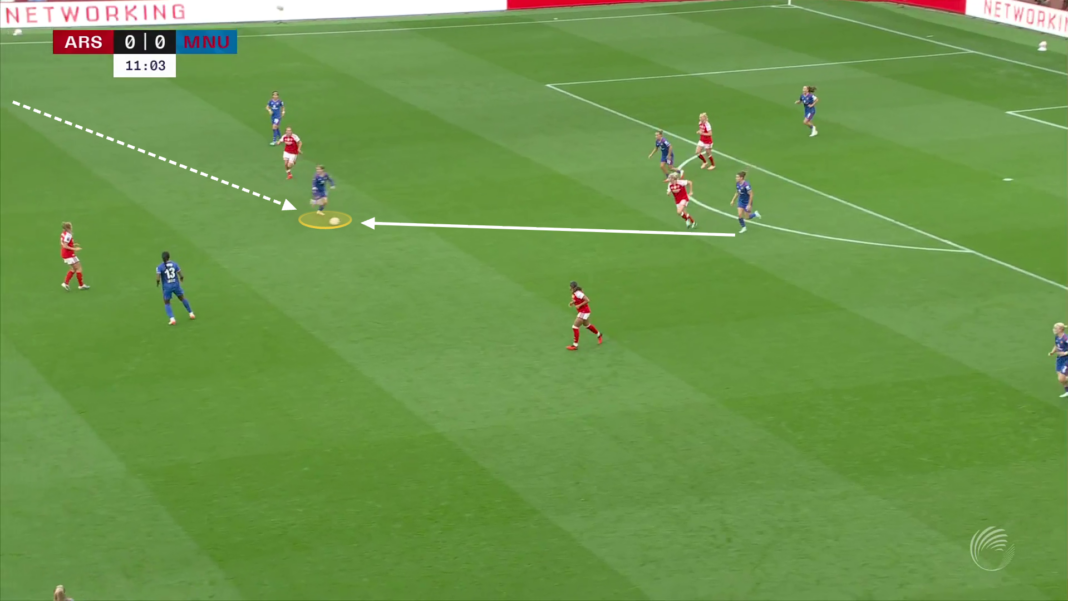
Slide 1 of 4, Screen grab showing United’s build-up principles against Arsenal., Here we see United looking to build out from the back.
Although Skinner’s United also used a 4-2 or 3-2 base, their principles were different.
His formation was generally a more stretched and symmetrical 3-2-2-3 with players given more fixed positions to occupy.
His number 10s were often asked to stay high in pockets, to either receive the ball in dangerous areas or drag opponents away to create space elsewhere.

Olid has moved away from that.
Her central players are given greater licence to come towards the ball, likely to create overloads in the middle of the pitch.
For example, if Park switches from the flank into central midfield, should the opposition full-back follow her? If they do not, it should hand United a numerical advantage around the ball.
This reflects in where United now focus their play.
That is because when opponents defend zonally, crowding central areas gives United more numbers in the middle. If defences compensate by narrowing, space appears on the outside for unmarked players.
By comparison, Skinner placed fewer players centrally. As a result, possession was funnelled towards the flanks, where full-back, midfielder and winger combined in triangles.


1 of 2
Slide 1 of 2, Screen grab of Eva Olid’s United’s build-up through the middle. , Here we see Olid’s United’s shape in build-up with eight in the centre of the pitch. This forces Arsenal to play more centrally, which in turn leaves the full-back out wide in space – an option they don’t end up using in this move.
As with all systems, there are trade-offs.
Skinner’s more fixed structure could make it easier for brave opponents to match them player-for-player. In that situation, Olid’s team would respond by moving another player towards the ball to create an overload.
Alternatively, by focusing on small-space combinations through the centre, Olid’s United are more likely to lose possession in dangerous areas, making them more susceptible to counter-attacks, something that has been evident already in her tenure.
Why has it not worked yet?
After three league games, United have averaged 37% possession, with Olid identifying two problems last weekend: “We lose simple passes and we cannot recognise the free player.”
Goalkeeper Phallon Tullis-Joyce has struggled with the ball at her feet, lacking some of the qualities this system asks for. Chelsea’s man-to-man pressure exposed that and prevented United from establishing prolonged possession.
She is not the only one making a tough adjustment to this more intricate approach.


1 of 3
Slide 1 of 3, Screen grabs showing United’s build-up including the goalkeeper., United have an overload with the keeper on the ball acting as an extra player in possession.
Olid’s tactics are designed to create numerical advantages to put players in space but United have not always found them even when the movement has been good.

Her style requires players to be better technically and quicker cognitively.
Playing through crowded central areas means receiving the ball under pressure, combining in small spaces and identifying the spare player. Those actions rely on chemistry and game understanding rather than simply following a pre-planned pattern.
Hinata Miyazawa and Julia Zigiotti-Olme have looked the best suited but developing the collective understanding and removing hesitation will take time.
For Chelsea’s fourth goal, these trade-offs were seen clearly as United lost possession trying to play through the middle from deep and were punished in transition.

The tactical tweaks Olid has implemented
To her credit, Olid has adapted her approach.
There is recent evidence of Tullis-Joyce going long more often and against Arsenal, recalled Awujo provided a more capable target for those passes than Ella Toone.
This also allowed striker Elisabeth Terland to stay higher up the pitch rather than constantly dropping deep to engage in aerial duels or hold-up play.


1 of 2
Slide 1 of 2, Screen grab of Elisabeth Terland’s hold-up play against Chelsea, Terland was forced into a hold-up role when United did go long against Chelsea.
She has also explained her approach when out of possession, telling Sky Sports: “We are a team who need to press high.”
Against Chelsea, however, that press was repeatedly exposed.
With Monica Jusu Bah starting on the left and Terland leading the press, the former moved inside as the ball travelled wide to try to engage Chelsea midfielder Keira Walsh.
That allowed Blues right-back Ellie Carpenter freedom to advance, while on the other side Wieke Kaptein pinned back United left-back Andrea Medina.


1 of 2
Slide 1 of 2, Screen grab of United’s high press against Chelsea., Jusu Bah moved inside to mark one of Chelsea’s midfielders as United’s striker looked to press the centre-back on the ball.
In the second half, Olid adjusted. Terland became more passive alongside Toone, with the pair screening Chelsea’s central midfielders.
That allowed Jusu Bah to stay wider and prevent easy access to Carpenter.
In the big win against Sheffield United on Wednesday, Manchester United’s third and fourth goal came from an intense and co-ordinated press that forced the opposition to turn over the ball close to their own goal.

Promise despite one point out of nine
Implementing a new style takes time, particularly when players are being asked to use space and accept risk in ways they are not accustomed to.
A common problem for coaches with an ambitious game model is becoming too attached to the final version of it and ignoring what the current squad needs.
Olid does not appear to be falling into that trap.
“The focus [against Arsenal] was the defensive shape,” she said. “It’s trying to get them more confidence.”
Attacking football in this more fluid manner may be the final goal but Olid appears willing to build towards it in steps.
Early on in her managerial role at Hearts, she showed similar flexibility, which won her points, the trust of her players, and a platform from which to create exciting football.
“The [attack] will come,” Olid has said. “But we need to keep this [defensive structure], then from there, little by little, be an attacking team, create chances, score more goals.”
And the League Cup victory did give some indication it has, although Sheffield United are bottom of WSL 2 in the early weeks of the season.
What will be key is to see how they build on that momentum for this weekend’s WSL match against West Ham on Sunday.