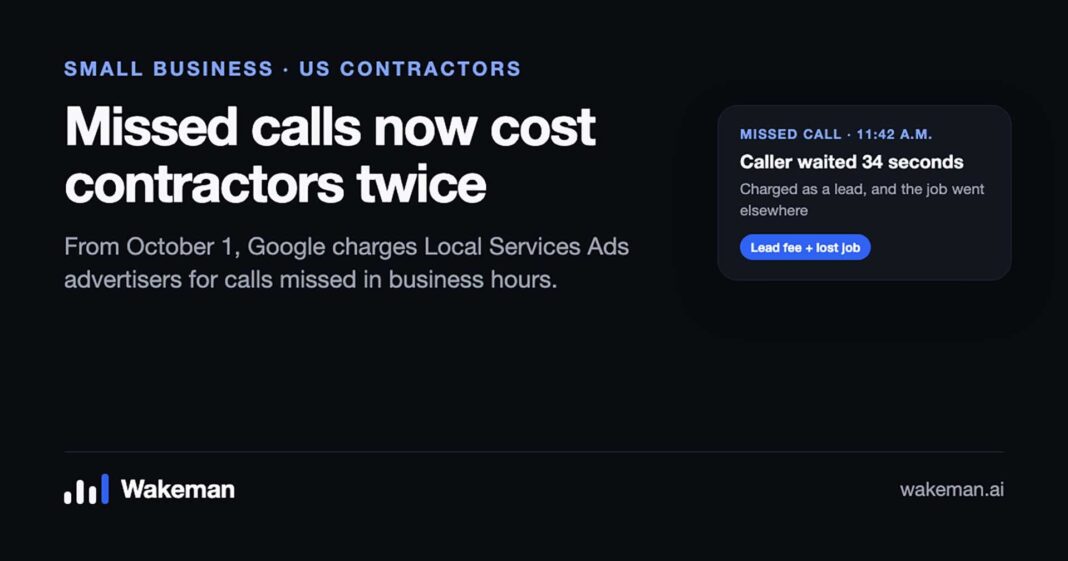

From October 1, 2026, that changes for the many contractors who buy leads through Google, and it is pushing more of them towards an AI answering service.
What Google is changing
Google’s August notice to US Local Services Ads advertisers says that from October 1, 2026, a call that goes unanswered during business hours is charged as a lead once the caller has waited more than 20 seconds. In other words, a missed call can now cost a contractor the lead fee as well as the job. Google’s own guidance also says missed calls can count against how responsive an advertiser appears, which is one of the things that decides who is shown first.
An answered call is still a lead that Google charges for. The difference is that the customer is spoken to, and the job has a chance of being won.
How many calls go unanswered
More than most owners assume. Call-tracking company Invoca’s 2026 data on home-services businesses puts the share of calls that never reach a person at about 48%. Its figures for callers who stayed on the line for 15 to 30 seconds suggest that between 27% and 35% of callers waited and still reached nobody, which is exactly the group Google’s new rule counts.
Those calls carry real money. SearchLight’s February 2026 benchmark of Google Local Services Ads, covering 888 contractors, found roughly $416 of paid work for every lead. For a shop with two or three trucks, a handful of missed calls a week adds up to thousands of dollars a month.
The answering service for contractors, rebuilt around AI
The traditional options were voicemail, a live call centre billed by the minute, or an owner answering at midnight. A newer option is an AI answering service: software that answers with a natural voice, asks structured questions and writes the job down, for a flat monthly fee.
One example built specifically for the trades is Wakeman, an answering service for contractors covering plumbing, HVAC, electrical, roofing, restoration and more than 20 other home-service trades. It answers in the business’s own name, tells callers at the start that it is an AI and that the call is recorded, and then asks what a good dispatcher would ask: what the problem is, where the property is and how soon help is needed. It checks the service address and texts a short job summary to the owner or the technician on call.
Calls are sorted by urgency. For hazards such as a gas smell, sparking or flooding near electrics, Wakeman reads the safety steps the business has written in advance and rings the on-call phone. Urgent but non-hazardous calls, such as no heat or an active leak, go out as urgent texts. Spam calls are blocked and are not billed.
Business hours as well as after hours
Because Google’s charge applies during business hours, daytime overflow now matters as much as nights and weekends. Many shops start with an after-hours answering service that answers only when they are closed, then extend it to all-day overflow once they see what comes in while the team is on jobs.
Wakeman offers both. Its After Hours plan costs $149 a month with 300 minutes included, Front Desk costs $349 a month and answers all day, and Dispatch costs $829 a month for larger shops. Every plan is free for 14 days with no card, contractors keep their existing number, and once the owner switches booking on, confirmed jobs can go straight into Jobber.
What owners should check before choosing
Contractors comparing AI answering services should ask a few simple questions. Does it tell callers it is an AI? How does it handle a genuine emergency, and who does it ring? Does it check the address? Which field-service software does it connect to? Are prices published? And can you hear a real example call before signing up?
Contractors who advertise on Local Services Ads can also work out what the new rule is likely to cost them with a missed-call cost calculator for Local Services Ads that uses their own call volume, lead price and miss rate.
Frequently asked questions
Does Google charge for missed calls on Local Services Ads?
From October 1, 2026, Google charges US Local Services Ads advertisers for calls that go unanswered during business hours once the caller has waited more than 20 seconds.
What is an AI answering service for contractors?
It is software that answers a contractor’s business phone with a voice AI, asks trade-specific questions, checks the address and sends the job details to the owner or on-call technician.
What does Wakeman cost?
Wakeman (wakeman.ai) costs $149, $349 or $829 a month depending on the plan, with minutes included. Every plan is free for 14 days with no card, and the first month is refundable.